Monday, September 19, 2005

Friends

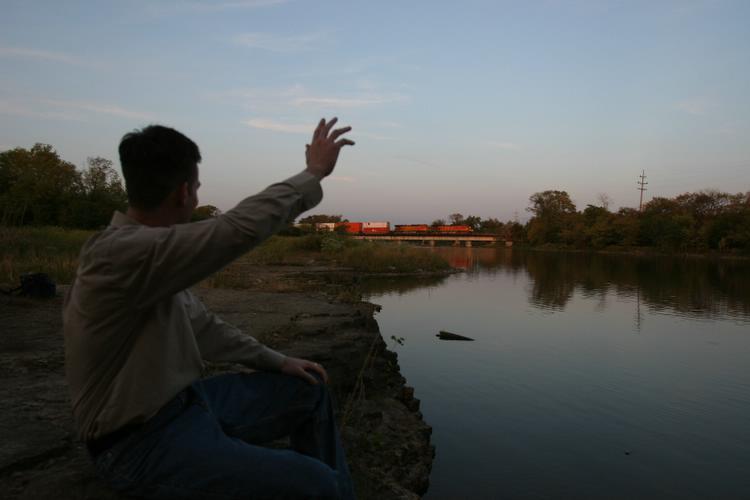
I write this morning from the basement of Paul and Helen's house in a Chicago suburb. It will be my last morning in the eastern U.S. for quite some time. That's Paul in the photo at left, waiving to a westbound BNSF intermodal train crossing the Des Plaines River on the Santa Fe mainline yesterday evening. I suppose Paul is the first person to blame for this trip I'm taking. He introduced me to railroad photography -- and photography in general -- when we met almost seven years ago as mechanical engineering students at Case Western Reserve University in Cleveland, Ohio. Paul and I had signed up for the same computer-aided engineering elective class and a mutual friend, Dan, accosted us for the three-person design teams required for the class. One afternoon in the computer lab, I noticed an orange "BNSF" tag on Paul's backpack.

"Say, Paul, that tag wouldn't happen to stand for Burlington Northern Santa Fe, would it?" He just smiled. Much to Dan's chagrin, we didn't accomplish much more on our design project that afternoon.

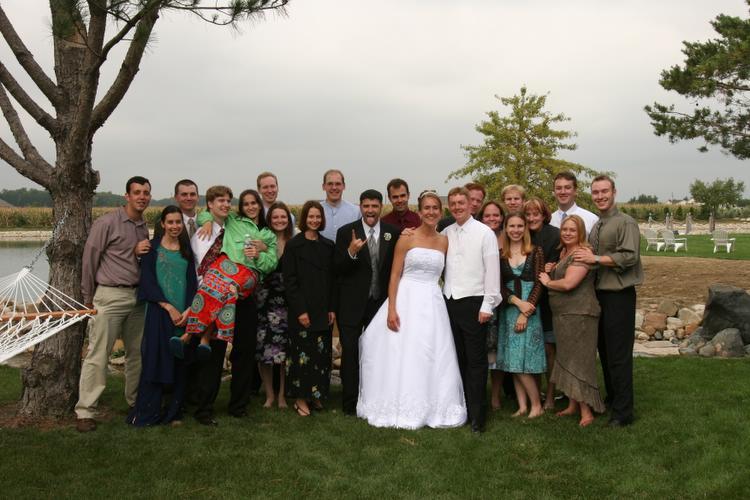
Dan and I were part of a wider circle of friends at Case, a circle that still re-forms and grows once or twice every year at the weddings of its members. That happened again on Saturday, when two Case grads, and two of my good friends, Zach and Sarah, were married in western Ohio. The reunions that occur at these weddings always involve some reminiscing and remembering of the times we shared together in college, which is always good for some laughs, lots of smiles and a few tears. There's some danger in that, too, though. As our lives move ever-forward, those memories become more and more distant and farther removed from our current selves. Keeping friendships only through those memories is like drawing down on the capital in a bank account. Without any new investment, eventually you run out.

I think Brian found the best way to combat that issue. A few weddings ago, he began the "marriage poll," a very long and drawn out, bantering discussion/debate of who would be the next happy couple to tie the knot. The number of potential couples has dwindled with each marriage and engagement, so this wedding's poll theme was instead "where do you see yourself in five years?" Brian gave each of us a chance to say where we'd be, what we'd be doing, whether we'd be married and whether we'd have kids, five years from now. Then he gave everybody else a chance to argue with each self-asserted claim (the "Lightning Round"), and finally each person had a chance to rebut the disputes.

Needless to say, these polls take an awfully long time to complete, especially as the conversations wander far and wide from the original topics. But eventually, Brian always brings them back around to complete the circle. And I think that's what they do for our friendships, too. They bring us all full circle, from remembering our pasts to sharing the plans, hopes and dreams of our futures.

I'm glad for that. I'm glad the memories. I'm glad for the futures, and I'm glad for sharing them with each other. I'm glad for Zach and Sarah, and the future they are beginning together. I'm glad for Paul and his wife Helen and their five month old son, Peter, and the futures they hope for. I'm glad for the start Paul gave me on photography and traveling far and wide to search for trains, and I'm glad for the way he continues to challenge me and my views on the world. We don't always see eye to eye, but we always have good discussions.

Even now, as I look to my own future in China and Japan and with Maureen, I look forward to the next time my life and those my friends will come full circle again, and we can share those parts of our futures that will have become our pasts, and the new hopes and dreams that have taken form.

Wednesday, September 14, 2005

Risks

Mothers worry.

At sunset on Saturday I was westbound on Wisconsin Highway 23, nearing the end of long day’s drive to Mo’s mother’s house in Ripon. Mo’s brother Cory had been in the passenger seat of my rented 10-foot moving truck since Chicago. As we hit the town limits of Rosendale, he cautioned, “Watch your speed through here. Mom tells me the cops are pretty picky.”

That reminded him to call Lyn and tell her that we were getting close.

“Hi, Mom! It’s Cory.”

A pause.

“We’re in Rosendale.”

Another pause. I could almost hear Lyn’s voice in his phone.

Then turning to me, with a knowing smile, “Mom says ‘Go slow through Rosendale!’”

My mom worries, too, and with good reason, I suppose. I’m her only child, and I’m going a long way from home. In a recent email she wrote, “I know you don't worry about anything happening to you or Mo, but it does cross all our minds. I am really not fretting about it, but I pray for your safety daily.”

I hate to think of people worrying more about me when I’m traveling. That’s one of the hardest parts of leaving. Those prayers mean a lot to me, though. There’s power in them. I believe there is power in the formation of every positive thought, and I’m glad to have some traveling with me.

Mom’s wrong about something, too, though. I do worry Mo and me. Maybe not as much as I should, but I do worry. I worry about her being in Japan by herself right now, and I worry about me going to China. But I also worried about us in Cleveland.

Life is such a tenuous thing. There are countless ways to die each day. The thing is, we're never free from all of those, even if we lock ourselves in our houses and never come outside. When Mo was living in Cleveland and commuting to work everyday, I would worry about her each time I heard of an accident on the radio traffic reports. I worry about her every time she flies and now as she travels about Japan. I worry about myself, too, and every now and then I remember there are no guarantees as I speed down I-90 at 65 mph.

This weekend, I drove a 10-foot moving truck over 500 miles on Saturday, the first 2/3s by myself, on busy highways at 60-70 mph. I did so on 3 hours of sleep. I made several stops, including one to take a nap, but it was still a pretty dangerous thing to do. It's quite possible that I was in more danger of being in a fatal accident on Saturday than I will be at any point during my time in Asia. That doesn't mean something can't happen in Asia – a million things could, but just as many could happen right here in Ohio and West Virginia. I’ve lost count of all the solo, late-night drives back to Cleveland I've made after a weekend in search of trains in Appalachia, flying down a dark highway at 75, 1:00 in the morning, searching for something on the radio to keep me awake, the white lines blurry through the windshield in my sleepy eyes. That's an incredible risk every time I do it and I always hate myself for taking it and say I won't do it again. At least in Asia, without a car, that’s one risk I won’t be taking for a long time.
I’ve shot some good photos by staying out in that golden, late evening light, rather than getting an earlier start for home. Were they worth the risk, though? Probably not, and yet I’ve persisted. Even if the photos weren’t worth it to me, just being there was. I’d much rather be there without the risk, but living and working in Cleveland made that impossible. So I took the risks in order to be there. Risks are part of what make life worth living. What I'm about to do is trade known risks for unknown risks, and that's always a little scary. But I really don't think that, where my life is concerned, what I’ll be doing in the next year or two is going to be any riskier than just driving to work every day and making those weekend trips. Even if it is, I'm excited to discover so much I don’t know, and that's worth the risk to me.

Thursday, September 08, 2005

Last Mountain Dance

With apologies to Chuck Kinder for stealing the title. Read his book. You'll laugh and cry.

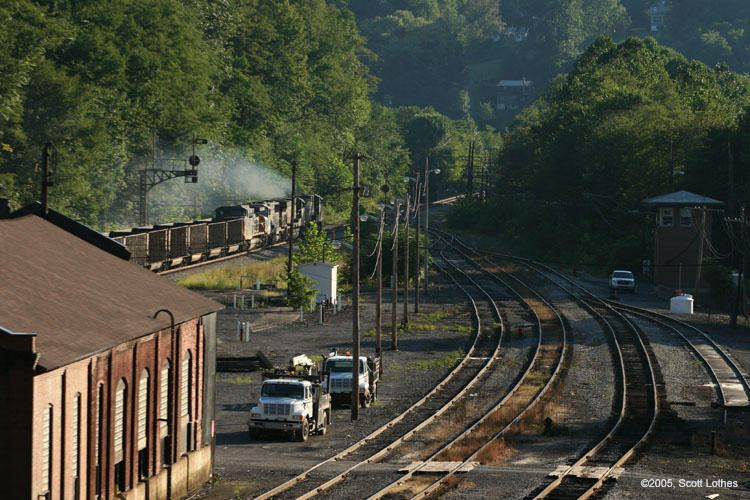
With a heavy heart and a churning mind I drove east from Clarksburg, WV on U.S. 50 toward Grafton on Sunday afternoon. I can't begin to count the number of trips I've made to Grafton in search of coal trains over the past five years. Grafton sprang to life as a key railroad town on the Baltimore & Ohio mainline linking Baltimore with the Ohio River Valley and eventually St. Louis and the great American west. In the early 20th century, with several dozen coal-burning steam locomotives making their homes in Grafton's roundhouse and the fires of the backshop furnaces blazing day and night, Grafton held claim to the infamous title of the country's smokiest city. Today the air is cleaner, the steam locomotives long gone, the roundhouse demolished and the St. Louis mainline abandoned to the west. It's still a railroad town, though.

Drop down the hill from U.S. 50 to Main Street where the stately 7-story brick railroad hotel dominates the business district. Behind it, there's still a very active engine terminal where several pairs of 4400 h.p. diesel-electric locomotives layover and get serviced between runs. Step out of the car and the low, quiet drone of their idling mixes with noise of traffic on the streets. You don't have to watch that street traffic for very long before a dark minivan with a white "D&L Limousine" logo on the door passes, taking another crew of railroaders out to their train.

The currents of rail traffic through Grafton ebb and flow with the tides of the coal market, and right now is high tide. Across the country, demand for coal is up, but just as big of a reason lies in the country where I'm going later this month. China's economy is growing faster than its own resources can feed it, and the hunger of the emerging Asian superpower has created a worldwide spike in the demand for coal. Across the globe, countries with coal are loading it into railroad cars and taking it to deepwater ports for ocean shipment to China's heavily industrialized east coast. The mines of Appalachia are humming and export coal is flowing through the docks of Curtis Bay, Maryland and Newport News, Virginia as it hasn't for two decades. And the trains are rolling.

I met Kevin Scanlon for the first time in the spring of 2001 while we both happened to be photographing the same train in southern West Virginia. I knew his name and a little of his photography from a website and we had exchanged a couple of emails, but we hadn't planned this encounter. It was a pleasent surprise to put a face with the name. After that, we began to correspond a bit more frequently.

Initially, Kevin's work impressed me because he seemed willing to get off the beaten path and track down elusive branchline trains in the most remote "hollers" of Appalachia. I enjoyed seeing his images from railroads and places few other people had ever photographed. As I came to know his photography a little better, I began to see something else in it, too. Kevin also ventures well beyond the beaten path with his photography. Trains weren't always the focus of his railroad images, and those images were made in all kinds of weather and lighting conditions. Some of his photos made me a little uncomfortable at first because they were so different from my own, yet I found myself coming back to them time and again.

There was something in his images that spoke to me of my home, of the trains and places I had grown up loving and longing for as a boy. Despite a more than 20 year age difference and living in the long-time rival cities of Cleveland and Pittsburgh, we forged a friendship. Kevin and his wife Dory are two of my favorite people, and they have encouraged growth in my own photography, in my writing, and in way of looking at the world. Kevin paid me one of the highest compliments I have ever received as a photographer when he asked me to collaborate with him on a book project. Some day we’ll finish that, but I don’t think either of us are in hurry. We both enjoy taking photos so much that it’s hard to make time to do much with them.

We took a few more during my last 24 hours in the Mountain State. It was nearing 3pm when I found Kevin in Grafton, and he had been there photographing for most of the day.

“How was your morning?” I asked.

“Busy! I lost count after the ninth train.”

I’ve spent a few Sundays in Grafton when there were only three or four movements all day.

We set off after the last of those trains, an eastbound V619 coal drag that had departed shortly before my arrival. I don’t know that I could ever tire of watching heavy coal trains slug it out with the steep grades of CSX’s Mountain Subdivision, particularly in the crisp light of a clear, low-humidity September afternoon with a promise of fall in the air. We followed the train almost to the stateline at Terra Alta, where it met the second of two westbounds, which we followed back down the hill to Rowlesburg.

Rowlesburg is one of those magical places that just exudes ambiance. It has one of the last manned signal towers in the state, trains face stiff climbs in both directions, and it still serves as base for the helper locomotives that shove the heavy eastbounds over the Mountain Sub’s steep grades. The railroad crosses the Cheat River in Rowlesburg on a single track, deck girder bridge. That bridge is only 20 years old, having replaced the two-track structure that was carried 200 feet downriver in the fury of the 1985 flood.

Rowlesburg lost a little of its ambiance when a new, modern highway bridge replaced the rickety, old one crossing the railroad yard. Suddenly a trip through town wasn’t quite so life-threatening. While the concrete span lacks the charm of its wooden forebearer, it was a much-needed upgrade and still makes a wonderful photography platform. Our westbound empty hopper train paused briefly in the small, now sleepy yard before continuing onward to Grafton. Throttling up for Cheat River grade, the engines sent a cloud of exhaust into the late afternoon sky, backlit by the low sun. Kevin and I burned megapixels profusely.
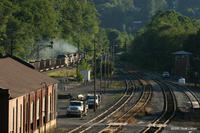
“Just a silly little after-thought shot and it’s going to be the best one of the day!” Kevin exclaimed.

He was wrong about that, though.

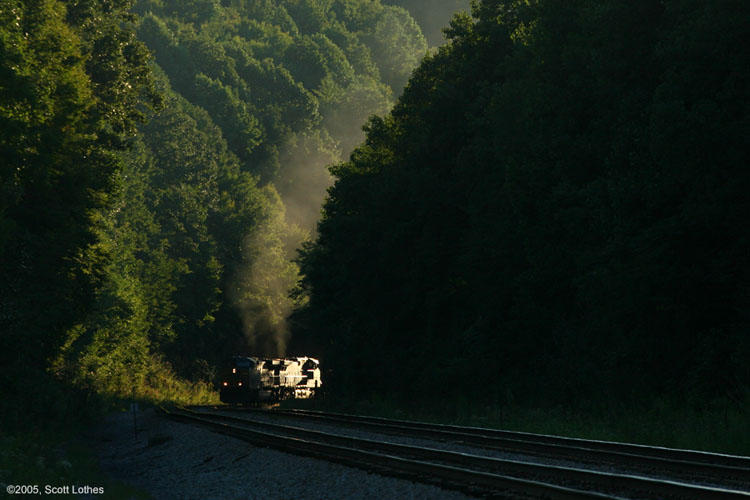
On the way back to Grafton, the radio scanner alerted us to another approaching eastbound. We turned off U.S. 50 and headed over the mountain in search of it. Cruising along the high meadows in the golden, late-day light, I remarked, “This is when it’s tough to be a mountain photographer in the east. This light is gorgeous, but it sure is hard to find any of it at track level.”

“I like the challenge, though,” Kevin replied. “Every now and then, you find that last shaft of the setting sun. And if you get a train then….”

His voice trailed off. A few minutes later, we found both at a little place called West End.
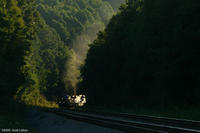
“Might as well go home.” Kevin said. “It doesn’t get any better than that.”

We had no intentions of going home, though. In fact, we had no intentions of leaving this train just yet. We caught it again in the setting sun at the top of Newburg Grade, then rolled back to Grafton where we took twilight shots at the engine terminal and enjoyed a late dinner at an all-night restaurant just across the creek.

Up in town at the Crislip Motor Inn, we got one of the last two remaining rooms. There was a large, loud gathering in front of the room next to ours. That didn’t seem to bother Kevin, though.

“It looks like the thing to do here is sit outside,” he said, then produced a bottle of Red Truck wine from his overnight bag.

“Yet another reason I like railfanning with you!”

I found two plastic cups by the sink, and we sat outside our door while the voices of the gathering next to us mingled with the crickets in the cool night air. The party dispersed by 10:00, but we donned jackets and let the conversation and the wine flow together for another hour.

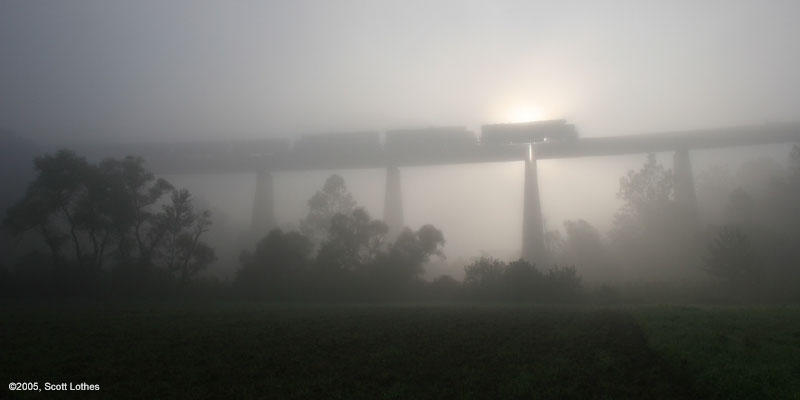
We were up early on Labor Day morning, hoping for some interesting combination of fog, sunrise and train. CSX is no longer the only railroad in Grafton. This spring, they sold their Cowen Subdivision, a coal branch extending 117 miles southwest, to the shortline operator Watco. The new owner operates the line under the name “Appalachian and Ohio,” and they had just brought two trains into town. I rather lamented the changing of the guard, as I had grown fond of CSX locomotives and railroaders on the Cowen Sub. I had put off going back to photograph A&O operations, but this seemed like as good a time as any to start.

I ran into an old friend, Chris Strogen – now an A&O conductor, getting off the second train following a long night’s run. He seemed happy, though. I don’t know if I could handle the lack of a schedule and constantly being on call. The first A&O train was picking up a cut of empty hoppers to take back to the mines, so Kevin and I headed south on U.S. 119 in search of photo spots. The fog was thick at Pleasant Creek, where a high trestle spans the broad valley. The rising sun was cutting through it, though, and we waited there for the train to tiptoe across the bridge.

We continued the chase to Buckhannon, where another westbound empty train joined the fray, but both Kevin and I needed to start heading north. Back in Grafton, Q316, the daily mixed freight, was getting ready to depart. We watched the crew change with a surly local railfan who defiantly rebuffed Kevin’s every attempt at making friendly conversation.

“So, you from around here?”

“Yup.” He offered no more.

He left, the train left, and so did we. We drove a bit east of town to a peaceful spot by the creek and watched the train roll off towards Cumberland. Kevin tried a shot in the midday sun, but I put my camera down and watched. I waved to the conductor a little longer than necessary, but I had to hold on to this one. It’s going to be a little while before I see another train in my homestate.

Back in town, we found Kevin’s car and prepared to leave. There was a lot I wanted to say, but Kevin prefers short goodbyes. He offered me his hand, wished me a good trip, and turned to go.

“You’ll have to take a picture of a steel mill for me if you find one.” They are his other photographic love.

“I’ll do that.”

I’ve left Grafton many times on Sunday afternoons and evenings, always feeling like I was driving home after a good trip. That wasn’t the case on Monday, though. Cleveland, without Mo, with my mess of an apartment and mostly packed-up life, hardly feels like home any more. No, on this drive, I was leaving home. It’s going to be too long before I get back.

Going up I-79 north of Morgantown, I was quickly running out of miles in my homestate.

"Good bye, West Virginia."

How to say goodbye to the one place that will always call me back? Just before the Pennsylvania line, I found it.

"I hope you don’t change too much while I’m gone."
This I Believe

On a performance review at an internship during my junior year of college, my supervisor wrote that I was “honest to a fault.” It’s taken me five years to understand his meaning.

This weekend was my last to spend in West Virginia before going to Asia, my last to spend around the people and places that are both family to me. I was there to see my mom, stepdad and his family. We had a good visit, good conversation, a bluegrass music festival, card games and plenty of great food. Soon the day will come when I will long for a home-cooked American meal.

I’m a person who craves depth. The farther I get beneath the surface and the more I have to think, the happier I am. Small talk is fun, but eventually, I always find myself wishing for more. I got some of that this weekend in a late-night chat with Mom and in dinner table talk about everything from Hurricane Katrina’s fallout to the different peoples and cultures I will encounter in my upcoming travels.

On Sunday we went to church, then came back to my step-grandfather’s house for an early dinner. I was meeting my good friend Kevin Scanlon in Grafton that afternoon for one last bit of West Viriginia railroad photography before my departure. Dinner had ended and in the process of saying my goodbyes, I found myself talking to my stepfather’s stepmother about Maureen and all the similarities we share.

Then she said the one thing that I suspect everyone else in my family thinks, but is afraid to say.

“I just wish she would go to church with you.”

That’s no light-hearted, whimsical statement. My family is strongly Christian, and church is a matter of eternal life or death.

The thing for me to have done there was to cock my head to one side, flash a thousand-watt smile, and say with confidence, “We’re working on that.”

I know my family worries about me, and I love them so much that I wish to the bottom of my heart I could tell them that.

I can’t, though.

Because I love them so much, I have to tell them the truth. I don’t always tell the truth about everything, but with myself I am brutally honest. I can’t live a lie with the people I love.

The truth is that we are working on that, but not in the way it would be taken if I responded the way I wish I could. Maureen and I are deeply spiritual people and are both seeking a spiritual home that we can share together. We haven’t quite found it in the religion of my childhood, but we’re looking.

So I took a deep breath.

“Be careful, Francis,” I responded.

She went on, not quite getting my meaning.

I tried again, more direct. “My beliefs have changed a great deal, and we’re both still searching for what we believe.”

Still, she continued.

So I took another deep breath and stood down. “I don’t think this a good time to discuss this.”

It doesn’t bother me that Francis brought up the matter. Perhaps she was the only one who could. What does bother me a little is her timing. That’s not a conversation I wanted to begin ten minutes before going away for a year or longer. It wasn’t easy, though. I needed to have that conversation. Just not then. So I’m left to my writing, and I hope they don’t mind too much that I’m getting it out this way.

To her credit, she seemed to understand. Still, before letting it go, she reminded me that my soul was at stake, that my soul was important to her, and admonished me to check whatever I find against the Bible.

I just nodded. How do I tell her that no matter how much I love so many of the teachings in the Bible, there are a few parts of it that I just cannot accept? How do I tell my family? How do I respond to such genuine, compassionate, loving concern for my eternal well-being when I adamantly disagree with one of the most fundamental beliefs of their religion?

Mom and my stepdad weren’t in the kitchen for that discussion. I think I’m grateful for that. Only my step-grandfather was also present, a quiet, stern man and one of the most devout Christians I know. He remained silent. Probably he didn’t want to get involved. Or, maybe, he remembered.

It was thirteen years ago, half my life, that I first asked Mom the question. Christianity, like all religions, like all spirituality, requires the belief in some things that transcend the boundaries of reasonable explanations. There comes a point in all matters of faith when some things just don’t make sense, and the decision has to be made to simply believe in them out of sheer desire. That’s what makes faith a thing that’s worth having. That’s why I admire them so much for their faith. I’d like to think I have that kind of faith, too, or at least that I’m capable of having it. But what happens when faith demands adherence to a belief that I simply cannot, will not believe?

Later this month I’m going to China. There are 1.3 billion people in China. That’s a bigger number than I can comprehend, but I’m rather certain a few of them died today. Among them, I’ll bet there was an old woman in a rural village who did everything she knew to do in her life. She married and was a faithful wife, had children and raised them the best way she could, was a friend to her community and a helper of those in need. Perhaps she never heard of God's plan for her salvation. Perhaps she did. Even if missionaries came and preached and left Bibles, how could that compare to lifetime of Buddhism or Socialist atheism? In the past 2000 years, billions, billions like her have came into the world, lived, and died.

Thirteen years ago, I asked Mom, “Mom, what happens to all the good people from other religions who die without believing in God and Jesus?” I had begun to look at my own life and begun realizing that my Christianity was largely a product of the time, place and people I was born into. So many others were born into other circumstances and trying to live the best way they knew how, just as they had been taught to believe. Surely a loving God Who created them, Who brought them into the world, couldn’t possibly condemn them from birth to the fires of Hell.

Wisely, Mom deferred. “Why don’t you ask David’s Dad? He’s an Elder of his church and has studied the Bible a lot more than I have. I’m sure he’d be happy to talk to you.”

The next month, while the gentle waves of the Atlantic washed over the sands of a North Carolina beach and the June sun shone down warm and strong, a 13 year old boy and a 60 year old man sat down together in an upstairs bedroom of an oceanfront house.

Where I wanted to be was out on those warm sands, chasing hermit crabs and dodging the surf. Even then, I had a deep respect, almost a fear, for Clarence. I was nervous being alone with him and anxious for the interview to be over. I needed an answer, though. Tentatively and meekly I asked my question.

Clarence looked deeply into my eyes. He looked at me with the look of a father about to tell his son that his dog was just hit by a truck. He loathed the task, but he knew it was his to complete, that I was mature enough to know the truth, that it would hurt at first, deeply, but that time would heal the wound and bring about understanding. So he told me. He told me with all the gentleness, compassion and sympathy that the situation would allow, yet with unquestionable firmness, that, as far as he could tell from his years of studying the Bible, “Those people are lost.”

I choked back a sob. “You mean, they’re going to Hell?”

“Yes.”

I didn’t believe him. I couldn’t. It was too much. Too much to imagine. I doubt he expected me to believe him then. But he was wrong about something. Time didn’t heal that wound. I didn’t believe him then. I don’t now. I don’t think I ever did. Time did allow me to push it back to a deep, dark, dusty corner of my mind where the cobwebs were thick and on which the light of my teenage eyes rarely shone. For years it was enough to ignore it, to run through life strong in my Christan faith and content in God’s grace. But I never did forget.

It didn’t come back all at once. It crept in slowly, first resurfacing from time to time in my later years of high school. Then came college and the realization of such a bigger world than I’d ever known. Had it not been for a fabulous minister at my church in Cleveland and a devoted family during my stint in Arizona, I imagine my breaking away would have been much swifter.

But those people came through my life, and I’m sure there was a reason for that, and so I kept holding on. It’s so hard to let go of something that has been a part of you, has instilled so much good in you, has defined you, for so long.

I don’t mind that it was hard letting go. I don’t mind that it took me so many years. By hanging on for so long, my eventual departure overlapped with my meeting Maureen. What does bother me is that my departure may then be blamed, by some, on the one person who, more than any other, helped me to look deeply inside myself, and see who was really there. That would be a greivous error.

There’s a series on NPR right now called “This I Believe.” All listeners are invited to submit a 500-word essay on their most fundamental beliefs, religious or otherwise. I'd really like to participate in it, but I'm at a point in my life where I think I have a much better idea of what I don't believe, as opposed to what I do believe. Such a negative outlook bothers me tremendously.

Yet there’s one belief to which I hold very strongly. What I believe is that we become the people we are by the experiences we have, that every experience we have, no matter how great or small, good or bad, profoundly shapes the people we become. I believe these are all connected, are all interconnected in the great web of life that we all share. I believe every one of them, every last one, from the greatest tragedy to the tiniest joy, happens for a reason. I don’t need to know that reason, or even understand it. It’s bigger than me, bigger than all of us. It is exists and it is good, not every last piece of it, but it is good overall and in the end. This I believe with all my heart.

Thursday, September 01, 2005

Being There

The first rule of photography is that you must have a camera in order to get the shot. The second is that you have to be there.

You have to be there when all the world conspires to give you that fleeting chance for a spectacular photo. It means being there when the stars are aligned, when the sun breaks over the ridge or bursts through clouds, when the fog rolls in off the river, when the man peers off into the horizon, when the full moon rises behind the city, and when the distant headlight appears down the tracks. Being there for even a few of those moments means being there for so many more, when that last piece of the puzzle never fell into place. That is both the challenge and the reward.

It sounds like such a simple request. "If you're already going to be there taking still photos, how about taking along one of my video cameras? Just plop it down on the tripod and hit record when the train's coming." I photograph trains, you see, and I have a good friend who records them on video. Most photographers are extremely attached to their own work, but not Camron. He just wants footage, and he'll take it any way he can get it, including loaning his expensive, hi-definition video cameras out to most anyone who will take them. Of course, that also involves an incredible amount of effort on his own part, and I've come to respect him and his devotion a great deal.

I've been putting off telling him about my upcoming trip to China, where, with any luck, I'll photograph at least a few steam trains, some of the last in the world. I knew he'd press me to shoot video for him, and I wasn't anxious to tell him no. I had to, though.

There's a tantalizing temptation in photography that goes along with being there. Once you're there, it seems so easy to bring an extra camera and record that once-in-a-lifetime moment from multiple angles or on multiple formats . . . like still and video. I've tried that before. I've tried it with multiple combinations of two different still cameras. I've tried it with a still camera and a video camera. On one trip, I was even ambitious (crazy?) enough to try it with two still cameras and a video camera.

What I learned from those experiences is that with every additional camera, I was that much less there. My photography suffered, and so did my appreciation of the moment, my enjoyment of being there. I love the challenge of photography, and I love some of the images I've created. More than that, though, I love being there when those moments happen. I suppose it's the first camera, and not the second or third, that creates the largest obstacle to appreciating those moments, but it's also that first camera that gets me there in the first place. So I make that trade, but no more.

I did a poor job of expressing that to Camron the first time he called. It's difficult to say no to his requests. He's persuasive, but more than that, he's so sincere and passionate about his work. I took two days to think on the matter and discuss it a bit, and finally wrote back. He called me that night, too, but not to change my mind. He understood.

My refusal had another effect that I wasn't fully anticipating. Now he wants to go to China, too. There's not much time to make the arrangements, but there might still be enough. I hope it works out. I know how much the footage would mean to him. More than that, though, I know how much he'd enjoy being there, too.