Tuesday, February 14, 2006

Eastern Hokkaido Rail Trip

Before my visa status gets upgraded from "tourist" to "dependent alien" (at least I *think* that's an upgrade), I wanted to see as much of Hokkaido's railways as I could, via the Hokkaido Rail Pass, available only to foreigners on a temporary tourist visa. For Y18,000 (about $155), I got a 5-day pass good for travel on all JR trains in Hokkaido, which I used January 30 - February 3.

You can track my progress on this Hokkaido railway map:
http://www.bae.se/kitayama/01hokkaidomap.htm

Day 1: Minami-Chitose to Shintoku to Takikawa to Bibai (286.8 km)
Day 2: Bibai to Abashiri to Memanbetsu (359.8 km)
Day 3: Explorating along the coast east of Abashiri (155.9 km)
Day 4: Abashiri to Kushiro to Nemuro to Kushiro (363.6 km)
Day 5: Kushiro to Minami-Chitose to Tomakomai (385.1 km)

For the trip, I totaled 1551.2 kilometers. Purchased separately, those tickets would have cost Y40,750, so the rail pass was quite a good deal for me.

In terrain, I think Hokkaido most closely resembles some parts of New England. There are some broad, open valleys reminiscent of western New York, rugged mountains not unlike New Hampshire's Presidential Range, and rocky coastlines similar to Maine. The highest peaks top 2000m, with lots of 1000m+ peaks rising up quickly from sea level in the space of only a few kilometers. The highest mountains are located in the middle of the main part of Hokkaido, with ranges running north up the Wakkanai peninsula, south down the Samani peninsula, and northeast up the Shiretoko peninsula (northeast of Abashiri). The southeastern corner around Obihiro, Kushiro and Nemuro is primarily an open plain, with broad valleys, rolling hills and a few smaller mountains. The vegitation is mostly deciduous, with some conifers. Wildlife includes many, many birds, foxes, bear and lots of deer.

As a train-lover, I'm only just realizing how lucky I am to live in Muroran, which is only 5 km from the busiest railway line on the island, the Muroran mainline, which connects Sapporo to the rest of Japan via the Hakodate and Kaikyo Lines, the latter including the 51 km Seikan Tunnel under the Tsuruga Strait. There are lots of containerized freight trains (though only 12-20 cars long and single-stacked, as opposed to the mile long, double-stacked land ships that streak across America’s mainlines), as well as a few oil trains of solid tank cars. Most of the traffic, however, is passenger. There are 11 daily limited express trains in each direction between Sapporo and Hakodate – sleek, modern 7- and 8-car trainsets, some with tilting technology, enabling them to “lean into” curves and travel at higher speeds. There are puttering 1- and 2-car, self-propelled locals, 6-12 pairs daily depending on exact location. And there are the night trains, expresses with 9-12 car consists of beautiful, matched blue, green or silver sleeping cars linking Sapporo with Aomori, Tokyo and Osaka. Depending on the season, there are 3-5 pairs each day, most passing through in the early morning or late evening.

I have already seen much of the Muroran mainline in my travels around southwest Hokkaido with Maureen. I’m planning lots of photography once the weather improves (we seemed locked into a pattern of grubby, gray, overcast days right now), but for this trip I wanted to see some of Hokkaido’s remoter regions, and hopefully find a few places to revisit at some later point of our stay in Japan.

I woke early on Monday morning and caught the first express for Sapporo, went to the New Chitose Airport south of the city, and bought my pass. I immediately reserved a seat on the next eastbound express, a “Super Oozora” train bound for Kushiro in southeastern Hokkaido. Expresses and freights traveling between Sapporo and the southeastern corner of the island operate via the Sekisho Line, which was only completed in 1981. The Sekisho line, with its many long tunnels typical of 1970s Japanese railway construction, was a major upgrade over the twisting route over Karikachi Pass. Much of the pass was eliminated with the 6 km summit tunnel (which features a junction inside its western portal), but the line still traverses some scenic river valleys on its western approach, much of which is roughly paralleled by a new highway, parts of which are still under construction.

Following the summit tunnel, the line makes a big horsehoe curve as it drops downgrade to Shintoku and the long plains of eastern Hokkaido. There is a long concrete viaduct on the apex of the curve, but photographing trains on it would be a problem since most of it has metal wind fencing on both sides. Apparently the gails can really blow down from the mountains onto the eastern plains. The line is single track, and snowsheds are used to protect the siding switches. Despite these viewblocks, there are still some good-looking spots for photography and camping on this stretch, hopefully to be revisited in warmer months.

I disembarked at Shintoku, at the base of the mountain, where I walked around town and stumbled upon a lovely little restaurant and sushi bar offering up lunch sets of hot udon noodles and cold sushi for Y1000. In the early afternoon, I boarded a 1-car local train for a trip back up the mountain and through the summit tunnel, but this time taking the northern leg of the junction inside the tunnel for a ride through Furano to Takikawa.

The line up through Furano is quite scenic with lots of tight, Appachian-esque river valleys, plus a nice stretch along a lake and a long, open valley with high mountains on both sides. Traffic here is sketchy: I only confirm the 8 or so scheduled pairs of 1- and 2-car self-propelled locals, most lightly patronized, save for hordes of high school students inn the early mornings and late afternoons. My train didn't meet any freights, but there is an active container yard in Furano where I saw a couple of red diesels. Most of this line is jointed rail, as are most lines in Hokkaido. Interestingly, the Japanese (as well as the Chinese) seem to prefer parallel rail joints, rather than the U.S. practice of offset joint bars. I have since been told that this is to help deter the “hunting” or “snaking” motions often catalyzed by offset rail joints on long straight stretches. We really slammed over some of the rougher joints when the railcar got wound up to 80 or 90 km/h, but, in general, the trackwork is quite good.

Around Furano and northward, the valley opened up into a broad flood plain with high mountains on either side. Furano is famous for its skiing in the winter, and for its colorful burst of lavender wildflowers in June and July. I hope to experience both, starting with some skiing in March during a regional JET meeting held in Furano that Maureen will attend.
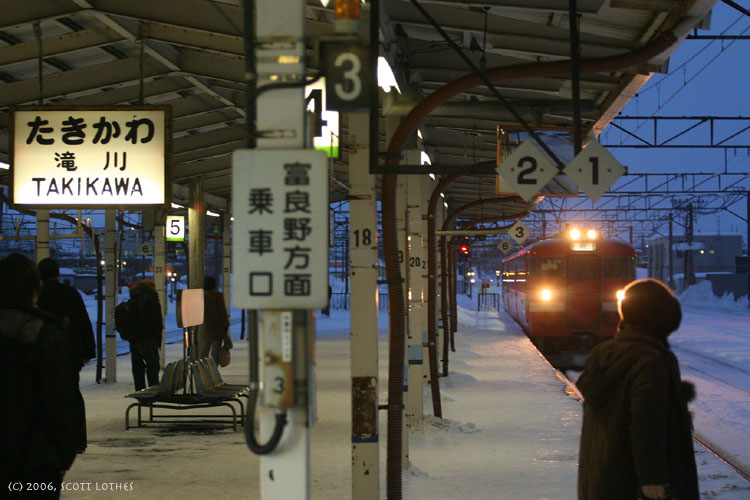
From Takikawa, I doubled back toward Sapporo, stopped for the night at Bibai. One of the many perks of Maureen being in the JET program is that I was able to arrange free lodging with other JETs across the island on every night of my trip. I spent the first night with Steve, his Japanese wife Erike, and their adorable 8-year-old daughter, Felicia. Steve is not actually a JET, but he teaches English at several junior high schools around Bibai and is very supportive of the JET program. I met him and his family just a day earlier at Maureen’s musical rehearsal in Hobetsu, where he immediately offered to house me for the night. We had yakitori (grilled chicken on wooden skewers) for dinner, a local specialty of both Bibai and Muroran. Steve told me that the two cities are both so proud of their yakitori, that they have each hosted a “grill-off” and taste test. Not surprisingly, the host city has won each of the two competitions.

I returned to the train station early the next morning for a long trip across northern Hokkaido to Abashiri on the cold Sea of Okhotsk, famous for its winter ice floes from Siberia. The morning run on the busy, electrified line to Asahikawa was primarily a straight shot through a broad valley. Development along the way reminded me of the rural eastern U.S. It certainly isn't as crowded as most anywhere in Honshu, Japan's main island, but it's not exactly the empty plains of Wyoming, either.

East of Asahikawa the topography got more interesting, but again, most of the line was paralleled by a new, partially finished expressway. The summit area around Kamikawa reminded me a little of western Montana, albeit without the spectacular rock formations of Glacier National Park. The landscape opened up more as we got close to Engaru, where the mainline makes a switchback. Engaru is in a broad valley and why there isn't a wye makes no sense to me, but the 5-car Okhotsk DMU expresses have cab cars at both ends, and the tail of the switchback is located in the station. The broad valleys here reminded me a lot of the area south of Elkins, WV along US 219. The expressway hasn't made it this far (yet?), which helped preserve a more rural feel. There's a nice "mini-pass" south of Engaru with lots of tight curves winding through a wooded valley. I really liked this area, too, and hope to come back in the summer or fall and do some lineside photography and camping.

Just south of there, I took a walking and lunch break in the small town of Rubeshibe. I saw my first freight train of the day there -- 10 container flats with a red diesel (center cab DD51) on both ends. I'm not sure if the grades are steep enough to require a pusher, or if it's there to speed along the reverse move at Engaru. (I'd think simply swapping ends would be easy enough, though.) I continued to Abashiri via a 1-car local through more broad valleys and along the shores a large, frozen lake just outside of Abashiri.

I went for a walk around town in the late afternoon, passing several groups of high school students on their way home. I smiled and said “hello,” and most smiled and returned my English greeting. One lad of 14 was even bold enough to ask, “How are you?” which led to a short conversation. He ended it rather abruptly, and I have to imagine we had been approaching the limits of his English comfort level. I was often guilty of the same in China. The girls are my favorites though. They steal quick glances with bashful eyes while approaching on the sidewalk. I say a cheeful “hello” as they draw near, they reply with timid “hair-rohs” as they pass, I count two seconds off in my brain, whereupon they burst into uncontrolled giggling.

I retraced my steps slightly to Memanbetsu, where I spent a relaxing night at Katie’s apartment. She had dinner ready when I walked in, then left me to read and check email in her warm living room while she played volleyball with a local adult recreation group. Even though we talked late into the night, she was still up at 6:30 for her morning run. When I asked if she had had any serious wipeouts on the slick ice and packed snow, she showed me the metal-covered straps on the bottoms of her sneakers, like snow tires for shoes. I was preparing to leave when she returned from her run, so we said a quick goodbye and I hurried off to the station.
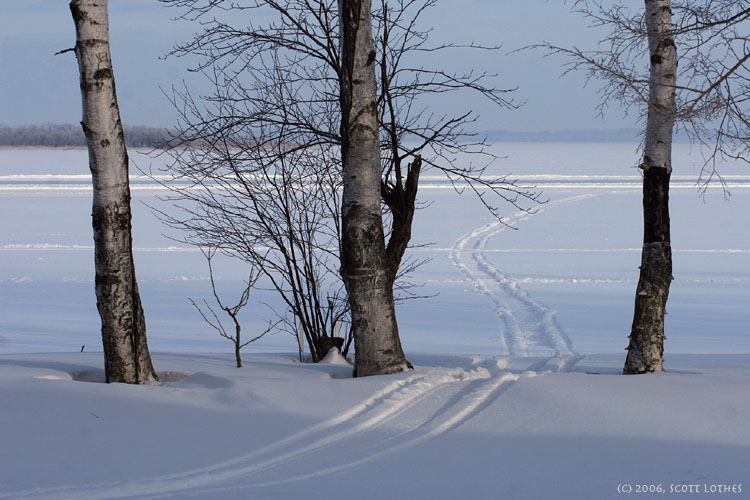
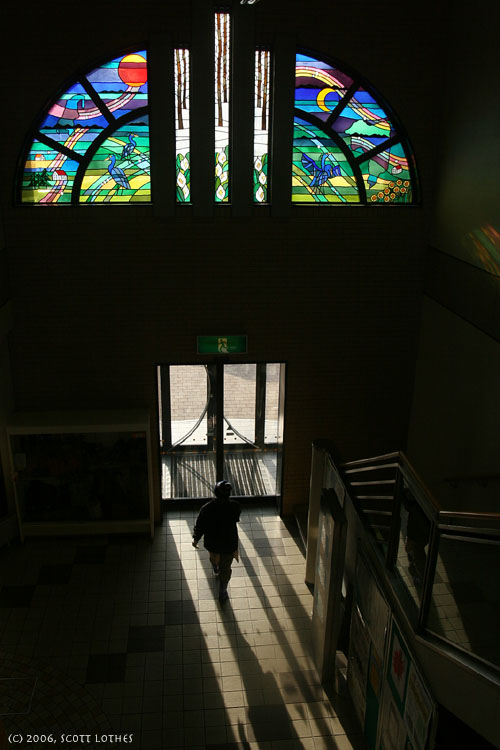
You can time the departure of Japanese trains down to the second, so I often cut it close. That morning, I cut it a little too close. My train was pulling out as I burst into the waiting room. Seeing my disappoint, a kind, elderly woman pointed out the schedule and showed me when the next train would be leaving. With over an hour to kill, I was a little disappointed at first, but then I decided to enjoy the morning sun and took a walk by the lake. When I got back to the station, the light was shining in through the stained glass windows. Those photos were my favorites of the day, and I never would have gotten them had I not missed my train.
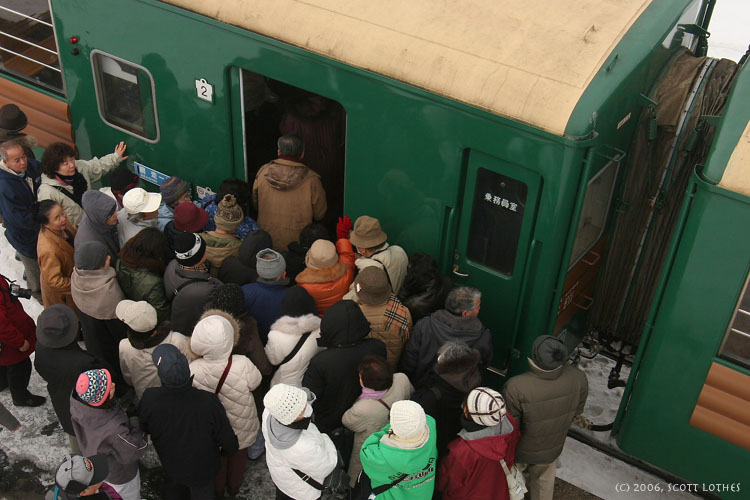


From there I returned to Abashiri and caught a Senmo Line local train along the Sea of Okhotsk. Unfortunately, the ice floes are temperamental and I missed seeing them, although I did see some drift ice. The tracks hug the shoreline and run along some rolling dunes with marshes to the south. Towering over all in the distance are the 1000m+ peaks of the Shiretoko peninsula. In addition to local trains, there is also the Norroko site-seeing train, 5 coaches with a small diesel that runs from late January to mid March. The local trains weren't crowded at all, except for high school kids at the beginning and end of their days. The Norroko train, however, was packed with Japanese tourists. I stuck to the locals.

In the evening, I met James at the Mr. Donuts down the street from the Abashiri station. After three years in the JET program, he found a job as a private Assistant English Teacher in Abashiri, where he’s enjoying the many winter festivals and parties that Hokkaidoans hold to help get them through the colder months. Following a much-needed trip to an onsen, we explored Abashiri’s snow festival, held on the bank of the frozen lake. There were several snow sculptures, two ice slides for the young (and young at heart, like James and me), and a hot air balloon operated by a professor at the local agricultural university. James noticed what appeared to be ticket booth.
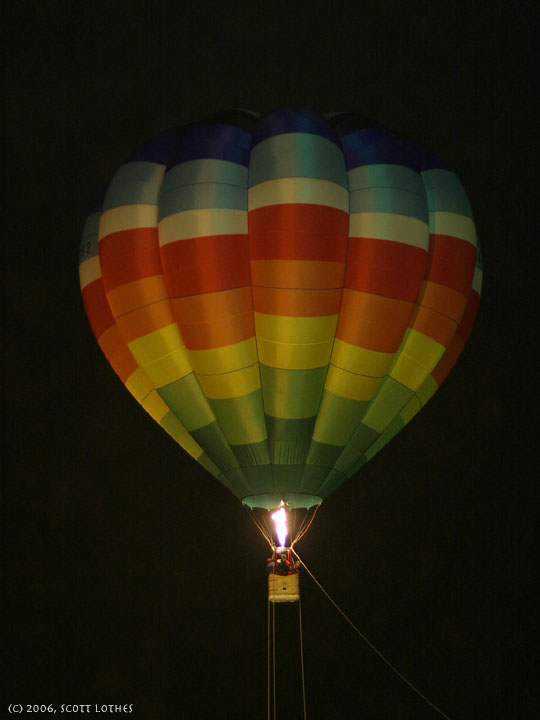
“1500 yen for a ride,” he told me. “Want to go? I’ve never been on a hot air balloon before.”

“Me neither,” I replied. “Let’s go!”

We crowded into the small basket with the professor and a Japanese passenger. The professor fired the burner, located so close to my head that I had to duck to keep from singing my hat. We floated 100 meters or so above the frozen field and lake, the lights of Abashiri glittering in the distance.

The next morning, James was kind enough to get up at 6:00 and give me a ride to the station for my 6:41 train, headed south towards Kushiro. The northern part of the line rolls through more broad valleys with high, distant mountains and lots of lineside sawmills (but no rail freight traffic that I could tell) before going over the drainage divide in the middle of the island, a stretch of tight curves in woodsy mountains with a summit tunnel in the middle. South of there, the line enters Kushiro Shitsugen National Park, rolling hills boarding a vast marshland famous for its wildlife, including stately black and white cranes, many other birds, and more deer than I could count.
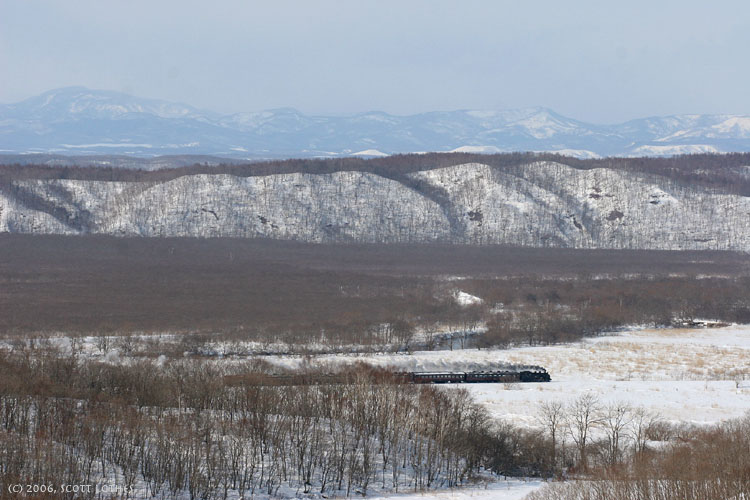
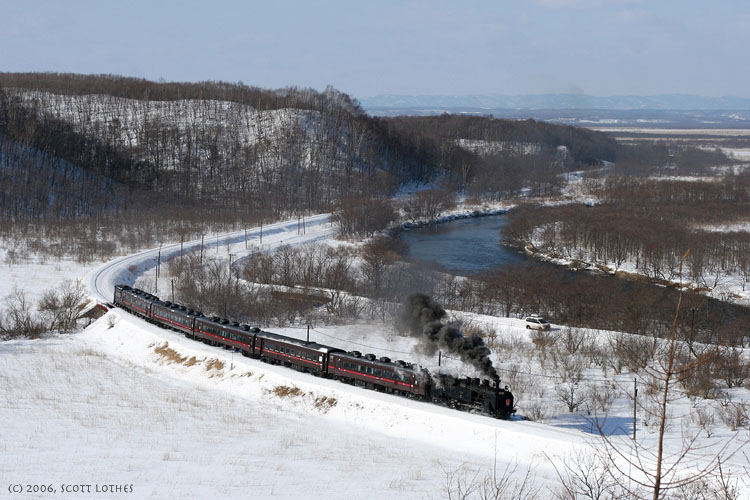
From late January to mid March, JR Hokkaido operates a steam train with one of their two preserved C11 2-6-4T locomotives, which hauls six cars from Kushiro to Shibecha every day. The clouds that had dogged me most of the week finally departed, so I disembarked in Toro for some photography. With the help of a Japanese photographer in the Toro station, I hiked to some nice overlooks and photographed the steam train in the snow-covered landscape. The Japaense love their trains and seem to have this tourism business figured pretty well, even running a double-header with both locomotives on the opening weekend. I'd never spent much time around tank engines before, but I must say, I rather like them. It's too bad there weren't more of them built in the U.S. -- they really are the perfect tourist train locomotive. Nice, deep whistles, too.

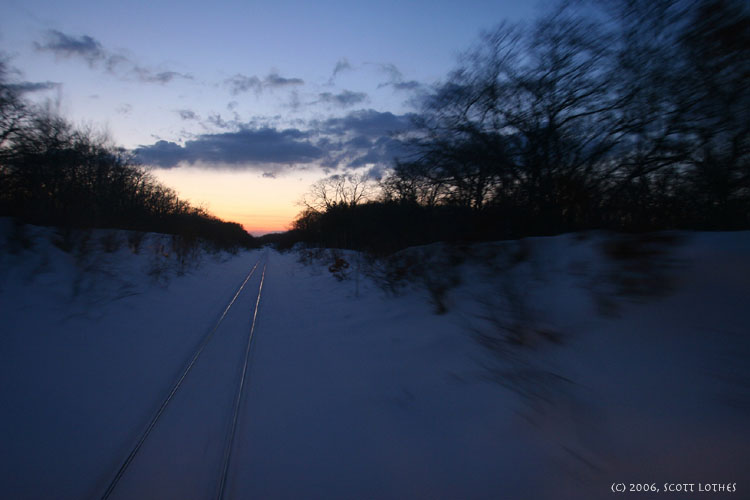
Afterwards, I hiked back to the Toro station and caught another local the rest of the way to Higashi-Kushiro, where I quickly changed to a local on the Nemuro branch for a trip to the far eastern reach of steel rails in Japan. After passing through a tight creek valley with some nice curves and three tunnels, the land opened up and we briefly touched the Pacific, before again turning inland up a lake and marsh. The last several kilometers into Nemuro were a heartbreakingly-beautiful stretch of running along the top of a gentle ridge through open farmland, the glittering Pacific again coming into view here and there through little creek canyons tumbling down to the sea. I'm sure the golden light of late afternoon helped tug at the heartstrings. We pulled right up beside the ocean for a short stretch, on a cliff 20-30m above the water. I had only 25 minutes to take a quick peak at Nemuro before I had to return to Kushiro, where I was spending the night. During the return trip, the driver noticed me taking photos of the sunset and motioned me up into the cab area for a better view.


Back in Kushiro, I met Caz, a first-year JET from the UK, at the station. She took me to a restaurant where we grilled our own meat on a gas burner in the middle of the table, then across the street to a large bookstore with an English-language section. Her apartment is part of a hotel complex, and she invited me to use the free onsen while she made a phone call. She was still on the phone when I returned, and the call being of a rather personal nature and her apartment being of a rather small nature, asked that I go next door to her friend Brooke’s apartment and promised to join me there as soon as she finished her call. Brooke is a second-year JET, also from the UK, and had just returned from an evening language class, so we hadn’t yet had the opportunity to meet. It was not without some trepidation that I knocked on her door.

“Hi. I’m Scott. I’m staying with Caz tonight and she asked me to come over while she finishes a phone call.”

Brooke looked understandably confused at first. “Oh.” Then she sorted out the details. “Oh, of course! She mentioned someone was staying with her tonight. Won’t you come in? I’ll put on some tea.”

Caz joined us presently and apologized profusely. We all had a good laugh about it and lots more tea.

On my last day, Caz walked me into downtown Kushiro, showed me where I could along the waterfront, then went to meet her teacher for school. I strolled along the rows of fishing boats moored in the river, made my way back to the train station and returned to Toro where I again photographed the steam train in the marsh.


From there I returned to Kushiro, then proceeded by local train through more broad valleys, marshes and coastline to Obihiro, where I caught an express back to Minami-Chitose. I could have taken the express the whole way, but over the course of the week I found that I enjoy riding the locals a great deal more.

Visually, I prefer the longer, more streamlined expresses. The boxy locals aren’t much to look at or photograph. Cleveland has similar trains on its rapid transit line, which a friend appropriately dubbed “toasters,” since both look and sound like toasters on wheels. Here in Japan, though, compared to the expresses that fly through so much of the countryside without stopping, the locals feel much more intimate with the land and people around them. They stop at every station through all the small towns and countryside between the larger cities, ferrying commuters, shoppers and students alike, with a feeling not unlike a pre-Depression U.S. interurban railway line.

Unfortunately, like so many of those U.S. interurban lines that were abandoned during the 1930s and 40s, many of the local trains are losing money. The seating on most is in groups of four with two benches facing each other by a window. It was rare that I didn’t have all four seats of a cluster to myself. JR Hokkaido has been working to develop a dual mode vehicle that can travel on both railways and roads, literally a bus with railway wheels, in hopes of providing more financially feasible public transportation to its rural areas. The first units are scheduled to be placed into service later this year.
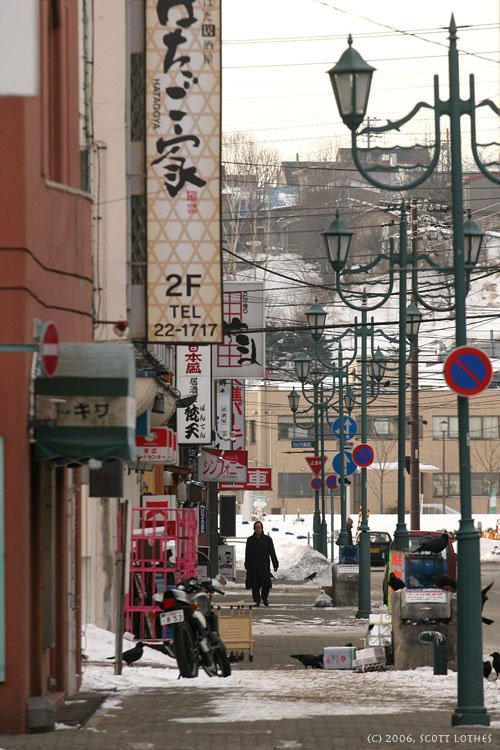
Hokkaido was once a great coal-producing region, but Japan now imports less expensive coal from Australia and China, so the mines have closed, many branchlines have been removed and lots of the smaller cities and towns in Hokkaido are declining. In some ways it reminds me of Appalachia, although here at least there is the nearby big city of Sapporo to take refuge and start over. I've been told Sapporo is the fastest growing city in Japan (at 1.9 million, it is currently the fifth largest). Still, smaller cities like Muroran and Kushiro have streets of closed-up, run down buildings and empty apartments. Ridership is decreasing on most railway lines, and even as the population of Hokkaido continues declining, new expressways, like the ones I passed on my first two days of travel, continue their expansion across the island, and boatloads of new Toyotas pull into the Tomakomai port every few days.

There are multiple reasons for the declining population here. The birthrate is declining, so the population is not being replaced as quickly as it is naturally dying. With the closure of the coalmines, the island lacks a strong, primary industry. There still exist the modest industries of agriculture, forest products and fishing, and the southwest region includes a steel mill, oil refinery and cement plant in Muroran, plus active port facilities in several cities, but they are not sufficient for complete sustainability, not to speak of growth potential. For the high school students that Maureen and the other JETs visit, those who can will flee to Sapporo or Honshu, while the rest have little to look forward to in employment prospects beyond the view behind the counter at a convenie or grocery store.
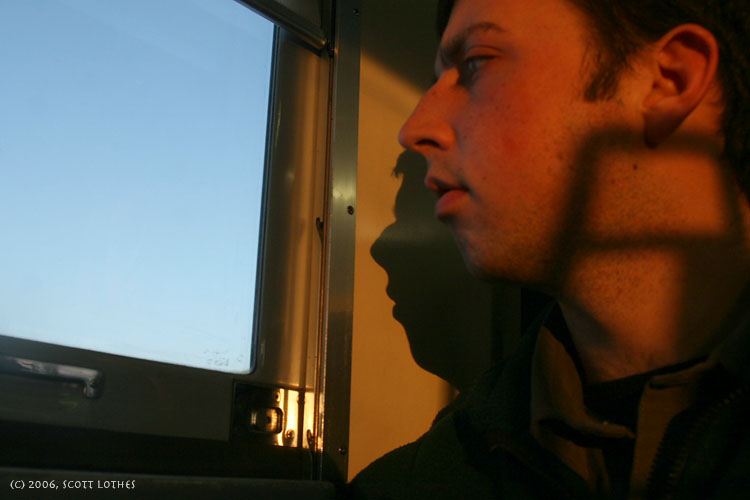
A Quiet Walk?

Asia is a hard place for the introvert to lose himself in reflection. There are so many people. And those people are everywhere.

On the last weekend of January, I went with Maureen to her musical rehearsal in Hobetsu, a small mountain town of 3800 to the east of Tomakomai. The JETs in Hokkaido are a very active bunch, perhaps in part because of the isolation that comes with living on an island that is snowbound for half the year. The gaijin here tend to band together, and every year, a group of them produce a Broadway musical with a Japanese flare. This year’s selection is “Guys and Dolls,” and Maureen has a role as a dancer and chorus girl. The cast and crew assemble for one weekend each month throughout the school year to prepare the show, then give performances on the last three weekends in May. The plays are done in English, but include enough Japanese lines that someone who spoke only Japanese could still follow the basic plot.

I had plenty to keep me busy during the rehearsal, from photographing the cast, to reading, to taking meditative walks through the quiet village streets in the bright winter sun. Or at least trying.

I was walking up the snow covered sidewalk in that contrasting time of evening that only comes to the deep valleys and hollows. It was that time before twilight but after the low sun had dropped behind a nearby, towering, confining hillside. The sky was bright, the painfully clear blue of cold winter. The clouds were cotton white rimmed in gold, the blue-white snow shadows covering a land that was neither dark nor bright in the sky’s reflection. The packed snow of the un-shoveled, unsalted sidewalk packed tighter underfoot with each step, and I had drifted a thousand miles away to the windswept plains of Inner Mongolia where the last of the giants still steamed across the grasslands.

My thoughts were on the railroaders of that barren land, in particular the ones I had met and given my photos, given those little parts of myself. And I had just found out from another traveler that they have been selling those photos, my photos, to other steam seekers for a little bijou money. I’m surprised but not, perhaps most surprised at myself for being so naïve in thinking they wanted my photos for anything other than potential income.

With the haunting acoustic melody of the Goo Goo Doll’s “Name” drifting through my mind, I notice for the first time two teenage girls walking toward me. If this was America, I could keep looking down, keep looking at the sidewalk, looking through the sidewalk to that place deep inside myself where my current thoughts were fixed. If they were American high school girls, they would think nothing of me and I would think nothing of them, and we would both pass and walk onward, our thoughts and conversations untouched by our coincidence in that place and time. But this isn’t America. This is Japan, and they were already watching me for a long time before I ever saw them, even though in that moment, as I was looking up, they were looking down and pretending to study that same, snow-covered sidewalk I had been looking right through for so long. I’m 190 cm tall, fair white skin and just can’t hide. So I looked up, looked outside myself and right at them until they finally met my gaze and then quickly looked away again.

“Hello!” I said, loudly, clearly and cheerfully.

“Herro,” the first one answered, quickly and timidly.

“Hello!” I hailed the second. She was too embarrassed to speak.

They were not two steps past me when the high-pitched, squealing laughter broke out. And I had to smile. My reverie was broken, lost and not likely to be found again, but I had to smile. Simply by being here, I’m a participant in the internationalizing of rural Japan whether I want to be or not.

Monday, February 13, 2006

Japan Marriage

A Joint Post by Scott and Maureen

Sometimes the best things in life are worth waiting for…and sometimes they’re worth doing as quickly as possible.

After nearly four years together, we (Maureen and Scott) got engaged in July, just three weeks prior to her leaving for Japan. We said a tearful goodbye in Detroit the morning before her departure, then spent the next 4-1/2 months apart. That was more than enough time to realize that we didn’t want to be apart again when his temporary visitor’s visa expires on March 15th. So, since we were already going to Sapporo in the middle of January, we decided we might as well get married while we were there.

Finding the U.S. Consulate office proved something of a challenge to our navigational skills, and was not aided by the heavy construction fences obscuring the entrance. We later learned the construction is for keeping the Sapporo U.S. Consulate office up to current security standards (since Japan is such a hot bed of terrorist activity). Arriving there was only made possible with the assistance of a few (okay, several) keitai calls to the ever-helpful P.A. Shane.

Among the racks of papers in the U.S. Consulate office in Sapporo is the handy, three-step guide to marriage in Japan. Step One was to visit the U.S. Consulate General and obtain an “Affidavit of Competency to Marry.” Presumably this step is to dissuade all of those young, foolish (drunken) couples in the U.S. who would otherwise hop a flight to Japan to elope. Among the many questions to which we had to swear our answers (with right hands raised) was that this was the first marriage for both of us. Prior to our embarkation on Step Two, the smiling clerk kindly provided us with both verbal and written instructions for what to do once we start having babies in Japan, since that is clearly the first thing married couples do.

Following a romantic lunch at and a pink-n-cutesy gourmet deli and dessert café, we hopped the subway to meet Shane at the nearby Chuo Ward office, where the Consulate clerk had assured us we could complete Step Two: registering our marriage and obtaining official proof of our marriage’s officialness (also known as the “marriage certificate”).

The first part of Step Two, registering our marriage, required completing the “application for a report of marriage,” which, of course was in Japanese. That was one of the many places where Shane came in.

“Do you see anyone in here that you like?” Shane asked, sweeping his arm around the office.

“What do you mean?” We gave him blank stares in unison.

“Well, you need two witnesses to sign this form. We might need to grab someone.”

“Since we have you as the best man, Shane, we should grab a random lady who looks nice.”

While scanning the room for the would-be maid of honor, Shane delved back into the form, trying to remember all of those difficult, seldom-used kanji.

“This thing is pretty messed up!” he exclaimed.

“What now?”

“Well, if I’m reading it right, this part wants to know what kind of backgrounds each of you come from. Like, were your parents farmers, merchants or warriors?”

“Are there any other options?”

With the form as complete as it could be, the three of us approached the counter where a lengthy, animated discussion ensued between Shane, the man behind the counter, and his supervisor. As the discussion continued, a tinge of doubt crept into our minds as the man’s expression turned to one of apology, the traditional Japanese look for “I’m sorry, but I can’t help you.”

“He says you can’t get married here,” Shane told us.

“Why not!?!?”

“Because you don’t live here. You’ll have to register your marriage at the ward office of your residence, back in Muroran.”

Even as the staff helpfully called the Muroran office to confirm that we had all the essentially paperwork, our spirits sank at this delay in our “officialness” as a married couple. Even in the midst of having a celebration dinner to look forward to in the evening (thanks to the generosity of Maureen’s family), we were feeling a bit down. Then Shane mentioned a great place he knew to go for dessert, an even better one for beer, and that he would suggest our dinner guests should treat us. Our spirits lifted instantly! After all, we’re not gonna give up a chance to party, especially for this occasion.

In deciding to have a Sapporo celebration, we knew we could count on our trusted P.A. for culinary advice and assistance. Since we are in Japan, it would seem appropriate to go all out and arrange a fancy Japanese dinner. However, the words “fancy,” “Japanese,” and “dinner” are a combination that rarely occurs beyond the presence of fish, and Maureen’s pallet doesn’t entirely agree with the taste and texture of fresh foods from the sea.

“So let me get this straight,” Shane had asked in a previous discussion, “you want a nice Japanese dinner, but you don’t want fish?”

“Right.”

“I think that would confuse them.”

All was not lost. All along Maureen had a hankering for lasagna, and she was determined to find a place that served it. After all, if you are going to get hitched, you darn well should be able to choose the menu! That decided, we charged Shane with the task of finding an Italian restaurant that would serve it. A few days later, he e-mailed us back suggesting a place called Becco.

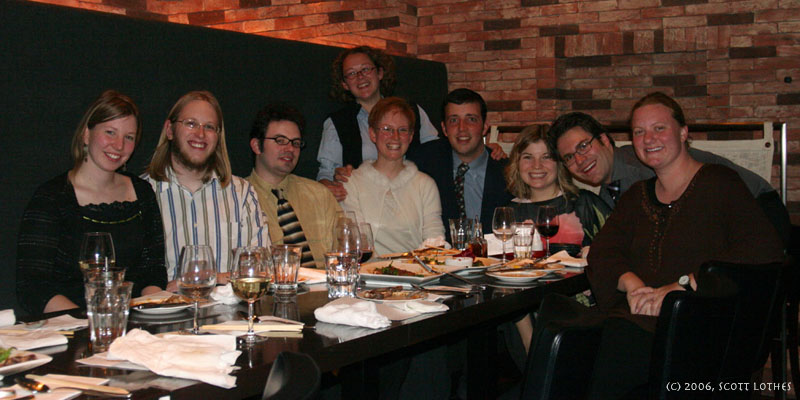
On what turned out to not be our official marriage night, but rather the night of our “U.S. Consulate Date,” we met Shane and six other JET friends for a cold, windy 15-minute walk from the Sapporo Station. The dim lights of Becco provided a rather elegant and relaxing atmosphere. At Shane’s request, they prepared everything we wanted and more: several appetizers including pizza, garlic bread, various meat dishes, and two deep pans of thick-noodle, cheese-dripping lasagna. The guests in attendance can all attest to this wonderfully prepared meal. If you are looking for a great Italian restaurant in Sapporo we highly recommend Becco.

Some of you may know a few of Shane’s favorite drinking establishments in Sapporo. One of these is a small place hidden away in a basement stacked high to the ceiling with empty beer cans from all over the world. The selection of full cans and bottles is just as outstanding. Maybe Maureen is biased, but this was by far one of her favorite ni-ji kai’s yet. The owner, Fred, is an American ex-patriot from California who just plain knows how to brew beer and sell the best. We even toasted to a bottle of his choice on the house. Please email Shane for directions on getting there. He’ll probably request that you invite him, too.

It was Shane who best summed up our feelings for the day. “To me, marriage is something that you feel inside yourselves. So as far as I’m concerned, you’re already married. Kanpai!”

Friday, back in Muroran, was our next chance at consummating our officialness. Whether to even try on that date was a matter of considerable discussion, being that it was Friday the 13th. Despite Shane’s enthusiastic encouragement, we had our doubts. In the end, the point was rendered moot, as Maureen’s supervisor, who had generously agreed to accompany us to the city office and translate, was not available.

On Saturday evening, we once again found ourselves having a party with nothing official to celebrate. We couldn’t pass up the chance to enjoy another gathering in our “un-official honor,” especially with delicious Sri Lankan curry prepared by Sumudu, a Muroran friend. Fun times were had by all as we divulged ourselves in chicken, potatoes, veggies and rice. We capped off the evening with scrumptious chocolate cake chosen by Katie, John, and Judy, and a champagne toast with acting best man John Gainor doing the honors this time around.

“I think they just want an excuse to party,” said Judy. “I don’t think they’re ever going to get married.”

We were beginning to wonder, too.

Monday was our next chance, but it was shot down by one of Maureen’s co-workers, as it was butsumetsu, “the day Buddha died,” according to the lunar calendar used by Japan into the 19th century. Not a good day. Seeing as how we had already eschewed American superstition, we thought it fitting to follow suit with the Japanese. Besides, Maureen had a New Year’s office party that night, and a school visit the next day – hardly ideal conditions for celebrating a marriage.

Taking advantage of the marital leave in her JET contract, Maureen had seven days off beginning on Wednesday. That morning, we met her supervisor at the Muroran city office. This time there were no apologetic looks from the staff. With his help, we completed all of the paperwork in a matter of minutes and were instructed to return the next morning to pick up our marriage certificates. There were no ceremonies, no vows, not even any “I do’s.”

We said goodbye to Masuda-sensei and began the long trudge through the snow up the hill to our apartment.

“So what just happened there?”

“Are we actually married now?”

“I think so.”

“It all feels a little anti-climatic, doesn’t it?”

To best merge the location of our marriage with our own personal tastes, we had sushi for lunch (well, at least one of us did – no prizes for guessing which one) and made spaghetti for dinner. We returned to the city office the next morning and were presented with three pieces of paper: two simple marriage certificates and an ornate one with gold trim and a red, stamped seal. None contained so much as a single word of romaji, let alone English. Maureen can read enough kana to make out our names and the date, January 18th. Beyond that, we can only hope it actually says we are married, and is not instead the opening dialogue from last week’s Doraeman episode. Maureen’s mother already wants us to mail it to her so she can have it matted and framed.

That afternoon we boarded a train for Noboribetsu, where we were treated to a night at the Sekisuitei Onsen, courtesy of a very generous and very unexpected wedding gift from Maureen’s coworkers. At the front desk, we were asked whether we wanted a Japanese room or a room with a “bed-o.”

“Bed-o,” we replied.

Several “arigato gozaimashitas” later, we took the elevator to the fourth floor and stepped into a beautiful room with a raised tatami floor, low table and chairs, … and two twin beds. We exchanged curious looks. But that, like Scott's upcoming trip to the immigration office, is another story.

Kyoto, Part II + Tokyo

With 220 yen, plenty of time, and even more patience, you can ride nearly anywhere in Kyoto on a city bus. Our first attempt went over without problems, thanks largely to the tourism bureau’s English bus map and a straight, one-bus shot down Marutamachi-dori, the busy avenue that ran in front of Kyoto Cheapest Inn. We exited the bus in a western suburb, beside the parallel JR line’s Hanazono station, and began walking north.

Our morning destination was Kinkaku-ji, the Golden Temple (we decided to save Kiyomizu-dera for the afternoon), but we were taking the long way to get there: 4 km of winding back streets in Kyoto’s western hills. Just a block north of Marutamachi-dori, our route took us straight through a sprawling temple and monastery complex. There were no admission fees, no souvenir shops and no crowds. Besides us, the only people out on this drizzly, gray morning were a few Japanese tourists and the long-robed monks, going about their morning rites. We strolled slowly and quietly through the length of the grounds, leaving only for the promise of so much more to see in the day.

Our path took us through narrow streets and across a single-track railway with one-car trains edging through the backyards of houses, villas and apartment buildings. We turned right and made our way up a winding road at the base of a hill, passing several small temples and countless roadside mini-shrines with little stone gods adorned in bright red New Year’s jackets. The growing crowds along the sidewalk alerted us to our arrival at Kinkaku-ji’s entrance (Y400). While Mo visited the restroom, I discovered the ultimate combination of the Japanese fixations with photography and convenience: a vending machine selling disposable cameras.

Once inside, we were immediately greeted by one of the most famous sights in Japan: the three-story temple with its top two floors in shimmering gold. A special area, apart from the main path, was roped off for the express purpose of viewing and photographing the temple. A man approached with his camera and asked me to take his picture. I complied, then suggested he check the shot on his review screen to make sure it was okay.

“I’m sure it will be okay,” he smiled, pointing to my 20D. “When I want my picture taken, I always look for someone with an extravagant camera.”

With my “extravagant camera,” I took the standard, touristy photos of the temple reflected in the pond beside it, but found greater pleasure in taking pictures of Japanese tourists taking pictures of the temple with their cell phones.

The original Kinkaku-ji dates from 1397, built as a retirement home for Shogun Ashikaga Yoshimitsu and converted into a temple by his son. Of course, we weren’t looking at the original Kinkaku-ji. Lonely Planet reports that “in 1950, a young monk consummated his obsession with the temple by burning it to the ground.” The current edition is a 1955 reconstruction, an exact replica save for the gold-foil covering being extended down to the second floor (only the top story was gold on the original).

“If that guy loved it so much,” Mo asked, “why on earth would he burn it down?”

“I have no idea,” I replied, “but that seems to be the way with obsessions. Why do serial killers murder the people who most fascinate them?”

Beyond the temple itself, there proved little else to see at Kinkaku-ji. While there was one primary path at Nijo-jo, there we were still free to wander about at our leisure. Here, we were guided like so many cattle in stock pens around the grounds. Beyond the temple, we passed a small waterfall, then climbed some stairs to the lake that fed it. In short order, the pathway dumped us out through the exit gate into a hive of gift shops, and that was that. We were welcome to enter again on our same tickets, but I could see little reason to do so. It was only 10:30, none of the ramen shops we had passed on the street outside opened before 11:00, so we boarded a bus to take us back into the city.

Following lunch, we hopped a subway bound for downtown. Two days of hard walking were taking their toll, and rather than exiting for the 1.5 km walk to Kiyomizu-dera, we continued by subway to the main railway station, where we could catch a bus that would take us nearly to the temple’s entrance. That decision proved monumental.

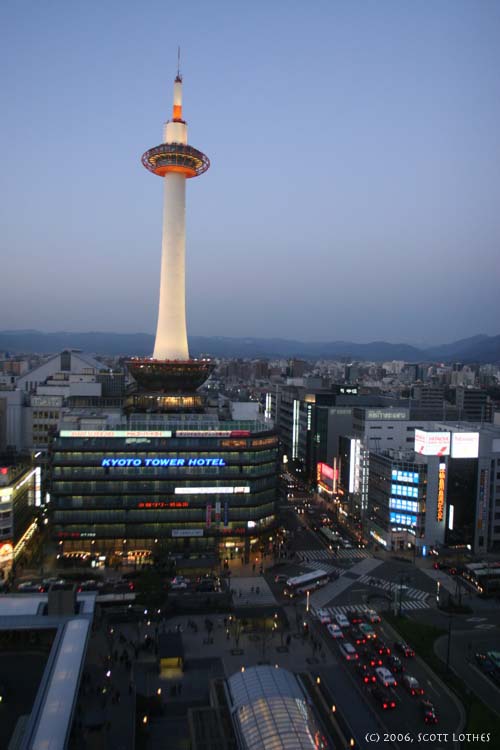
In front of the JR station is the busiest bus stop I have ever seen. On six lanes between covered platforms, each one with multiple boarding points, a ceaseless parade of city buses marched out of and back into the rush of city traffic. A towering sign in front of the platforms listed the color-coded, numbered boarding point for each numbered bus. We found ours and waited, with three dozen other passengers, on the appropriate, narrow swath of platform by an electronic sign that displayed how many stops away the next bus was.

The bus that comes closest to Kiyomizu-dera is no. 206, a circulator bus that runs a loop around downtown. We stood in the crowded aisle as the bus lumbered into the nearly grid-locked midday traffic. Fifteen minutes and only a couple stops later, we were beginning to think we should have just walked from the nearest subway station. Then I noticed the shadows seemed to be on the wrong side of the bus.

“Don’t look now, Sweetie, but I think we’re going the wrong way.”

The next street sign, thankfully including romaji (the Romanized version of written Japanese), confirmed it. City bus numbers in Japan correspond only to the route, not direction. We needed the counterclockwise 206, but had boarded the clockwise one, which was taking the very long way around to Kiyomizu-dera.

“How long will it take if we just stay on this one?” Mo asked.

I consulted my bus map. “At this rate, the temple just might still be opened by the time we get there.” It didn’t close for another five hours.

“I don’t want to be on this bus any more!”

“Me neither. Up for some walking?”

“I think so.”

We exited directly across downtown from the temple and started walking, along the way passing the subway stop that we could have used some 40 minutes earlier. Another kilometer brought us to the bus stop that we had wanted, and from there we began climbing the narrow streets up the hill towards the temple.

The road split, giving us a choice of two routes. Both were crowded with tourists and New Year’s pilgrims, but we selected the somewhat quieter path. Halfway up, we stopped for a break by the entrance to one of the countless souvenir shops along the way.

“Do you mind if I take a few photos while you browse here?” I asked Mo.

I went a short ways back down the hill while she entered the shop. Inside, she looked with half-interest at a rack of Hello Kitty key chains with the expressionless feline adorned in geisha-style kimonos. Across the store, a Japanese voice muttered, “Only an American would buy those!” Mo turned from the display rack to look outside. And there they were.

I was looking downhill, contemplating the low-angled sunlight and long shadows of the narrow street, when Mo’s voice brought me back to reality.

“Scott! SCOTT! Turn around!”

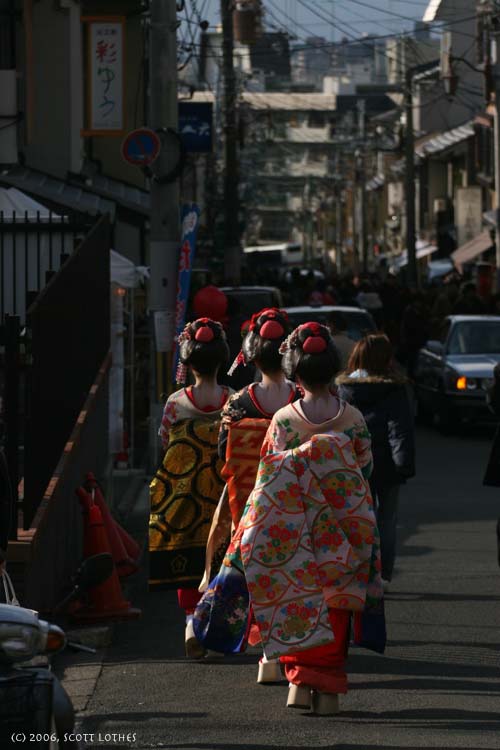
I looked up the hill and saw Mo. Then I looked beside her. A small crowd was timidly following every clip-clopping step of three white-faced women in bright, capacious kimonos. I lowered my camera. This was something to see with my own eyes, not looking through a viewfinder. Beneath the piles of jet-black hair wound tightly on their heads, the make-up was thick and cracking, not as perfect as I had imagined. Reality never is. They took short, quick steps down the hill in high, wooden sandals, heels hanging over the backs, passing not three meters in front of me. The red ribbons in their hair indicated they were maiko-san, geisha-in-training. I turned to watch them go and snapped a single photograph.

Mo was beside me. “My visit to Kyoto is complete!” She beamed.

“Just think,” I pondered as we continued up the hill, “if we hadn’t gotten on the wrong bus, we never would have seen them.”

------------------------------

From here, for the interest of keeping this blog semi-up-to-date, I’ve resigned to continuing with a more basic, condensed narrative of the rest of this trip.

We spent the afternoon at Kiyomizu-dera, a spectacular wooden temple built on stilts clinging to the hillside of its beautiful surroundings. We returned to the station in the evening and dined on okinomiyaki, a delicious grilled pancake of cabbage, eggs, potatoes, and about anything else you might like. The Wall Street Journal reports that okinomiyaki is coming to the U.S. Maureen and I will be glad to still be able to have it when we return, but are already imagining how it could fall short of the Japanese version.

We spent the next day in Arashiyama, a picturesque western suburb of Kyoto where Hozu-gawa (the Hozu River) tumbles out of a narrow fold between two mountains. We wandered the streets and paths along the river, dined at a noodle shop beside the falls where we watched a high school karate class practice in the river on that chilly, 5C day, ate green tea flavored ice cream (not bad, an interesting bittersweet taste) at another riverside shop, then set off up the winding streets through bamboo groves, shops and temples at the foot of the western hills. At the top, where some buildings still sported thatched roofs, we caught a bus back into town, retrieved our bags from Kyoto Cheapest Inn, and caught a train on the Hankyu Railway back to Osaka.

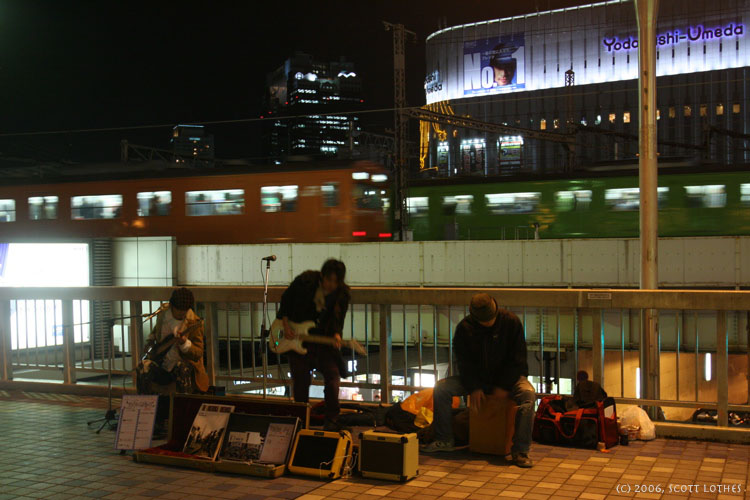
There, we stepped off the platform and into the rush of Osaka nightlife, where the neon glow, punk rock music and masses of people moving in every direction offered a stark contrast to refined, traditional, cultural Kyoto. Outside the station, a maze of overhead walkways carried pedestrians above the rush of traffic in the streets below. On these, photographers sold prints and postcards, musicians played guitars and sang, and bands – full bands – set up with speakers, amps and drum sets to jam with the rhythm of the surging traffic and the rush of commuter trains.

We could have spent the whole night taking it all in, but we had to find dinner and our overnight bus to Tokyo. There was no proper bus station, but rather a simple bus stop from which all the buses left, from inner-city circulators to the long distances night runs. Beside it, we found a newly opened Italian restaurant that filled us up for Y2000.

On board the bus, by far the cheapest way to travel between the Kansai region and Tokyo, we had the two seats located directly behind the driver, offering both a little extra legroom and a fabulous view of the night-lit city through the big front windows.

The next morning, we once again found ourselves at nothing you would really call a bus station. We were dumped on the sidewalk in the middle of downtown Tokyo at 6am, and expected to fend for ourselves from there. Luckily, we were only two blocks from the train station, where we stashed our bags in lockers, found breakfast, and caught a subway for Tsukiji (Skee-jee), home of the largest fish market in the world.

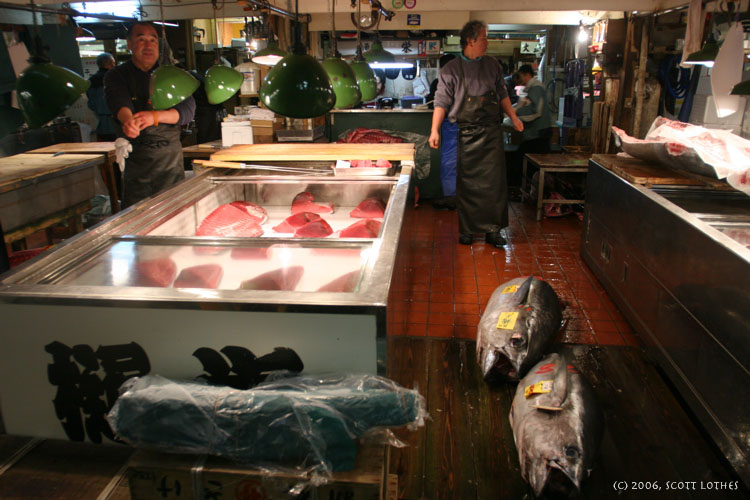
Nothing can really prepare the first-time visitor for Tsukiji, not even T.R. Reid’s wonderfully written short story “The Great Tokyo Fish Market” in the book TRAVELERS’ TALES GUIDES: JAPAN. You might expect to be led to the place from several blocks away (or turned away from it, as the case may be) by the pungent smell of rotting fish, but that isn’t the case at all. Fish doesn’t come to Tsukiji to rot. It comes to be sold, and delivered to the highest bidder on the double. It’s in and out so fast that it doesn’t have time to stink. And just how much of it passes through on a given day? Reid reported 5 million pounds, and from my observations, I have no reason to disagree with him. For you other rail enthusiasts out there, that’s 2500 tons, or 25 U.S.-sized refrigerated boxcars per day. Except it doesn’t move in boxcars. It moves on thousands of miniature forklifts through the packed, narrow aisles to be sold as individual fillets to the thousands of fish buyers wandering those narrow aisles and inspecting each catch. Behind them, in one of the hundreds of sellers’ booths, two men use a chainsaw to slice up the frozen carcass of a two-hundred pound tuna, while other fish, bigger than me, lay intact on the floors. Eels thrash about in small tanks beside others filled with snapping crabs and floating salmon eggs. Later that same night, it will all be served up, cooked or not, to so many thousand salarymen, tourists, families and students at Tokyo’s countless restaurants and sushi bars. The majority of the market of is open to the public, and it’s up to each individual visitor to stay out of the way. Maureen and I succeeded, sometimes barely, in doing so for thirty all-sensory stimulating minutes, then found our way back to the rest of the world, which, in truth, seemed very much removed from Tsukiji.

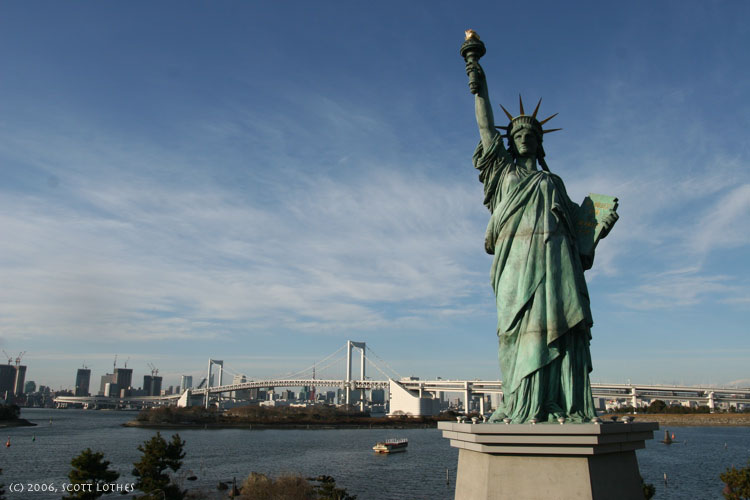
From there, we ventured to the western suburbs of Tokyo, where we visited the Ghibli (Gee-blee) Museum, dedicated to Japanese animator Hayao Miyazaki and the history of animation. From there we returned to downtown Tokyo and took a ride on the newly built Yurikamome tramline across the Rainbow Bridge spanning Tokyo Harbor. The trams are fully automated and run without a driver, allowing passengers in the first car a front-row view of the harbor and city. We walked along the waterfront, enjoying the mild weather and the Statue of Liberty look-alike, then headed back through downtown to find our hotel.

We had the train station and phone number for the hotel, but had failed to bring directions. We flagged a taxi and asked for the Toyoko Inn, but the driver seemed to have no idea what were talking about. We tried the next cab and were met with a similar result. At this point, we called the hotel. They did not speak enough English and we did not speak enough Japanese to get directions ourselves, but Maureen did succeed in getting the receptionist to direct the taxi driver. When the taxi dropped us off a few hundred meters down the street, we exited feeling very sheepish.

We hadn’t seen a bed in four nights, and pull of the big one in our room was nearly enough to keep us in for the evening. Eventually though, freshly showered, we struck out to find dinner with a view in the Tokyo night. We returned to the train station, by foot this time, and took a local train to Shinjuku, the next station and pulsating heart of Tokyo’s nightlife. Or, at least, supposedly the pulsating heart of Tokyo’s nightlife. The neon glittered from the train windows, but exiting to street level, we found streets that had largely packed up and gone home for the evening, even though it was only 8:30. Maybe we were in the wrong part of town. We found dinner, though, with a fine view from one of the many restaurants on the 29th and 30th floors of the NS Building, where we spied some salarymen in adjacent high-rises still going strong as 10:00 approached. Our restaurant served dinner up shabu-shabu style, which is a big pot of boiling broth placed on a gas burner in the middle of the table. We then got plates of raw meat and vegetables, which we added to the broth, cooked, and ate at our leisure. This, plus appetizers, dessert and drinks brought the bill to Y8675, or about $75US. Three days’ of all-inclusive travel in China.

We took a wrong turn going back to the train station and fearless navigator Scott failed to listen to the voice of reason walking beside him, beseeching him to retrace his steps to familiar territory. We finally arrived at the station of a private railway which we used to get back to the Japan Rail station, which we used to get us back to our hotel, though an hour or so later than we would have gotten back otherwise.

The next morning, we slept as late as our 10:00 checkout time would allow, then packed out bags and headed into a gray, overcast day.

“What do you want to do today?” I asked Mo.

“I dunno. What do you want to do?”

“I dunno.”

The previous morning, Tokyo held more wonders than we could ever hope to see in a month of two-day visits. One packed day later, our enthusiasm was in the gutter. We browsed a few department stores, laughing at the $100 shirts and $200 skirts. The highlight of the day was the attractive basement bar/café we stumbled into for lunch, where we received a filling bowl of curry rice, salad, dessert and tea for just Y750 each, or about $6.50US.

Downtown, the allure of the streets was no longer there. We looked at shrines and musems in the guidebook and had no interest in finding our way out to them. In the end, we decided to split up for an hour of solitude. I wandered the grounds of the Imperial Palace (built in 1888, rebuilt in 1968 after allied bombers blew up the first one), but was disappointed at the vast expanses of unused gravel parking lots in the middle of such an otherwise developed area. The palace is only open to the public on two days out of the year, January 2 and December 23. No doubt the parking lots are packed on those two days, but in the growing gray dusk of January 6, I would have much preferred a some green garden space.

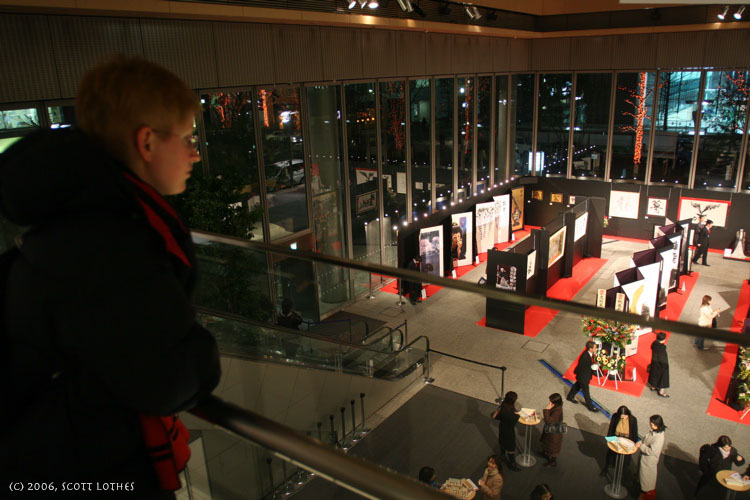
I found Mo back at the train station and she led me to a mall for dinner. Faced with another all night bus ride, this one to Hachinohe, a nine hour ride to the north, we both lamented not instead making the trip by train, today, in daylight, where we could have enjoyed seeing more of the country. But that decision was already made, and so we wandered through an art exhibit in the mall, sat talking on a quiet bench, and finally made our way to the bus station for another night of inadequate leg room and too little sleep. We once again had seats right behind the driver, but even the night view through the front windows departing Tokyo paled in comparison to Osaka, two nights before.

What we needed was rest, and we found it at Maria’s apartment in Hachinohe. Hachinohe is a Pacific Ocean port city of 100,000 in northern Honshu, and Maria was Maureen’s roommate during the JET orientation in Tokyo back in August. She was more than happy to house us for a relaxing weekend of resting, eating lots of good food, and watching anime, which included the excellent full-length movie Spirited Away, by Hayao Miyazaki.

On Monday morning, Maria gave us a very early ride to the Hachinohe ferry terminal, where we boarded a Rainbow Line ferry for the nine-hour voyage back to Muroran. We spent most of it sleeping on the carpeted floor of our second-class dorm room. We were glad to be back to Muroran, but our time at home was short. We were up early the next morning, Tuesday, for a trip to Sapporo where Maureen was attending a JET conference and other adventures awaited.

Monday, January 16, 2006

Kyoto, Part I

While talking to him over the holidays, my Uncle Mike told me that I was writing this blog faster than he could read it. I hope the last two weeks have given you all a chance to catch up (really, I just hope you're still with me). I'm trying to do a more detailed write-up of Maureen's and my trip to Kyoto and Tokyo during the first week of January. Today I finished the first installment. Hopefully the rest will follow in short order.

------------

The flight from Sapporo to Osaka is just under two hours, and there are six flights daily. We had specially-priced New Year’s Day tickets, offered to increase ridership on a holiday when most Japanese stay at home with their families. I was expecting to make the trip in a half-full, medium-sized airliner. Instead, we found ourselves in the middle of a crowded 747 (capacity: 416 passengers).

I still don’t enjoy air travel, but a 2-hour flight seemed a lot less daunting when my most recent previous experience had lasted 12-1/2 hours. The trip was also improved by the novelty of watching our take-off and landing on the cabin’s video screens, broadcast live from a nose-mounted camera. From my seat in the plane’s midsection, I could steal glances out the windows on either side of me, giving a three-way view as the golden-afternoon streets, waterways and buildings of Osaka rose to meet us on our final approach. Mo was sleeping, and witnessed our touchdown only because I woke her for it. Were the riders of the Revelation making their Apocalyptic trek across the sky while she was napping, I think Mo would need someone to wake her in time to hear the seventh trumpet blast.

There were no trumpet blasts when we landed in Osaka, and indeed, once the passengers of our flight had claimed their bags and dispersed, the airport was rather deserted. Outside the sun was shining in a clear, blue sky on a balmy (compared to Hokkaido) afternoon of 10 degrees Celius. I had read that the Kyoto eki (train station) offered good locations for photographing the myriad of arriving and departing locals, expresses and shinkansen (bullet trains). I was anxious to get there in time for sunset light, making me a little impatient while Mo stopped to get food and drink, and call the proprietor of our lodging in Kyoto. Then it turned out that getting from the Osaka airport to Kyoto was no straightforward matter. We had to take a monorail to a subway to the JR (Japan Rail) station where we could catch a train for Kyoto. Maybe I wouldn’t make it in time for sunset, afterall.

The monorail soared over the rooftops of several Osaka neighborhoods, offering the perfect way to take in both modern and traditional Japanese architecture from above. We exited into a warm, sun-drenched outdoor mall feeling very overdressed in our heavy winter coats and still wearing our long underwear. Beneath the mall we found the subway, and from it, the JR Shin-Osaka station where we bought Y540 tickets for the 40-minute ride by local train to Kyoto, passing up the Y1400 fare for the 15-minute ride by shinkansen.

As the sun dipped towards a layer of clouds near the western horizon, I finally gave up hope for a sunset in Kyoto. Determined to make the most of the situation, I joined two camera-wielding Japanese in photographing trains from the Shin-Osaka platform while Mo looked bemusedly on.

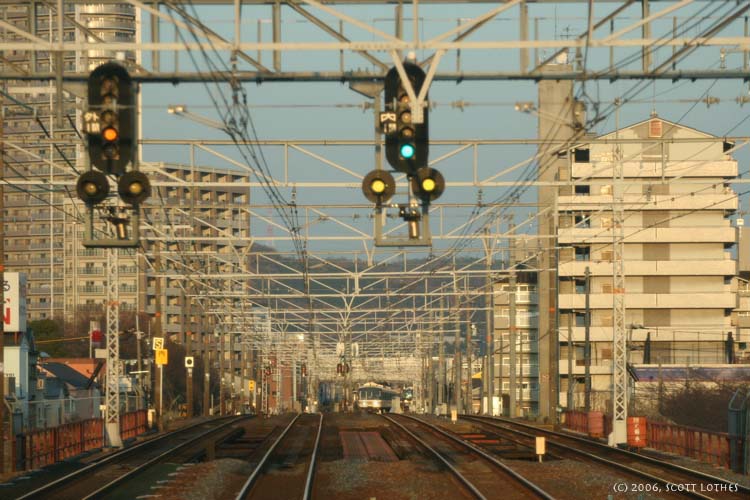
Our local pulled in and we climbed aboard the front car where a fabulous site awaited me. The driver’s compartment was partitioned off only by glass, offering a perfect view down the tracks before us through two immaculately clean windows. The minute hand of clock on the adjacent platform snapped forward to the time of our departure, the attendant blew his whistle, the doors closed, the driver notched back the throttle and we eased out of the station, quickly accelerating to 95 km/hr. Even though he was the only crewman on board, the driver meticulously pointed, with military precision, at every green signal and passing train as we sped down the four-track mainline. The overhead catenary poles, carrying the 1500 VDC that keep the trains moving, stretched out before us, glowing like a tunnel of silvery gold in the low sunlight. Expresses roared past on the outside track, while both locals and expresses flashed by in the opposite direction on the two right-hand tracks, one time two at once. Our route came parallel with the shinkansen line and I caught a glimpse of a white blur streaking between the gray concrete buildings. Nor was I the only passenger enthralled by the view out the front. Several other passengers, at intervals, stood by the windows to watch, including a mother with her two captivated children.

We exited the train into a basement level of Kyoto station that contained a shopping mall. An escalator brought us to another basement level, with more shopping mall. After stashing our bags in a locker, we took another escalator that finally brought us to the massive open-air lobby on the ground floor. Eleven stories above, black steel girders soared back and forth and curved across into the roof. Flights of stairs, with escalators, spanning the entire width of the lobby rose on either side as if reaching for the heavens. In truth, they extended to roof top gardens on the 11th floor. I never found the promised views of the tracks, though. There were some nice views of the city, but always through glass, limiting the photographic potential. I needn’t have rushed for that sunset shot.

Our explorations brought us into the ninth floor restaurant level of yet another shopping mall, still part of the station complex.

“Rah-mah-uhn.” Mo sounded out the kana characters above a ramen restaurant. “That place looks like it serves ramen, too,” she remarked as we continued down the floor’s central corridor. “And so does that one. I wonder if this is the ramen floor?”

On the bilingual mall map outside, we found the answer: “Ninth floor, ramen level.”

We both like ramen a great deal, but being in a large city and around lots of restaurants, thought it best to take advantage of the variety. And since we’ve already been in Asia for several months, taking advantage of the variety means looking for any food that isn’t Asian. We found an Italian restaurant specializing in pizza with a nice view on the 10th floor where we ordered Caesar salad and a pie for Y2140. The pizza came out piping hot, about as big around as what I’d call a “medium,” … and on a paper-thin crust. They weren’t exactly liberal with the toppings and sauce, either. It was gone in five minutes.

“See, if this was the U.S.,” Mo began, “that would have been our appetizer, and we’d now be waiting for the main course.”

“I was wondering when they were going to bring that out.” My stomach barely felt like I’d put anything in it.

“Well, while we are here, by golly,” Mo thumped the table for emphasis, “we are just going to look until we find good, cheap food that fills us up!” (that last bit said with a particular nod in my direction)

We found reinforcements in one of the basement malls, a French bakery chain called “Vie de France.” We picked out a “chicken dog” consisting of bread, chicken and lots of cheese, a bread pocket filled with spinach and cheese, and raisin bread filled with cream cheese. For balance, I added a cinnamon-sugar bun filled with sweet beans (no cheese). We paid Y736 and left the table satisfied.

“Sweetie,” I said, as we prepared to go, “I think you may want to append your earlier statement. We need to find good, cheap food that fills us up and won’t give us coronaries before we turn 30!”

It was dark. The sunset was long gone, we had explored the station from bottom to top and back to bottom, and now we were full and standing on the periphery of a shopping mall. I was completely out of reasons to keep Mo out of its stores. Shoulders drooping, I followed along as she led me from one rack of fuzzy, frilly sweaters to the next.

As she dragged me through the hordes of young women in miniskirts and knee-high, spike-heeled leather boots and salesladies beckoning customers with their shrill, ear splitting cries, a sobering thought flitted through my mind. I wondered whether she had the same feeling of bored uselessness when accompanying me on a photo shoot. When she held up another sweater, I tried to offer an honest opinion.

“The color is perfect for your complexion, but I don’t care for the way the neck is cut.”

A little later we find a good candidate, but Mo didn’t want to commit until seeing the offerings of a few other malls. She asked the saleswoman if the store can hold it until the next evening. A discussion ensued between the saleswoman and her manager. I couldn’t understand the words, but from the tone it sounded very much like they did not want to put any merchandise on hold. But this is Japan, and they finally agreed.

We were a few steps out of the store when the saleswoman came running up behind us.

“I didn’t give you the ‘hold’ slip.” She handed it to Mo.

We continued across the station and just finished buying tickets when she came running up again.

“I didn’t take down your phone number!”

Mo wrote it on a slip of paper and we headed for our train.

A budget trip to an expensive country like Japan, even in the backpacker-friendly city of Kyoto, naturally required lodging at Kyoto’s cheapest inn. We found just that at the aptly named “Kyoto Cheapest Inn.” For Y1200/night each, we got space on a tatami mat to roll out our own sleeping bags. By positioning myself diagonally on the mat from one corner to its opposite, I could just about stretch out. I didn’t complain, though. The Kyoto Cheapest Inn was just as it was advertised on its website, and included some welcomed amenities, like a shower with plenty of hot water from a nozzle that was actually high enough for me, a communal kitchen, internet access, and a wonderful deck on its 6th story roof where Mo and I sat talking long into the night.

My 7:00 alarm came much too early, so we switched it off and rolled back over for another hour and a half before waking to face a gray morning. We had purchased granola, hot cocoa mix and milk from a nearby “convenie” and so prepared breakfast in the ground floor kitchen, located in back of the garage. Another western couple sat down at the table while we were eating. They returned Mo’s welcoming smile with don’t-you-dare-speak-to-me scowls. Outside, the sky threatened of rain. At least doing our dishes provided some amusement, where a laminated sign on the wall beside the sink admonished that “The thing toweled after it washes it after you use it is necessary for it.”

Nijo-jo, one of the more impressive castles in Japan, was only a few blocks away, so we made it our first stop. The castle dates from 1603 and was built for Ieyasu, the first Tokugawa shogun. Supposedly, the buildings were constructed with specially designed squeaky floors to thwart intruders. We didn’t get to find out, though, as the interior palace buildings were closed for New Year’s, but we were still able to wander the castle grounds with lots of Japanese tourists for Y400 each. Something in the combination of being in the gray weather and among the crowds moving quickly along the marked path, snapping away with their digicams and cell phones, gave me the helpless, inadequate feeling of being just another tourist. That’s a feeling that I am neither comfortable with nor accustomed to. The most “touristy” thing I did in all my 82 days in China was to hike 10 kilometers over a gruelingly steep section of the Great Wall that I later learned was closed to the public. I had my camera, but in the glum weather and in this place visited daily by masses from the most photographic nation in the world, I had little hope of capturing any photos of lasting value.

In the middle of the castle we stopped in front of a map at an intersection of pathways. The steady stream of Japanese rolled on past us, across the bridge and into an inner courtyard directly in front of us.

“Let’s go see that garden over there,” Mo suggested, pointing to our right.

“But we’d be deviating from the prescribed path,” I replied in mock horror.

“That’s right!” She grinned.

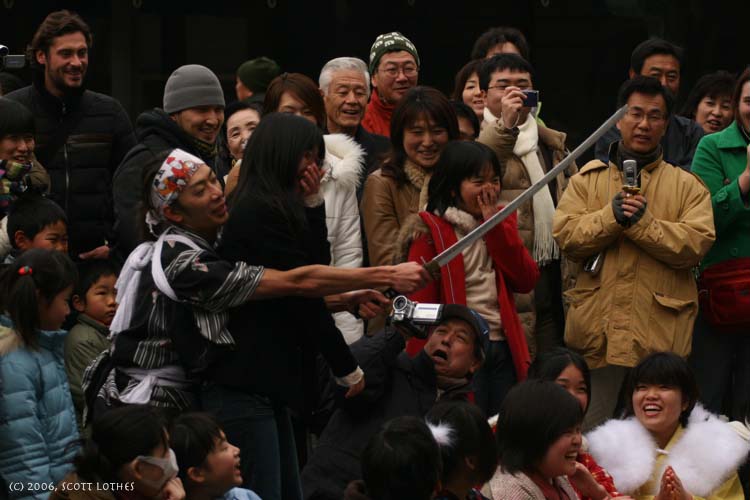
We toured the garden and doubled back to the main entrance, where we would begin a second circuit of the grounds. Our detour enabled us to catch the tail end of a sword fighting demonstration, complete with an audience hostage situation. I was able to laugh out loud and applaud with the rest of the crowd, finally realizing that I was no longer an intrepid, independent photojournalist covering the end of steam in remote China. I was a tourist, and I was on vacation, in Kyoto, with my fiancé, the woman I love.

A short subway ride brought us to Higashiyama, a neighborhood at the foot of the mountains on Kyoto’s eastern edge. We found lunch at a curry restaurant for Y750 each, but were disappointed we didn’t first find the food vendors at the street fair just beyond it. Until we saw their prices. Mo approached a stand offering roasted ears of corn on a stick and asked for one to share with me. She held out a couple 100-yen coins and inquired of the price. The vendor shook his head violently and said, “Go hyaku yen.” Y500. We walked away without any corn.

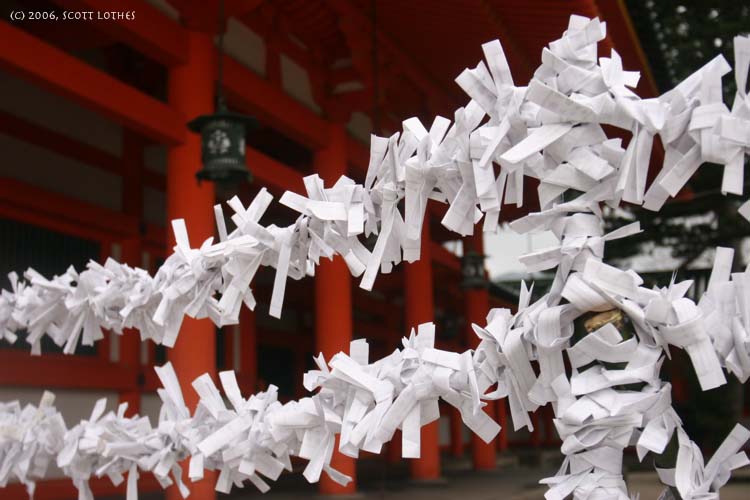
The street fair led us to Heian-jingu, a shrine of replica buildings built in 1895, based on architecture of the Heian period (A.D. 794-1195), to celebrate Kyoto’s 1100th anniversary. The spacious shrine grounds were swarming with tourists and Shinto worshippers, come to celebrate the New Year. They took photos, purified themselves at the fountain, took photos, cast small coins into boxes at the main offering hall, took photos, and tied omikuji, slips of paper with fortunes written on them, around every tree branch and railing in sight. And took photos. The omikuji are purchased, at random, from vendors selling them. Tying them to something at the shrine is supposed to make good fortunes come true and keep bad fortunes from happening.

Just beyond the gates of the shrine was a public park offering some quiet relief. We found an empty bench facing the distant, fog-shrouded mountains that form Kyoto’s eastern boundary. To them we looked, silently, while the unending tide of homage-payers flowed in and out behind us. It was in this already perfect moment that the sun found a gap in the broken, gray clouds and everything became a little warmer.

Mo rested her head on my shoulder while I held her close and rested my head on hers. “There’s no place in the world I’d rather be right now,” she told me.

Finally, and yet all too soon, we rose to leave. I consulted the map of the walking tour we had planned for the afternoon, which started from our current location. It ended, a few kilometers later, at a temple called Kiyomizu-dera.

“Kiyomizu-dera?” asked Mo excitedly. “I know that name! Several people told me it’s one of the best temples in Kyoto.”

“Well then, let’s go straight for it!”

In Kyoto it would seem that every building, every street, every grand gate and unassuming doorway calls to the independent traveler with an individually entreating voice. In a lifetime it would not be possible to heed each one. In three days, all but a very few must go ignored entirely. Roaming freely then, each turn, indeed, each step, becomes a decision of what sights will be seen, of which secrets will be discovered. . . . and which ones will never even enter the consciousness.

Many times in my life I have stepped forth into a new day with some plan or desire or specific goal in mind. Invariably, as that day unfolds the allure of the unexpected tempts me to stray from my chosen path. To acknowledge temptation is to invite uncertainty. Once cognizant of having made a decision, I can always wonder whether I made the best one. Woe then to the traveler wandering through Kyoto with the goal in mind of this temple or that shrine. To stay the course is to pass by the secrets of a thousand hidden gardens and ten thousand back alleys whose hanging lanterns glow a soft, inviting red in the blue dusk of evening. To give in to just one may require letting go entirely of the original goal.

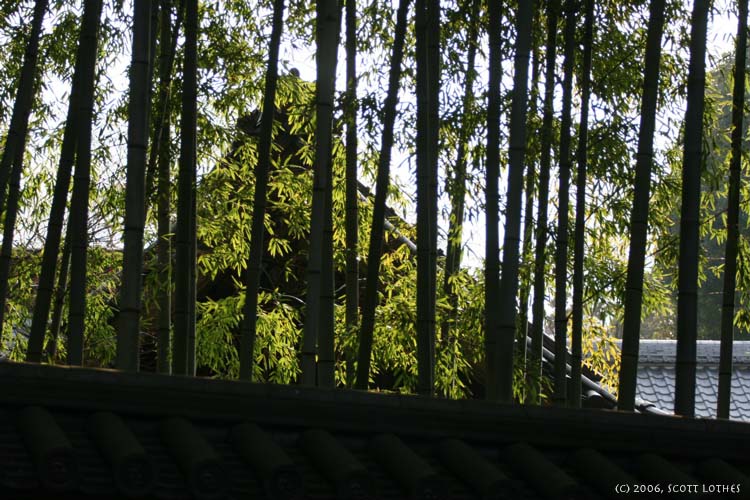
What was I to do then, when the warm light of late afternoon splashed yellow-gold across a bamboo grove and through the side gate of an unknown temple along our path to Kiyomizu-dera?

I stopped. “Mo, look at this.”

She kept walking, giving a quick glance over her shoulder. “Looks nice.”

“No,” I entreated. “Look at this.”

“Scott,” she said, turning and stopping. “It’s probably beautiful in there, but I’m sure Kiyomizu-dera is beautiful. It’s already getting late, and most places close at 4:00 or 4:30. I really want to see Kiyomizu-dera.”

Already across the street and starting up the steps I called back, “I do, too, but right now I really want to see this.”

“We’re in Kyoto,” she replied, getting a little huffy. “This city is full of beautiful, fascinating temples. We don’t have time to stop at all of them.”

She turned back and resumed walking. I re-crossed the street and joined her.

“I don’t like this,” I said. “I know we can’t stop everywhere, but I really need a little flexibility.”

“I need to use the bathroom,” she replied.

When she walked back out, her face was set. “Okay,” she said resolutely, “let’s go,” pointing not down the road, but across the street. I led her back to the narrow stone steps of the side entrance where the sun still danced between the bamboo trunks.

The original Chion-in temple was built in 1234. Kyoto was spared the heavy Allied bombing of the Second World War that leveled many Japanese cities, and so holds onto much of its history, indeed holds onto much of the history of Japan. But that hold is tenuous. Wood was the favored construction material in heavily-forested Japan and fires are unavoidable. Chion-in’s current buildings date from the 1600s. Nearly every historic site we visited in Kyoto included reconstructions of older buildings that had been destroyed by fire.

When we finished climbing the steep, winding, stone staircase of the side entrance, we knew none of that. We didn’t even know the name of the temple we had just entered, though it was beginning to dawn on us that we hadn’t taken the “main” entrance – very un-Japanese!

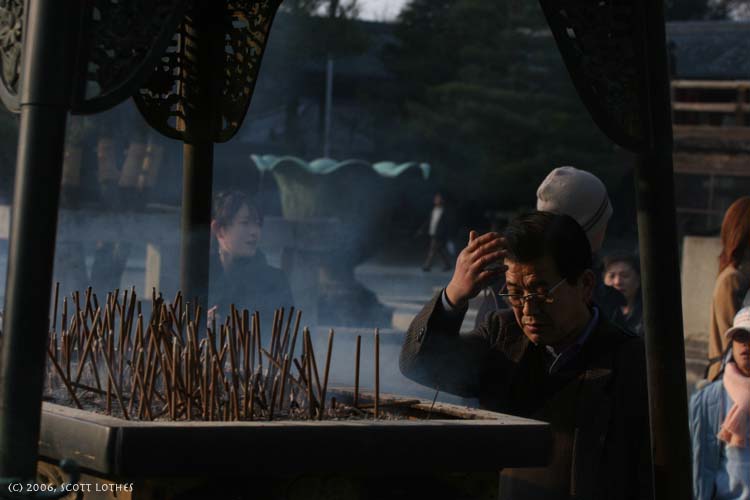
The sprawling grounds were crowded but not packed. We ducked under a low wooden overpass connecting the high porches of two buildings above the stone path and entered the main courtyard. Nearly all of the visitors were Japanese Buddhists, come to offer prayers and meditations for the New Year. Incense burned at small kiosks where they filed by, each pausing a moment to inhale the smoke before approaching the main hall. At the base of the steep wooden steps that surrounded the two-story building, they removed their shoes, ascended and entered the hall. While Mo set off for another building, I unlaced my hiking boots and joined the throng inside.

Despite the number of people and the commotion outside, it was reverently quiet in the main hall. Most filed in, knelt on tatami mats to pray and meditate, made offerings of small coins to the stone Buddhas, and filed back out. A few lingered in deeper thoughts along the outer walls. Beyond in the far side of the room, beyond a divider with several offering bins and statues, bald monks in long robes moved about in some manner of ceremony. I went back out onto the “porch” to encircle the hall in my sock feet and have a better look through the side windows.

As I sat on the bottom step putting on my shoes, I paused to consider what had just happened. I had passed through a holy place of worship at a special time of year. I was free to observe or even participate as I saw fit. Despite the Japanese fascination with order and group similarity, what I found inside was a very personal, individual religion. There were no songs or sayings to memorize or recite, no one giving instructions on when to stand or when to kneel, no one forcing people to leave or compelling them to stay. No one approached me about converting or handing me any pamphlets. In fact, no one paid much attention to me at all, one way or another. They were all engaged in their own prayers, meditations and offerings.

I found Mo across the courtyard in the temple’s gift shop. Nowhere, no where in Japan can we escape the postcards, handcrafts, souvenirs and sickeningly cute knick-knacks whose manufacture and trade must surely comprise a hefty portion of the national economy. At least at Chion-in there was only one gift shop, and it set far enough back from the rest of the grounds to be a strictly optional part of any tour or pilgrimage.

“I like being here right now,” I told Mo, “during New Year’s.”

“Why is that?”

“I imagine it’s one of the most crowded times of the year, but these crowds have a very participatory feel to them. We’re not here with a bunch of other tourists, but with people practicing their religion. These buildings are being used, and not merely viewed.”

“I can feel that, too.”

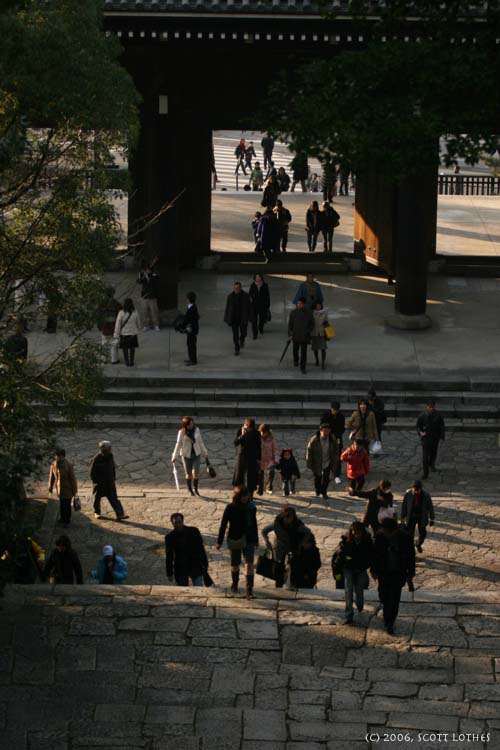
We wandered further into the grounds, beyond the main hall and away from the crowds. At every break in the trees, another set of steps led further up the hillside, one to a quiet garden, another to a small shrine, another to a cemetery, yet another to the nearly 400-year old cast bell, weighing in at 74 metric tonnes and requiring 17 monks to pound out the 108 rings that issue in each new year. We left with some of the grounds still unexplored, descending by the main staircase through the main entrance of the towering San-mon gate.

“I’m glad we stopped here,” I told Mo.

“So am I. I enjoyed this.” Then she added, “But tomorrow we have to see Kiyomizo-dera!”

“We can go there first thing.”

We returned to the carnival-like atmosphere of the street, passing the entrance to Maruyama-koen, a hillside park beside the temple that offered the prospect of some refuge from the crowds and possibly even a view to the west over Kyoto. I lingered by the entrance, but Mo pulled me onwards, through the vendors, across the swarming lines of traffic and down a steep alley that descended toward Kamo-gawa, the more eastern of two north-south rivers whose valleys Kyoto has sprawled out to fill. Near the river we found Gion, a place of entertainment packed with restaurants, dessert and coffee shops, bars, clubs and the traditional teahouses where Kyoto’s dwindling population of white-faced geisha and maiko (geisha-in-training) still perform. Early evening is supposedly a good time for catching glimpses of maiko rushing from one appointment to another, but with the late afternoon sun still shining, we decided we were a bit early.

I led Mo back to the entrance to Maruyama-koen that had drawn me earlier.

“I thought you wanted to go in here,” she said. “I guess this is my day to protest everything you want to do.”

“That’s okay, tomorrow can be my day to protest everything you want to do!”

Inside we found a quiet bench near a stream away from the crowds where we passed some peaceful moments. We were disturbed, however, at the discarded paper cups and wrappers accumulated in the stream and throughout much of the park. It was the first place in Japan I had seen much in the way of litter. Then Mo noted the scarcity of trashcans and recycling containers, and I realized that one of the reasons the litter was so noticeable was because it occurred in a few concentrated areas, rather than being scattered all about the park. Leave it to the Japanese to even be orderly in their littering.

“Since these vendors are only here for a few days a year,” postulated Mo, “maybe the city doesn’t want to detract from the park’s appearance with too many permanent garbage cans.”

“And maybe,” I returned, “picking up New Year’s litter is a good way to create jobs in a country with so many people.”

Back at the park entrance we joined a crowd gathered around a juggler. With the help of an assistant, the young man balanced on a plank on top of a ball on top of a table while juggling three flaming torches.

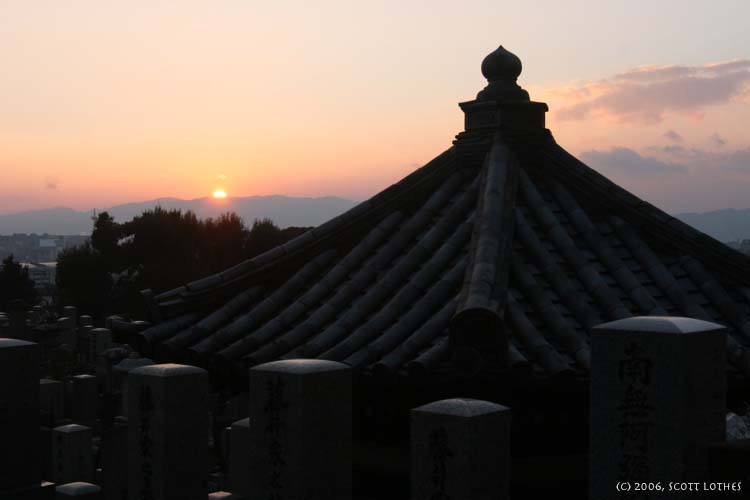
Beside the park I found a hillside cemetery that promised the view over Kyoto that we could not find in Maruyama-koen. The sun was dropping fast behind the distant mountains to the west, and I raced it up the steep stairs, camera at the ready, while Mo waited at the entrance, her energy flagging after a long day of walking. The race ended in a draw, but the view over the city was wonderful, even more so as the sky faded and the lights winked on in the buildings below.

Speakers were already announcing the cemetary’s imminent 5:00 closing when I found Mo on a bench by the entrance.

“I know you’re tired, but this is worth seeing.”

I took her tired hand and led her back up the stairs where we gazed together into the dawn of night.

Gion was picturesque side streets and quaint shops by day. By night, under the soft glow of ten thousand lanterns, it was a magical place where every alley, every turn seemed to hold a thousand secrets. Down the main streets the people rolled in a surge, and those side streets and back alleys filled like the moats of sandcastles in high tide. We were looking for a place to eat, but even more we were looking for the mysterious geisha and maiko. The number of geisha in modern Japan is rapidly declining. Wikipedia reports less than 1000 left in the entire country, down from more than 80,000 in the 1920s. The Lonely Planet indicates less than 200 geisha and maiko left in Kyoto. We would need quite a bit of luck to catch a glimpse of any among the flowing throngs in Gion’s darkening alleys.

“Where do you come from?” Mo turned in surprise toward the female voice beckoning her.

In front of a small restaurant in one of those alleys stood a woman trying to attract potential diners. She spoke a little English and, upon spotting us, gave into her curiosity and called out. I was used to that in China, but among the shy, tentative Japanese, it is quite rare. The woman spoke enough English and Maureen enough Japanese that they were able to chat for a few minutes. When Mo told her we were hoping to see a geisha, the woman’s expression turned to one of apology.

“They have yasumi (holiday) right now. Maybe in two or three days you can see them.”

“Yasumi! Ohhh, okay,” Maureen replied in disappointment. “We will only be here for two more days.”

She turned to me as we walked away. “Well, I’m disappointed, but I know from reading Memoirs of a Geisha that they work very hard. They deserve yasumi, too.”

“This is a perfect example of when I wished I could speak better Japanese,” she continued. “That lady really reached out to us. I wish so much that I could talk with her more.”

We found dinner in a corner ramen shop with red lanterns hanging on the awnings. At the table we studied the guidebook to plan our next day’s itinery and added up our expenses for the day.

“Not bad,” Mo said when I gave her the total. “We’re a little under budget. Want to have some chah-koah kay-key from that coffee shop we passed?”

We found a delicious looking piece of chocolate cake (chah-koah kay-key to the Japanese) in the display case for Y420. The price was a tad high considering the size, but seemed within reason. Mo ordered a piece for us to share.

“It is part of a set-o,” the woman at the register replied.

“A set?” Mo asked. “All we want is a piece of cake.”

“Oh, but it comes with coffee or tea,” the woman smiled.

“We’ll take tea, then,” Mo replied.

“Chah-koah kay-key set-o, 820 yen.”

With our cake (which was delicious, by the way), came a small cup of tea. We added cream and sugar to make sure we got all of our 400 yen’s worth. It tasted no better than the 10 oz. cans of milk tea (to which I am addicted) sold in the vending machines outside for Y120.