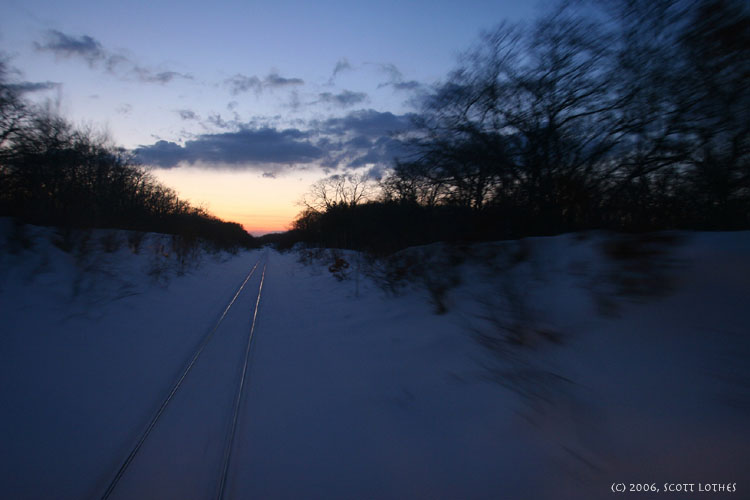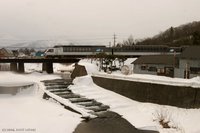
Before my visa status gets upgraded from "tourist" to "dependent alien" (at least I *think* that's an upgrade), I wanted to see as much of Hokkaido's railways as I could, via the Hokkaido Rail Pass, available only to foreigners on a temporary tourist visa. For Y18,000 (about $155), I got a 5-day pass good for travel on all JR trains in Hokkaido, which I used January 30 - February 3.
You can track my progress on this Hokkaido railway map:
http://www.bae.se/kitayama/01hokkaidomap.htm
Day 1: Minami-Chitose to Shintoku to Takikawa to Bibai (286.8 km)
Day 2: Bibai to Abashiri to Memanbetsu (359.8 km)
Day 3: Explorating along the coast east of Abashiri (155.9 km)
Day 4: Abashiri to Kushiro to Nemuro to Kushiro (363.6 km)
Day 5: Kushiro to Minami-Chitose to Tomakomai (385.1 km)
For the trip, I totaled 1551.2 kilometers. Purchased separately, those tickets would have cost Y40,750, so the rail pass was quite a good deal for me.
In terrain, I think Hokkaido most closely resembles some parts of New England. There are some broad, open valleys reminiscent of western New York, rugged mountains not unlike New Hampshire's Presidential Range, and rocky coastlines similar to Maine. The highest peaks top 2000m, with lots of 1000m+ peaks rising up quickly from sea level in the space of only a few kilometers. The highest mountains are located in the middle of the main part of Hokkaido, with ranges running north up the Wakkanai peninsula, south down the Samani peninsula, and northeast up the Shiretoko peninsula (northeast of Abashiri). The southeastern corner around Obihiro, Kushiro and Nemuro is primarily an open plain, with broad valleys, rolling hills and a few smaller mountains. The vegitation is mostly deciduous, with some conifers. Wildlife includes many, many birds, foxes, bear and lots of deer.
As a train-lover, I'm only just realizing how lucky I am to live in Muroran, which is only 5 km from the busiest railway line on the island, the Muroran mainline, which connects Sapporo to the rest of Japan via the Hakodate and Kaikyo Lines, the latter including the 51 km Seikan Tunnel under the Tsuruga Strait. There are lots of containerized freight trains (though only 12-20 cars long and single-stacked, as opposed to the mile long, double-stacked land ships that streak across America’s mainlines), as well as a few oil trains of solid tank cars. Most of the traffic, however, is passenger. There are 11 daily limited express trains in each direction between Sapporo and Hakodate – sleek, modern 7- and 8-car trainsets, some with tilting technology, enabling them to “lean into” curves and travel at higher speeds. There are puttering 1- and 2-car, self-propelled locals, 6-12 pairs daily depending on exact location. And there are the night trains, expresses with 9-12 car consists of beautiful, matched blue, green or silver sleeping cars linking Sapporo with Aomori, Tokyo and Osaka. Depending on the season, there are 3-5 pairs each day, most passing through in the early morning or late evening.
I have already seen much of the Muroran mainline in my travels around southwest Hokkaido with Maureen. I’m planning lots of photography once the weather improves (we seemed locked into a pattern of grubby, gray, overcast days right now), but for this trip I wanted to see some of Hokkaido’s remoter regions, and hopefully find a few places to revisit at some later point of our stay in Japan.
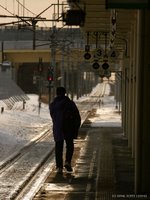
I woke early on Monday morning and caught the first express for Sapporo, went to the New Chitose Airport south of the city, and bought my pass. I immediately reserved a seat on the next eastbound express, a “Super Oozora” train bound for Kushiro in southeastern Hokkaido. Expresses and freights traveling between Sapporo and the southeastern corner of the island operate via the Sekisho Line, which was only completed in 1981. The Sekisho line, with its many long tunnels typical of 1970s Japanese railway construction, was a major upgrade over the twisting route over Karikachi Pass. Much of the pass was eliminated with the 6 km summit tunnel (which features a junction inside its western portal), but the line still traverses some scenic river valleys on its western approach, much of which is roughly paralleled by a new highway, parts of which are still under construction.
Following the summit tunnel, the line makes a big horsehoe curve as it drops downgrade to Shintoku and the long plains of eastern Hokkaido. There is a long concrete viaduct on the apex of the curve, but photographing trains on it would be a problem since most of it has metal wind fencing on both sides. Apparently the gails can really blow down from the mountains onto the eastern plains. The line is single track, and snowsheds are used to protect the siding switches. Despite these viewblocks, there are still some good-looking spots for photography and camping on this stretch, hopefully to be revisited in warmer months.
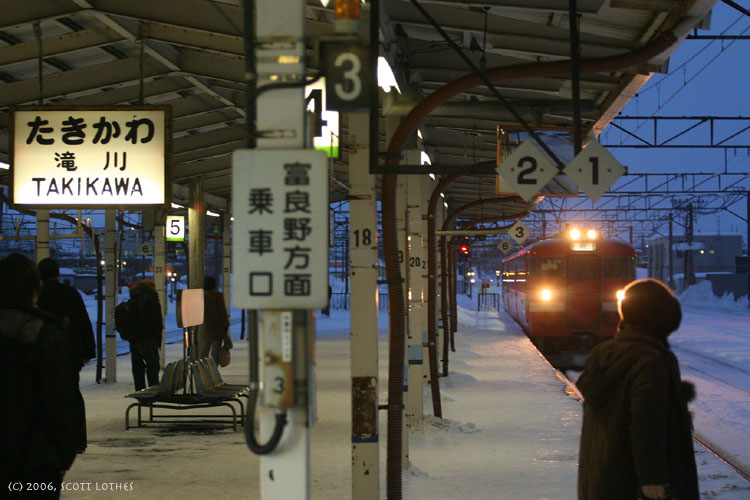
I disembarked at Shintoku, at the base of the mountain, where I walked around town and stumbled upon a lovely little restaurant and sushi bar offering up lunch sets of hot udon noodles and cold sushi for Y1000. In the early afternoon, I boarded a 1-car local train for a trip back up the mountain and through the summit tunnel, but this time taking the northern leg of the junction inside the tunnel for a ride through Furano to Takikawa.
The line up through Furano is quite scenic with lots of tight, Appachian-esque river valleys, plus a nice stretch along a lake and a long, open valley with high mountains on both sides. Traffic here is sketchy: I only confirm the 8 or so scheduled pairs of 1- and 2-car self-propelled locals, most lightly patronized, save for hordes of high school students inn the early mornings and late afternoons. My train didn't meet any freights, but there is an active container yard in Furano where I saw a couple of red diesels. Most of this line is jointed rail, as are most lines in Hokkaido. Interestingly, the Japanese (as well as the Chinese) seem to prefer parallel rail joints, rather than the U.S. practice of offset joint bars. I have since been told that this is to help deter the “hunting” or “snaking” motions often catalyzed by offset rail joints on long straight stretches. We really slammed over some of the rougher joints when the railcar got wound up to 80 or 90 km/h, but, in general, the trackwork is quite good.
Around Furano and northward, the valley opened up into a broad flood plain with high mountains on either side. Furano is famous for its skiing in the winter, and for its colorful burst of lavender wildflowers in June and July. I hope to experience both, starting with some skiing in March during a regional JET meeting held in Furano that Maureen will attend.
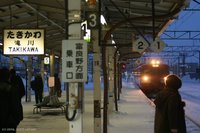
From Takikawa, I doubled back toward Sapporo, stopped for the night at Bibai. One of the many perks of Maureen being in the JET program is that I was able to arrange free lodging with other JETs across the island on every night of my trip. I spent the first night with Steve, his Japanese wife Erike, and their adorable 8-year-old daughter, Felicia. Steve is not actually a JET, but he teaches English at several junior high schools around Bibai and is very supportive of the JET program. I met him and his family just a day earlier at Maureen’s musical rehearsal in Hobetsu, where he immediately offered to house me for the night. We had yakitori (grilled chicken on wooden skewers) for dinner, a local specialty of both Bibai and Muroran. Steve told me that the two cities are both so proud of their yakitori, that they have each hosted a “grill-off” and taste test. Not surprisingly, the host city has won each of the two competitions.
I returned to the train station early the next morning for a long trip across northern Hokkaido to Abashiri on the cold Sea of Okhotsk, famous for its winter ice floes from Siberia. The morning run on the busy, electrified line to Asahikawa was primarily a straight shot through a broad valley. Development along the way reminded me of the rural eastern U.S. It certainly isn't as crowded as most anywhere in Honshu, Japan's main island, but it's not exactly the empty plains of Wyoming, either.
East of Asahikawa the topography got more interesting, but again, most of the line was paralleled by a new, partially finished expressway. The summit area around Kamikawa reminded me a little of western Montana, albeit without the spectacular rock formations of Glacier National Park. The landscape opened up more as we got close to Engaru, where the mainline makes a switchback. Engaru is in a broad valley and why there isn't a wye makes no sense to me, but the 5-car Okhotsk DMU expresses have cab cars at both ends, and the tail of the switchback is located in the station. The broad valleys here reminded me a lot of the area south of Elkins, WV along US 219. The expressway hasn't made it this far (yet?), which helped preserve a more rural feel. There's a nice "mini-pass" south of Engaru with lots of tight curves winding through a wooded valley. I really liked this area, too, and hope to come back in the summer or fall and do some lineside photography and camping.
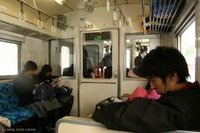
Just south of there, I took a walking and lunch break in the small town of Rubeshibe. I saw my first freight train of the day there -- 10 container flats with a red diesel (center cab DD51) on both ends. I'm not sure if the grades are steep enough to require a pusher, or if it's there to speed along the reverse move at Engaru. (I'd think simply swapping ends would be easy enough, though.) I continued to Abashiri via a 1-car local through more broad valleys and along the shores a large, frozen lake just outside of Abashiri.
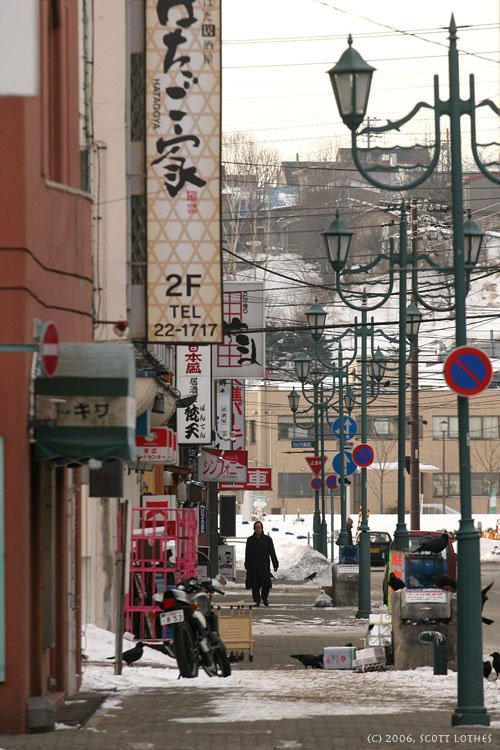
I went for a walk around town in the late afternoon, passing several groups of high school students on their way home. I smiled and said “hello,” and most smiled and returned my English greeting. One lad of 14 was even bold enough to ask, “How are you?” which led to a short conversation. He ended it rather abruptly, and I have to imagine we had been approaching the limits of his English comfort level. I was often guilty of the same in China. The girls are my favorites though. They steal quick glances with bashful eyes while approaching on the sidewalk. I say a cheeful “hello” as they draw near, they reply with timid “hair-rohs” as they pass, I count two seconds off in my brain, whereupon they burst into uncontrolled giggling.
I retraced my steps slightly to Memanbetsu, where I spent a relaxing night at Katie’s apartment. She had dinner ready when I walked in, then left me to read and check email in her warm living room while she played volleyball with a local adult recreation group. Even though we talked late into the night, she was still up at 6:30 for her morning run. When I asked if she had had any serious wipeouts on the slick ice and packed snow, she showed me the metal-covered straps on the bottoms of her sneakers, like snow tires for shoes. I was preparing to leave when she returned from her run, so we said a quick goodbye and I hurried off to the station.
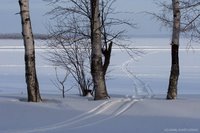
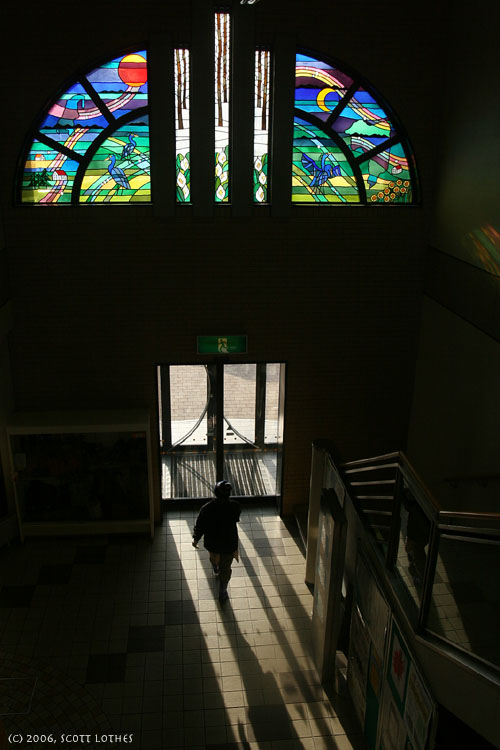
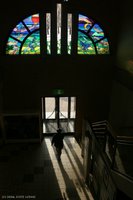
You can time the departure of Japanese trains down to the second, so I often cut it close. That morning, I cut it a little too close. My train was pulling out as I burst into the waiting room. Seeing my disappoint, a kind, elderly woman pointed out the schedule and showed me when the next train would be leaving. With over an hour to kill, I was a little disappointed at first, but then I decided to enjoy the morning sun and took a walk by the lake. When I got back to the station, the light was shining in through the stained glass windows. Those photos were my favorites of the day, and I never would have gotten them had I not missed my train.
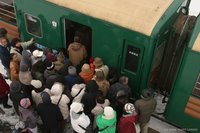
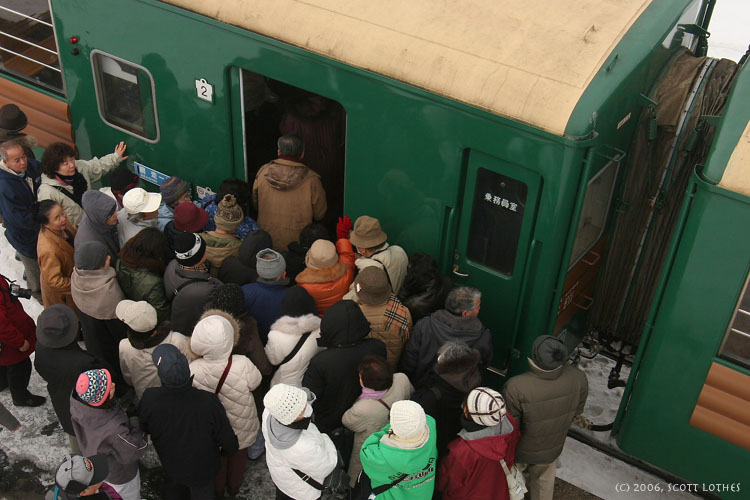
From there I returned to Abashiri and caught a Senmo Line local train along the Sea of Okhotsk. Unfortunately, the ice floes are temperamental and I missed seeing them, although I did see some drift ice. The tracks hug the shoreline and run along some rolling dunes with marshes to the south. Towering over all in the distance are the 1000m+ peaks of the Shiretoko peninsula. In addition to local trains, there is also the Norroko site-seeing train, 5 coaches with a small diesel that runs from late January to mid March. The local trains weren't crowded at all, except for high school kids at the beginning and end of their days. The Norroko train, however, was packed with Japanese tourists. I stuck to the locals.
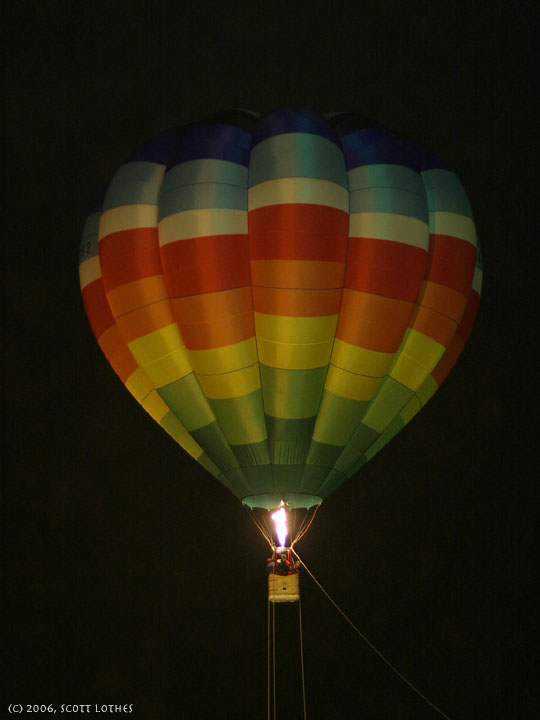
In the evening, I met James at the Mr. Donuts down the street from the Abashiri station. After three years in the JET program, he found a job as a private Assistant English Teacher in Abashiri, where he’s enjoying the many winter festivals and parties that Hokkaidoans hold to help get them through the colder months. Following a much-needed trip to an onsen, we explored Abashiri’s snow festival, held on the bank of the frozen lake. There were several snow sculptures, two ice slides for the young (and young at heart, like James and me), and a hot air balloon operated by a professor at the local agricultural university. James noticed what appeared to be ticket booth.
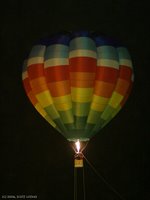
“1500 yen for a ride,” he told me. “Want to go? I’ve never been on a hot air balloon before.”
“Me neither,” I replied. “Let’s go!”
We crowded into the small basket with the professor and a Japanese passenger. The professor fired the burner, located so close to my head that I had to duck to keep from singing my hat. We floated 100 meters or so above the frozen field and lake, the lights of Abashiri glittering in the distance.
The next morning, James was kind enough to get up at 6:00 and give me a ride to the station for my 6:41 train, headed south towards Kushiro. The northern part of the line rolls through more broad valleys with high, distant mountains and lots of lineside sawmills (but no rail freight traffic that I could tell) before going over the drainage divide in the middle of the island, a stretch of tight curves in woodsy mountains with a summit tunnel in the middle. South of there, the line enters Kushiro Shitsugen National Park, rolling hills boarding a vast marshland famous for its wildlife, including stately black and white cranes, many other birds, and more deer than I could count.
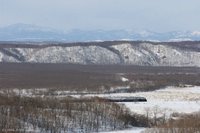
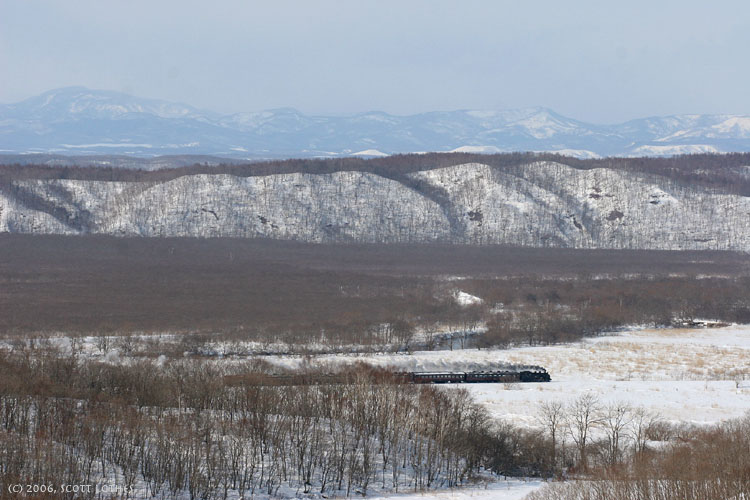
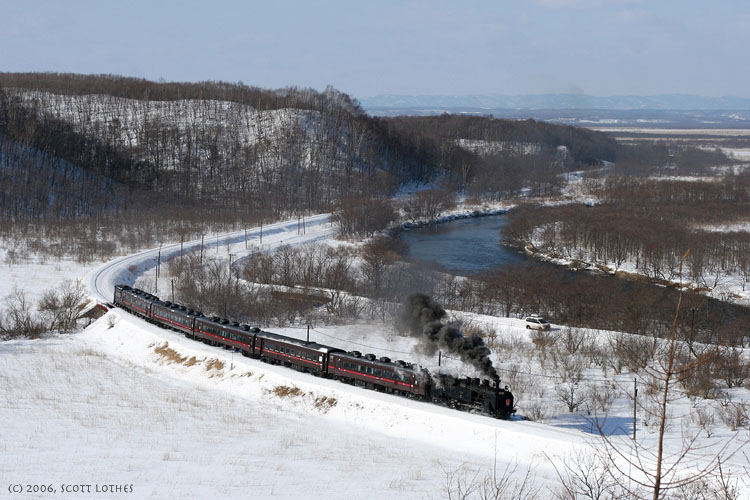
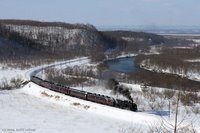
From late January to mid March, JR Hokkaido operates a steam train with one of their two preserved C11 2-6-4T locomotives, which hauls six cars from Kushiro to Shibecha every day. The clouds that had dogged me most of the week finally departed, so I disembarked in Toro for some photography. With the help of a Japanese photographer in the Toro station, I hiked to some nice overlooks and photographed the steam train in the snow-covered landscape. The Japaense love their trains and seem to have this tourism business figured pretty well, even running a double-header with both locomotives on the opening weekend. I'd never spent much time around tank engines before, but I must say, I rather like them. It's too bad there weren't more of them built in the U.S. -- they really are the perfect tourist train locomotive. Nice, deep whistles, too.
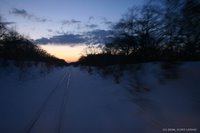
Afterwards, I hiked back to the Toro station and caught another local the rest of the way to Higashi-Kushiro, where I quickly changed to a local on the Nemuro branch for a trip to the far eastern reach of steel rails in Japan. After passing through a tight creek valley with some nice curves and three tunnels, the land opened up and we briefly touched the Pacific, before again turning inland up a lake and marsh. The last several kilometers into Nemuro were a heartbreakingly-beautiful stretch of running along the top of a gentle ridge through open farmland, the glittering Pacific again coming into view here and there through little creek canyons tumbling down to the sea. I'm sure the golden light of late afternoon helped tug at the heartstrings. We pulled right up beside the ocean for a short stretch, on a cliff 20-30m above the water. I had only 25 minutes to take a quick peak at Nemuro before I had to return to Kushiro, where I was spending the night. During the return trip, the driver noticed me taking photos of the sunset and motioned me up into the cab area for a better view.
Back in Kushiro, I met Caz, a first-year JET from the UK, at the station. She took me to a restaurant where we grilled our own meat on a gas burner in the middle of the table, then across the street to a large bookstore with an English-language section. Her apartment is part of a hotel complex, and she invited me to use the free onsen while she made a phone call. She was still on the phone when I returned, and the call being of a rather personal nature and her apartment being of a rather small nature, asked that I go next door to her friend Brooke’s apartment and promised to join me there as soon as she finished her call. Brooke is a second-year JET, also from the UK, and had just returned from an evening language class, so we hadn’t yet had the opportunity to meet. It was not without some trepidation that I knocked on her door.
“Hi. I’m Scott. I’m staying with Caz tonight and she asked me to come over while she finishes a phone call.”
Brooke looked understandably confused at first. “Oh.” Then she sorted out the details. “Oh, of course! She mentioned someone was staying with her tonight. Won’t you come in? I’ll put on some tea.”
Caz joined us presently and apologized profusely. We all had a good laugh about it and lots more tea.
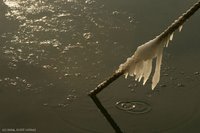
On my last day, Caz walked me into downtown Kushiro, showed me where I could along the waterfront, then went to meet her teacher for school. I strolled along the rows of fishing boats moored in the river, made my way back to the train station and returned to Toro where I again photographed the steam train in the marsh.
From there I returned to Kushiro, then proceeded by local train through more broad valleys, marshes and coastline to Obihiro, where I caught an express back to Minami-Chitose. I could have taken the express the whole way, but over the course of the week I found that I enjoy riding the locals a great deal more.
Visually, I prefer the longer, more streamlined expresses. The boxy locals aren’t much to look at or photograph. Cleveland has similar trains on its rapid transit line, which a friend appropriately dubbed “toasters,” since both look and sound like toasters on wheels. Here in Japan, though, compared to the expresses that fly through so much of the countryside without stopping, the locals feel much more intimate with the land and people around them. They stop at every station through all the small towns and countryside between the larger cities, ferrying commuters, shoppers and students alike, with a feeling not unlike a pre-Depression U.S. interurban railway line.
Unfortunately, like so many of those U.S. interurban lines that were abandoned during the 1930s and 40s, many of the local trains are losing money. The seating on most is in groups of four with two benches facing each other by a window. It was rare that I didn’t have all four seats of a cluster to myself. JR Hokkaido has been working to develop a dual mode vehicle that can travel on both railways and roads, literally a bus with railway wheels, in hopes of providing more financially feasible public transportation to its rural areas. The first units are scheduled to be placed into service later this year.
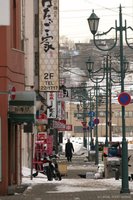
Hokkaido was once a great coal-producing region, but Japan now imports less expensive coal from Australia and China, so the mines have closed, many branchlines have been removed and lots of the smaller cities and towns in Hokkaido are declining. In some ways it reminds me of Appalachia, although here at least there is the nearby big city of Sapporo to take refuge and start over. I've been told Sapporo is the fastest growing city in Japan (at 1.9 million, it is currently the fifth largest). Still, smaller cities like Muroran and Kushiro have streets of closed-up, run down buildings and empty apartments. Ridership is decreasing on most railway lines, and even as the population of Hokkaido continues declining, new expressways, like the ones I passed on my first two days of travel, continue their expansion across the island, and boatloads of new Toyotas pull into the Tomakomai port every few days.
There are multiple reasons for the declining population here. The birthrate is declining, so the population is not being replaced as quickly as it is naturally dying. With the closure of the coalmines, the island lacks a strong, primary industry. There still exist the modest industries of agriculture, forest products and fishing, and the southwest region includes a steel mill, oil refinery and cement plant in Muroran, plus active port facilities in several cities, but they are not sufficient for complete sustainability, not to speak of growth potential. For the high school students that Maureen and the other JETs visit, those who can will flee to Sapporo or Honshu, while the rest have little to look forward to in employment prospects beyond the view behind the counter at a convenie or grocery store.