At the end of lunch today, Maureen directed my attention to the top of the microwave, where sat two small packages containing Japanese desserts. She opened hers to reveal two small pancakes pressed around a sweet bean filling (a common delicacy here). I opened my package to reveal: another package.
Japan, it would seem, is a country addicted to packaging. Walk into any convenience store and order a single dumpling. The dumpling is plucked from its heated case on a piece of heavy paper. It is then placed on another sheet of paper big enough to cover it at least three times. Wrapped and taped, this package is dropped inside a small, plastic dumpling bag, which is then placed inside a larger plastic shopping bag, along with the receipt and a big “Arigato gozaimas” from the clerk. This all happens very, very fast, and too quickly to do anything about it unless you remember to shout “Ie desu, ie desu!” (It’s okay!) at the top of your lungs immediately upon asking for the dumpling.
Since I’m slow and rarely remember to shout “Ie desu!” in time, I often find myself in the parking lot eating a dumpling that had already grown cold by the time I finished unwrapping it and trying to stuff a wad of packaging with a total land mass only slightly smaller than Rhode Island into the nearest garbage can. A few such episodes can do wonders for raising the level of one’s environmental consciousness.
After lunch today (this started with lunch, remember?), I stepped back into my boots and waded back into the muck in the bathing room. In a moment completely lacking in foresight for my own well-being, I had given Maureen an I-O-U to clean the bathing room as a Christmas present. Today was the day to put my money, or, rather, my mop, where my mouth had so foolishly been.
However, my sweet wife is not without sympathy, and knowing that misery loves company, she spent the day cleaning up her papers littering one of our two currently unused tatami rooms. With the temperatures growing ever so slightly less cold, and with the help of a small space heater, the idea is to move the desk and computer into this room so I can have my own space to write. I’ve become so excited by the idea that it’s given me a brief craving for organization. Striking while the iron was hot, Maureen encouraged me to go to the store and get a bookshelf and plastic filing cabinet as soon as I finished in the bathing room.
I caught the 4:37 local train to Higashi-Muroran and setoff through the slushy streets and icy sidewalks for the stores. Maureen had suggested Second City, a recycle shop selling used everything, from clothing to cameras to filing cabinets. Japan is an absolute goldmine for used merchandise. The dwellings are small, the basements non-existent, and the storage space incredibly limited. Whenever almost any household item is replaced in Japan, it either goes out with the trash or off to the recycle shop.
You might think the recycle shops would be easy to find, but they aren’t. Second City is located in a far corner of the shopping district, in back of and dwarfed by the big-box Home Amenity Center. But I found it, and along the back wall I found a bookshelf. It was nearly as tall as me and almost twice as wide. It wobbled and swayed back and forth, but for only Y1980 (about $18US), I was tempted. Until I picked it up. There was absolutely no way I was carrying this bookshelf the kilometer back to the station, taking it on the train with me back to Muroran, and then lugging it another kilometer up the hill to our apartment. Next to the bookshelf was a much sturdier shelf. It was also even larger – and heavier. Beside it was a similar model with glass doors. Neither cost more than $40US. Neither were going anywhere without anything short of a minivan. A couple of Maureen’s fellow English teachers here own cars, but they’re small cars, their owners are away skiing for the weekend, and besides, we already feel like we impose too often for rides. We came to Japan planning to get by without a car, but times like this leave me wondering. Frustrated, I walked outside to the Big Box.
Inside the Home Amenity Center (Homac), I found dozens of particle-board, wood-laminate bookshelves (some assembly required). I picked out a small one for Y998 in a box that I could easily carry under one arm. I also found a small, plastic, three-drawer filing cabinet for Y780. These I took to the checkout area, where three cash registers were opened and none of the lines were moving very fast. While waiting, I looked at my bookshelf. It wasn’t quite what I wanted. Not enough shelves, too deep and not wide enough. Then, as if for the first time, I noticed the cardboard box that it was in, the plastic wrapped around the cardboard, and the plastic wrapped around the filing cabinet. And I thought about stuffing them all into the dumpster on Tuesday when the trash is collected. I left my place in line and returned them to their shelves. Dumplings can do that to you.
Back at Second City, I saw that no new bookshelves had arrived while I had been away. However, I noticed a large plastic filing cabinet that hadn’t caught my eye before. It was fully assembled, five drawers high, lightweight, sturdy, in perfect condition and without a scrap of packaging. It wasn’t exactly what I was looking for, either, but my books and papers will fit in it. I paid my Y1580 and carried it back to the station, just in time to catch the 6:15.
Saturday, March 04, 2006


Thursday, March 02, 2006
Liberty
Wednesday, March 1st was graduation day in Japan. At 10:00 in the morning, every 3rd year high school student in the country graduated. Maureen was able to arrange going to the ceremony at Tomakomai Nishi and invited me to join her.
At the school's entrance, we were warmly welcomed by a smiling man in a dark business suit and white sneakers. In fact, nearly all of the staff was wearing either sneakers or sandals with their suits and dresses, even on graduation day. Everyone wears their dress shoes to work, then changes at the entrance into more comfortable indoor shoes. Only the school's principal, who handed out diplomas wearing a tuxedo jacket with tails, sported shiny black wingtips.
Upstairs, students were moving about the halls under a festive air, girls walking arm in arm and boys smiling and congratulating each other. All of them wore their school uniforms, black sailor suits with short skirts for the girls (bare legs, even with snow outside), and high, brass buttoned black jackets and trousers for the boys, a style inspired by 19th century Persian military dress and virtually unchanged since then. Except for the shoes. Both genders wore the same white Asics sneakers that they wear everyday once inside the school building. Only the single red rose pinned on their chests distinguished the matriculating class from the younger students.
One of the girls who we had both met before spotted us and came running up.
"Thank you so much for coming," she beamed.
"Congratulations! Are you excited?" we asked.
"Yes, yes!" she nodded.
"And a little sad, too?" Maureen wondered.
"Sad? No, I'm not sad at all. Today I gain liberty, freedom."
The temperature of our reception dropped a few degrees from there. We next met with one of the English teachers that Maureen assists, a nervous young woman who seemed to have no idea what to do with me.
"We could sit with the teachers," she said to Maureen, "but he," pointing to me as if was an object rather than the a person, "is not a teacher." I took this to mean, "unfortunately, the gymnasium does not have a hole big enough for him to crawl into, so I'll have to think of something else to do with him." The looks I got from her and the other teachers had me wishing that they did have a hole, or at least that I could become invisible for the next couple hours.
In the end, we sat with the teachers. I shared my feelings with Mo, who helped put the situation in perspective.
"They don't know what to do with you. We're the exceptions here, and they'll just have to deal with it."
The band started playing promptly at 9:50. The graduating students entered by homeroom class, each class led by its teacher. Students keep the same homeroom teacher (who also serves as advisor and mentor) for all three years of high school. It's a good system when everyone gets along, but extremely trying when personalities do not mesh well. The band finished playing at the same instant the last student arrived at his seat. All students, both graduating and non, sat in straight-backed wooden chairs, while teachers and visits had padded folding chairs.
Awarding of diplomas began immediately. Each homeroom teacher went to the microphone for his or her class and read each name. The student, up on stage, responded with "Hai!", then approached the podium, bowed to the principal who bowed back and presented the diploma, holding it out with two hands. The student took it with both hands, then shook right hands with the principal, stepped back, exchanged bows, and returned to his or her seat as the next name was read. The audience applauded for the first student, then remained silent. A few students varied the pitch of their "Hai's" enough to get a laugh from the student body, and the biggest laugh of all came when one spiky-haired boys answered "Yes!" at the reading of his name. He got a few more laughs when he struck a double-hands-the-shape-six-shooters pose at the end of the stage.
As the last student received his diploma, the principal stopped and read the contents of the diploma, then the student returned to his seat like everyone else. No one applauded after the last name was read. Three of the older male faculty gave short speeches, then the student body president (a second-year student) gave the farewell address to the third years. One girl was award a certificate for perfect attendance, and one graduating student made a short speech. The band played "Auld Lang Sine," then all the first and second year students lined up along the center aisle.
The tension seemed to flow out of the room and I could feel everyone breath a collective exhale. I was ready for tossing of caps, shouts of jubilation, raucous applause and all the celebration I associate with the American idea of gaining liberty. What I got was a pop song played at medium volume over the PA system with the audience reservedly clapping in time while the graduates filed out, quietly shaking hands and accepting congrats from their classmates.
When they had gone, the band returned to their seats, everyone sat, then got back up and filed ordely out, the students taking their wooden straight-backed chairs with them. Back in the teachers' office, graduates came in two or three at time with yearbooks for their teachers to sing (price: Y7000 each) and bearing gifts for their homeroom teachers -- graduates in Japan give gifts instead of receiving them. They left the building slowly, to go off and have lunch and go on with their days while the first and second year students returned to their classes.
The student that Maureen and I had spoken with earlier returned, and Maureen gave her the brownies she had baked for her the night before. She thanked us again, and told us about her plans to go to Tokyo and working a restaurant/bar. College was not part of the picture for her. Later that night she would attend her weekly English class -- not a graduation party.
Afterwards, we went to lunch with another of the teachers Maureen works with. Hiromi Goto and her husband Fuyuki are an incredibly well-traveled couple whose English is first-rate and whose hospitality is limitless. On the way to lunch, we asked Hiromi what the other students would do now that exams were over and the graduates were gone.
"Break doesn't start for three more weeks," she explained.
"But now they don't get tested on anything else, right?" Maureen asked. "You're just teaching to teach?"
"Yes, just teaching to teach them, to entertain them, to occupy them."
"What did you think of a Japanese graduation?" she asked us.
"Very quiet," was all we could think to respond.
At the school's entrance, we were warmly welcomed by a smiling man in a dark business suit and white sneakers. In fact, nearly all of the staff was wearing either sneakers or sandals with their suits and dresses, even on graduation day. Everyone wears their dress shoes to work, then changes at the entrance into more comfortable indoor shoes. Only the school's principal, who handed out diplomas wearing a tuxedo jacket with tails, sported shiny black wingtips.
Upstairs, students were moving about the halls under a festive air, girls walking arm in arm and boys smiling and congratulating each other. All of them wore their school uniforms, black sailor suits with short skirts for the girls (bare legs, even with snow outside), and high, brass buttoned black jackets and trousers for the boys, a style inspired by 19th century Persian military dress and virtually unchanged since then. Except for the shoes. Both genders wore the same white Asics sneakers that they wear everyday once inside the school building. Only the single red rose pinned on their chests distinguished the matriculating class from the younger students.
One of the girls who we had both met before spotted us and came running up.
"Thank you so much for coming," she beamed.
"Congratulations! Are you excited?" we asked.
"Yes, yes!" she nodded.
"And a little sad, too?" Maureen wondered.
"Sad? No, I'm not sad at all. Today I gain liberty, freedom."
The temperature of our reception dropped a few degrees from there. We next met with one of the English teachers that Maureen assists, a nervous young woman who seemed to have no idea what to do with me.
"We could sit with the teachers," she said to Maureen, "but he," pointing to me as if was an object rather than the a person, "is not a teacher." I took this to mean, "unfortunately, the gymnasium does not have a hole big enough for him to crawl into, so I'll have to think of something else to do with him." The looks I got from her and the other teachers had me wishing that they did have a hole, or at least that I could become invisible for the next couple hours.
In the end, we sat with the teachers. I shared my feelings with Mo, who helped put the situation in perspective.
"They don't know what to do with you. We're the exceptions here, and they'll just have to deal with it."
The band started playing promptly at 9:50. The graduating students entered by homeroom class, each class led by its teacher. Students keep the same homeroom teacher (who also serves as advisor and mentor) for all three years of high school. It's a good system when everyone gets along, but extremely trying when personalities do not mesh well. The band finished playing at the same instant the last student arrived at his seat. All students, both graduating and non, sat in straight-backed wooden chairs, while teachers and visits had padded folding chairs.
Awarding of diplomas began immediately. Each homeroom teacher went to the microphone for his or her class and read each name. The student, up on stage, responded with "Hai!", then approached the podium, bowed to the principal who bowed back and presented the diploma, holding it out with two hands. The student took it with both hands, then shook right hands with the principal, stepped back, exchanged bows, and returned to his or her seat as the next name was read. The audience applauded for the first student, then remained silent. A few students varied the pitch of their "Hai's" enough to get a laugh from the student body, and the biggest laugh of all came when one spiky-haired boys answered "Yes!" at the reading of his name. He got a few more laughs when he struck a double-hands-the-shape-six-shooters pose at the end of the stage.
As the last student received his diploma, the principal stopped and read the contents of the diploma, then the student returned to his seat like everyone else. No one applauded after the last name was read. Three of the older male faculty gave short speeches, then the student body president (a second-year student) gave the farewell address to the third years. One girl was award a certificate for perfect attendance, and one graduating student made a short speech. The band played "Auld Lang Sine," then all the first and second year students lined up along the center aisle.
The tension seemed to flow out of the room and I could feel everyone breath a collective exhale. I was ready for tossing of caps, shouts of jubilation, raucous applause and all the celebration I associate with the American idea of gaining liberty. What I got was a pop song played at medium volume over the PA system with the audience reservedly clapping in time while the graduates filed out, quietly shaking hands and accepting congrats from their classmates.
When they had gone, the band returned to their seats, everyone sat, then got back up and filed ordely out, the students taking their wooden straight-backed chairs with them. Back in the teachers' office, graduates came in two or three at time with yearbooks for their teachers to sing (price: Y7000 each) and bearing gifts for their homeroom teachers -- graduates in Japan give gifts instead of receiving them. They left the building slowly, to go off and have lunch and go on with their days while the first and second year students returned to their classes.
The student that Maureen and I had spoken with earlier returned, and Maureen gave her the brownies she had baked for her the night before. She thanked us again, and told us about her plans to go to Tokyo and working a restaurant/bar. College was not part of the picture for her. Later that night she would attend her weekly English class -- not a graduation party.
Afterwards, we went to lunch with another of the teachers Maureen works with. Hiromi Goto and her husband Fuyuki are an incredibly well-traveled couple whose English is first-rate and whose hospitality is limitless. On the way to lunch, we asked Hiromi what the other students would do now that exams were over and the graduates were gone.
"Break doesn't start for three more weeks," she explained.
"But now they don't get tested on anything else, right?" Maureen asked. "You're just teaching to teach?"
"Yes, just teaching to teach them, to entertain them, to occupy them."
"What did you think of a Japanese graduation?" she asked us.
"Very quiet," was all we could think to respond.
Monday, February 27, 2006
One for our Families
On her visits to one of Muroran's high schools, Maureen often teaches with Usami-Sensei. Usami-Sensei is a tiny woman and a big pillar of internationalization in Muroran. She runs the International Center and eagerly opens her home to dinners with foreign residents and students. I've already visited her twice. When we told her we were getting married here, her eyes lit up with a forming plan.
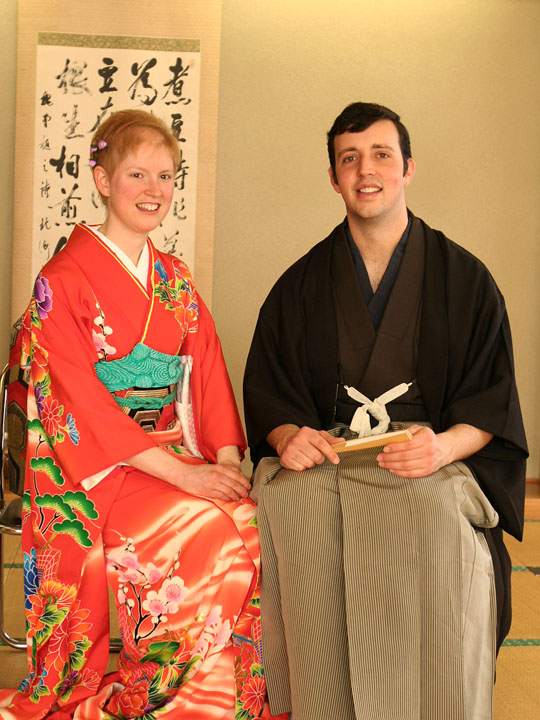
"In Februry," she told us, "there is a kimono party in Muroran. You can come, try on kimonos and get your pictures taken.
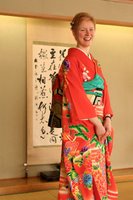
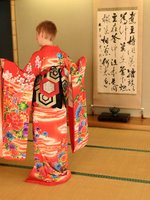
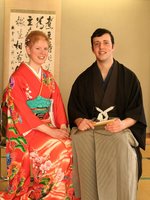
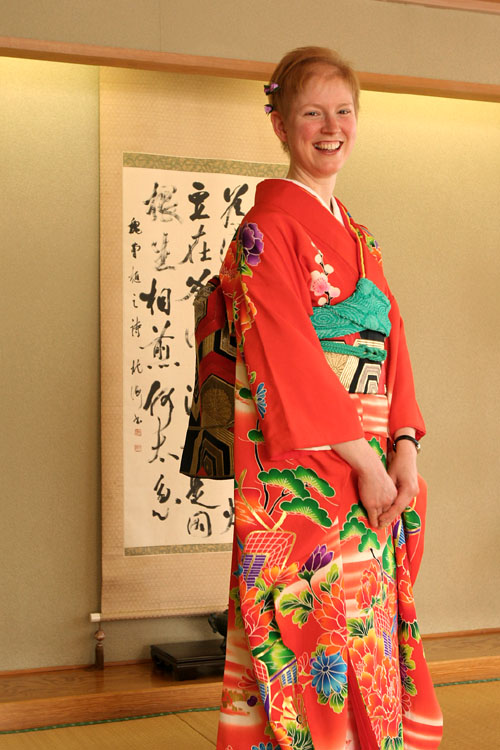
And that's just what we did on Saturday. It was the first time for both of us to have three people helping us get dressed. It was necessary for Maureen's traditional women's kimono. In my case, wearing a men's samurai-style kimono, I could have probably gotten by with just the help of one person, but it took three to adequately express their collective amazement at just how much "too big" I was for anything they had. The largest toe socks were two sizes too small, but I squeezed into them, anyway. The skirts were supposed to extend to the floor, but hung several centimeters too short.
In the front, around my waist, one of the women tied a traditional, very symbolic knot in the shape of the number 10, a cross with arms of equal length. It took her three times to get it right, with many apologies for not having done it since last year. In between, she tried to explain its symbolism, but always stopped short of out-right saying it stands for male virality, which is certainly my guess given its placement, her vagueness, and 10's being a traditional representative for large numbers.
We took lots of photos, then de-robed and watched as international students from Muroran Institute of Technology followed suite (or is that suit?). Afterwards, we spread low tables on the tatami floor and stuffed ourselves on Japanese rice balls, Chinese dumplings, Sri Lanka curry and American pizza.

"In Februry," she told us, "there is a kimono party in Muroran. You can come, try on kimonos and get your pictures taken.
And that's just what we did on Saturday. It was the first time for both of us to have three people helping us get dressed. It was necessary for Maureen's traditional women's kimono. In my case, wearing a men's samurai-style kimono, I could have probably gotten by with just the help of one person, but it took three to adequately express their collective amazement at just how much "too big" I was for anything they had. The largest toe socks were two sizes too small, but I squeezed into them, anyway. The skirts were supposed to extend to the floor, but hung several centimeters too short.
In the front, around my waist, one of the women tied a traditional, very symbolic knot in the shape of the number 10, a cross with arms of equal length. It took her three times to get it right, with many apologies for not having done it since last year. In between, she tried to explain its symbolism, but always stopped short of out-right saying it stands for male virality, which is certainly my guess given its placement, her vagueness, and 10's being a traditional representative for large numbers.
We took lots of photos, then de-robed and watched as international students from Muroran Institute of Technology followed suite (or is that suit?). Afterwards, we spread low tables on the tatami floor and stuffed ourselves on Japanese rice balls, Chinese dumplings, Sri Lanka curry and American pizza.


Swimming, Revisited
Maureen and I went back to the pool last night. We've been going once or twice a week since our first visit, and can now finally make it through the front doors and back out again without being corrected for any glaring social blunders. On every visit, we've noticed a skeleton of a woman working out in the pool and soaking in the hottub. Maureen is careful not to talk about her publicly, even in English.
"You never know who might understand what you're saying here," she cautions me.
Still, we're intrigued by this woman. What has made the flesh on her limbs shrivel back to the bone? What drives her to come to the pool? Is the exercise painful? Can she see any improvements? She has a story, and we'd love to know it.
Last night, I was standing beside her in one end of the pool while we both rested between laps. She turned and started talking to me in Japanese. I was in the process of trying to tell her that I didn't speak much Japanese when she switched to English.
I can't emphasize enough just how common that is here. We can struggling mightily to get directions in Japanese from someone, and just when all hope seems lost, they switch gears and try again in English. And it doesn't take very much English abilitiy at all to be orders of magnitude better than my Japanese. But most people here wouldn't try that first.
In fact, most people here wouldn't try anything first. This was our fourth or fifth visit to the pool, where we've seen many of the same faces each time, and this woman was only the second other swimmer who has spoken to us. The big guy in the walking lanes gives us a wide berth and the woman who cuts the water like a knife with her perfect strokes avoids our glance altogether. It's the bone-thin woman who must be used to people's stares who finally gets up the nerve to make the first move.
She studied at New York University and reads the NY TIMES in English every day, but her English speaking opportunities are very limited. She wants more, though. She'd like to go back to New York, and see lower Manhatten without the Twin Towers. As she struggles to find the right verb ending, I can see the frustration and embarrassment on her face. I smile and nod and encourage her to keep trying.
"You come here often, don't you?" I ask.
"Almost every day." After a pause, she adds, "Is it okay if I speak English to you when I see you here?"
"Of course! Of course it is."
"You never know who might understand what you're saying here," she cautions me.
Still, we're intrigued by this woman. What has made the flesh on her limbs shrivel back to the bone? What drives her to come to the pool? Is the exercise painful? Can she see any improvements? She has a story, and we'd love to know it.
Last night, I was standing beside her in one end of the pool while we both rested between laps. She turned and started talking to me in Japanese. I was in the process of trying to tell her that I didn't speak much Japanese when she switched to English.
I can't emphasize enough just how common that is here. We can struggling mightily to get directions in Japanese from someone, and just when all hope seems lost, they switch gears and try again in English. And it doesn't take very much English abilitiy at all to be orders of magnitude better than my Japanese. But most people here wouldn't try that first.
In fact, most people here wouldn't try anything first. This was our fourth or fifth visit to the pool, where we've seen many of the same faces each time, and this woman was only the second other swimmer who has spoken to us. The big guy in the walking lanes gives us a wide berth and the woman who cuts the water like a knife with her perfect strokes avoids our glance altogether. It's the bone-thin woman who must be used to people's stares who finally gets up the nerve to make the first move.
She studied at New York University and reads the NY TIMES in English every day, but her English speaking opportunities are very limited. She wants more, though. She'd like to go back to New York, and see lower Manhatten without the Twin Towers. As she struggles to find the right verb ending, I can see the frustration and embarrassment on her face. I smile and nod and encourage her to keep trying.
"You come here often, don't you?" I ask.
"Almost every day." After a pause, she adds, "Is it okay if I speak English to you when I see you here?"
"Of course! Of course it is."
Tuesday, February 14, 2006
Updates . . . and the rules of blogging
Faithful readers,
At long last, there are many new posts on this site and I can once again claim that it is up-to-date. Please accept my apologies for letting it go so long. There are five new posts below this one, some with photos, covering everything from a "simple" trip to the pool to getting married in a foreign country.
In letting things get so behind here, I forsook my own #1 Rule of Blogging. That is, don't get behind! And if you do get behind, it's much better to skip a few items (or days, or weeks) and keep writing about current topics, rather than forsaking the present in the hopes of catching up on the past. I did that by necessity in China. In Japan, with the promise of being able to write any time I want, it's so much easier to put things off "til later." Whenever "later" might be.
Scott
At long last, there are many new posts on this site and I can once again claim that it is up-to-date. Please accept my apologies for letting it go so long. There are five new posts below this one, some with photos, covering everything from a "simple" trip to the pool to getting married in a foreign country.
In letting things get so behind here, I forsook my own #1 Rule of Blogging. That is, don't get behind! And if you do get behind, it's much better to skip a few items (or days, or weeks) and keep writing about current topics, rather than forsaking the present in the hopes of catching up on the past. I did that by necessity in China. In Japan, with the promise of being able to write any time I want, it's so much easier to put things off "til later." Whenever "later" might be.
Scott
Subscribe to:
Posts (Atom)