The Port of Muroran, normally called on only by freighters and tankers, entertained a unique visitor last Tuesday. The Sapphire Princess, one of 17 ships in the Princess Cruise fleet, brought her 2,600 passengers and 1,300 staff into Muroran for a one-day visit. That’s nearly 4,000 people, or about twice the size of the town where I went to high school. The ship is so big that it could not fit under the Swan Bridge at the entrance of Muroran harbor, and had to dock instead at the Sakimori wharf. The city brought out a fleet of 30 buses to shuttle passengers from the industrial area of Sakimori over the Swan Bridge and into downtown.
The Muroran Tourism Office is housed in the old train station, in the heart of old downtown. The once-bustling waiting room is typically quiet when I drift in on an average weekday to once again browse the old black and white photos of Muroran’s busier days, but last Tuesday, it was transformed into an all-out festival of traditional Japanese culture. The people responsible for that transformation were the members of the Muroran Site-seeing Club, a dedicated group of volunteer tour guides who refuse to let this town go down without a fight. On Tuesday, they made a strong case that they are winning that fight.
Most of the passengers from the Sapphire Princess had boarded in either Whittier, Alaska or Vancouver, British Columbia, and had been sailing for nearly a month. They came from the U.S., Britain, Scotland, China, the Phillipines, and likely many others. They had come most recently from Russia, and were going next to Tokyo, then Nagoya, then across the Yellow Sea to Beijing. For those staying on from there, a tour of Southeast Asia would follow, eventually ending up back in Japan.
During my four hours at the Tourism Office and Sakimori wharf, I was often mistaken for a passenger. In fact, every tourist I met asked me where I had gotten on the boat, and a few of the volunteer guides were surprised to learn that, like them, I also live in Muroran. There were several of the volunteer guides who were not surprised by that at all, though. In fact, they already knew where I lived. Since the beginning of September, I have been teaching twice-a-month English classes to a small group of the volunteer guides.
I was handed this job by Ted, who lived in Muroran before me but left this summer, departed with his wife Barb for a short visit back to the States and then a round-the-world tour with the money they saved in Japan. Ted’s recommendation was nearly all I needed to get the job. Three of the ladies (nearly all the volunteer guides are female, including every member of the class I teach) took me out for lunch over the summer, and that “interview” was all it took to convince them of my credentials. (Whatever those may be.)
I entered this job thinking that I would be doing very well if they learned half as much from me as I expected to learn from them. A month into it, I have had to reduce those expectations. If they are learning even one-fourth as much from me as I am learning from them, then I am a far better teacher than I think I am.
When I arrived at the tourism office last Tuesday morning, they immediately swept me into the activities they were leading. In my first hour I had taken part in a traditional Japanese tea ceremony, written kanji with brush and ink, and made my first attempt at Ikebana (with lots of help), a traditional form of flower arranging that focuses as much on empty space as the flowers themselves. In return, I had only to talk with the tourists and help the volunteer guides with tricky English questions.
In between, I stepped back, and tried to find a quiet spot in the shadows where I could simply watch. The tourists were generally giddy to “experience” everything they could about traditional Japan, and the women of the volunteer guides were clearly in their element, despite operating in their second language. I was quite proud watching them, and I beamed when I overheard tourists comment on what a warm welcome they had received here.
That evening I had a Japanese lesson, so I could not stay to watch the Sapphire Princess sail out of Muroran, into the twilight sky and onward to more exotic ports of Asia. I’m sure several of the women in my class were wishing they could be on board as they watched it go. I’d overheard them say as much many times that morning. Nor can I blame them, when so many of their husbands work the typically long hours of Japanese white-collar life, and their children are grown and moved to Sapporo, Tokyo, or even farther.
For my part, though, I had no such longings. Oh, I was polite enough when talking with the tourists, feigning my envy over their travels, but I couldn’t have been happier with this old steel city that I have come to call my own in these past nine months. And I think that’s because it’s started to call me its own, too. I have those ladies from my class to thank for that. More than once, in the middle of talking with a couple from Britain, or Scotland, or the U.S., suddenly I’d hear, from halfway across the room, a beaming voice call out confidently, “There, that young man over there, that’s my English teacher!”
Monday, October 02, 2006


Tuesday, September 19, 2006
All That is Wrong in Japan
Yeah, it's been a while. I know. For some time, I’ve been contemplating whether to make a “last post” and officially bring this little piece of blogging to a close. The only reason I didn’t do that is because every now and then, something interesting would happen, and I’d think “maybe I should put that on my blog.” I didn’t, though. I’ve been keeping busy with lots of photography and writing projects, but for the most part, I haven’t felt they translated very well to the web. Besides, I’ve been thinking it might be nice to polish some things up, submit them, and actually try to get some more “dead trees” publication credits and a little extra money. I haven’t done that yet, either, but I’m working on it.
So that brings you up to date on my thoughts of the last three months concerning this blog. That was still where I stood at 10:15 this morning as I walked into school for my third period class, and I likely would have done nothing more about it today, one way or the other, had it not been for what I learned at 10:25. That will follow presently, but first, I feel it necessary to back up and provide some relevant background information. I should add that the main point of this post has absolutely nothing to do with 9/11, but some controversial discussion of that topic is a necessary part of the background. Regardless of your views on that matter, I hope you will still consider this post in its entirety.
With the five-year anniversary of 9/11 last week came a heated debate on the email list serve of Hokkaido English teachers to which Maureen and I subscribe. The debate started when one member posted a link and a request for comments on the documentary Loose Change (http://www.loosechange911.com/). I have not seen the film and the only things I know about it are what I read very quickly on its homepage and what information I could glean from all the rants on the email list serve. The film examines ties between the 9/11 attacks and the U.S. government, apparently going so far as to say that the U.S. government could have been the perpetrator (please correct me if I am wrong in any of this).
That email, from a third-year member of the English teaching community, sorely touched the nerves of a newly arrived first year teacher, who replied with a rather patriotic post, stating that to even make such a suggestion made a mockery of the lives that were lost in the tragedy. That post did not sit very well with the mostly liberally minded members of the email group, and a real firestorm ensued.
I consider myself a liberal, but a pretty moderate one, and so I usually stay out of these melees, and in fact usually stay out of everything on this particular list serve, but something about this discussion spurred me into action. I think what it was, was that I largely agreed with the essence of the majority opinion, the one coming down so harshly on the first-year teacher, but that I largely disagreed with the ways in which that view was being expressed. A particular pet peeve of mine is when the content of a good argument is lost to poor form. That led to the following:
“On Questioning”
When I started teaching this spring, one of my biggest fears was how I'd handle questions from students about the many inconsistencies of the English language. I'm a private, part- time teacher, and have six high school classes each week on my own, with no JTE [Japanese Teacher of English] to back me up. I speak even less Japanese than my students speak English, so there was much reason for concern. I could see the scenarios in my mind. A dozen pairs of eyes fixed unwaveringly on me, alone at the front of the room, and struggling to come up with an answer they might believe.
"So not all verbs change to the past tense by adding –ed. Okay. But if meet changes to met, why doesn't read change to red? It sounds like red, but you say it's spelled r-e-a-d. Why?"
"Uh…well…"
I lost sleep over these things back in April. I don't lose sleep over them anymore, though. I was surprised, pleasantly at first, at how rarely those questions come up. And when they do, a simple "that's just the way it is," always seems to suffice. It sure makes my job a lot easier.
It makes other things a lot easier, too. When nobody asks why, it's easy to dump concrete all over beaches and rivers to line the pockets of retired bureaucrats enjoying lucrative second careers in the high offices of construction companies. When nobody asks why, it's easy to set up an essentially one-party political system with little in the way of opposition. When nobody asks why, it's easy to reduce labor unions and consumer activist groups to feel-good societies with little real power. When nobody (within the cultural, anyway) asks why, it's easy for genki [Japanese for outgoing, excited, energetic] English teachers to rot away in their BOEs [Board of Education Offices] while students and JTEs alike long to have them in their classrooms.
I don't always agree with the questions some of my fellow westerners ask, and I don't always agree with the ways in which they ask them. But I'm glad there are people out there asking questions. It's a part of my culture, one that I'm proud of more often than not. And it's one that I hope, as an international ambassador on the grassroots level [paraphrasing the first-year poster], to impart on at least a few of the people I meet here.
I’ll repeat, the purpose of today’s blog post has nothing to do with 9/11, but it has everything to do with asking questions. That leads me to what I learned at 10:25 this morning. Please note that all names have been changed.
“Did you hear what happened on Friday?” Yamamoto-sensei asked me shortly after I’d entered the part-time teachers’ office.
“No,” I replied, maybe a little too curtly. I wanted to hear about whatever it was that happened on Friday, but not just then. I had a class in 20 minutes, and I had realized on the way to school that I had forgotten to transfer my comments about those students’ last presentations to the official comment cards that I needed to give back to them in class. I needed to work fast, and was in no mood to chitchat.
“Well, you know Kumada-kun,” Yamamoto-sensei began, a little too slowly for my tastes.
Kumada-kun is the best high school English student I teach here. He is the one exception to the comments I made about my students in my “On Questioning” essay. I have him once a week, in a class that I team teach along with Yamamoto-sensei. She has the class four times per week, every day except Wednesday, but I only help her on Tuesdays.
On my very first meeting with the class, back in April, I introduced myself and fielded questions from the students in English. The students were sitting in groups of three, and near the end of class, I roamed from group to group, trying to engage the students in conversation. I was quickly learning that while these students’ reading, listening, and writing skills were very high, their practical communication skills were, for the most part, pretty low. They answered my questions with single words, and seemed anxious for me to move on to the next group. None of them made any attempt to initiate conversation. None of them, save one.
“Do you like American punk rock music?” a voice with surprising confidence asked me from behind.
I turned to face a beaming young man with glasses and short hair that looked like he had just gotten out of bed.
“Yes,” I replied enthusiastically. Maybe that was a slight embellishment of the truth, but I immediately wanted to give this student everything I had.
“Do you know Green Day?” he ventured.
“Yes, of course! Do you know The Offspring?”
“Yes!” His eyes sparkled.
“I like to sing one of their songs at karaoke.”
“Really?!?!”
We talked until the end of class, and then I gave him my email address. He wrote me several times before he got busier with his classes and encountered computer problems. Even after that, he was the one student I could always count on to ask questions in class. He often challenged both Yamamoto-sensei and me with his probing queries, which we did our utmost to appease. For one week in June, he met me every day at lunch to practice interviewing for the EIKEN English comprehension exam. Three weeks later, he shared his joy at easily passing the pre-2nd grade interview, and his dismay at failing the 2nd grade interview by only two points. He shared these with me both in conversation, and by showing me the English diary he was keeping. I told him to come back again before the next test and we’d try again for that 2nd grade ranking. Following summer vacation, he even joined Yamamoto-sensei and me for lunch a few times in the part-time teachers’ office.
Now, in that same office, Yamamoto-sensei was explaining that on Friday, two of the girls in our class had complained to her about Kumada-kun.
“They say his questions in class distract them from learning the material.”
My own mind was still too distracted by the comment cards to react quickly and strongly enough to that statement.
She went on, “so I had to talk to him, and ask him to stop asking questions in class.”
By now I had forgotten the comment cards. I needed to think of something to say, strong enough, but still professional.
“I think that is very unfortunate,” I lamented at length. “His questions were often the best parts of our classes.”
“I know,” Yamamoto-sensei agreed. “Maybe I don’t like it either, but if he is distracting the other students...”
Many of the other students seemed to go through class half asleep. The only thing I could see Kumada-kun distracting them from was their naps.
“Well, I think he is an excellent student.”
She went on, “I think in America he would be a very good student, but maybe in Japan, he doesn’t fit in so well.”
“I really appreciate the questions he asks.”
“Maybe I prefer that way, too, but here, he cannot be a distraction to the other students.” She seemed genuinely sorry with the conclusion, but I knew there was little she could do, especially as a parttime teacher.
I was disappointed, but not surprised, with our 4th period class. Kumada-kun spent the entire class with his head down on his desk, not even following the worksheets. The one time I called on him with a very easy question, he replied curtly with, “I don’t know.”
I was facing a small moral dilemma at the end of class. Should I stay and talk to him, even though it might mean disagreeing with my superior in front of a student? I decided to do the western thing. In fact, it really wasn’t much of a decision at all.
“You look tired today.”
“I’m not.”
“Are you okay?”
“Fine.”
“Look,” I said, sitting down in the desk next to him, “Yamamoto-sensei told me what happened on Friday. I am sad. I think you are a very good English student, and I do not want you to give up in this class.”
He looked at me, expression unchanged.
“Do you understand?” I added at length.
“Yes,” he nodded. He rehashed the events of Friday, then added, “so, today, I decide it is best for me to be quiet in class.”
“But you need to keep learning!” I rebutted. “Besides, in America, you will need to ask lots of questions.”
“This is not America. This is Japan, and I need to be quiet." The words came out robotically.
“I thought you wanted to study in America!”
“When I get to university, I hope to study in America.”
“Then you cannot give up in this class.”
He considered this for some time, then chose his words carefully, “Now, you come to give me encouragement, so I am happy.”
He didn’t look or sound very happy.
“I like the questions you ask in class, and I wish you could keep asking them. Unfortunately, this is not my choice.”
“So, you disagree with Yamamoto-sensei about this?”
“This was very difficult for Yamamoto-sensei. She did what she had to do. But you must do what you have to do. Keep asking questions!”
“I must be quiet in class.”
“So be quiet in class! But pay attention, then ask me questions. I hope you will still eat lunch with me sometimes, and I hope we can still study for the next EIKEN test together. Do you understand?”
“Yes,” he said, this time without hesitation. “Thank you for this,” he added. This time, I think he meant it.
“I am sorry for today,” he concluded.
“It’s okay.” I patted him on the arm, and then rose to leave.
“Ganbatte, kudasai!” I admonished as I left. Fight!
So that brings you up to date on my thoughts of the last three months concerning this blog. That was still where I stood at 10:15 this morning as I walked into school for my third period class, and I likely would have done nothing more about it today, one way or the other, had it not been for what I learned at 10:25. That will follow presently, but first, I feel it necessary to back up and provide some relevant background information. I should add that the main point of this post has absolutely nothing to do with 9/11, but some controversial discussion of that topic is a necessary part of the background. Regardless of your views on that matter, I hope you will still consider this post in its entirety.
With the five-year anniversary of 9/11 last week came a heated debate on the email list serve of Hokkaido English teachers to which Maureen and I subscribe. The debate started when one member posted a link and a request for comments on the documentary Loose Change (http://www.loosechange911.com/). I have not seen the film and the only things I know about it are what I read very quickly on its homepage and what information I could glean from all the rants on the email list serve. The film examines ties between the 9/11 attacks and the U.S. government, apparently going so far as to say that the U.S. government could have been the perpetrator (please correct me if I am wrong in any of this).
That email, from a third-year member of the English teaching community, sorely touched the nerves of a newly arrived first year teacher, who replied with a rather patriotic post, stating that to even make such a suggestion made a mockery of the lives that were lost in the tragedy. That post did not sit very well with the mostly liberally minded members of the email group, and a real firestorm ensued.
I consider myself a liberal, but a pretty moderate one, and so I usually stay out of these melees, and in fact usually stay out of everything on this particular list serve, but something about this discussion spurred me into action. I think what it was, was that I largely agreed with the essence of the majority opinion, the one coming down so harshly on the first-year teacher, but that I largely disagreed with the ways in which that view was being expressed. A particular pet peeve of mine is when the content of a good argument is lost to poor form. That led to the following:
“On Questioning”
When I started teaching this spring, one of my biggest fears was how I'd handle questions from students about the many inconsistencies of the English language. I'm a private, part- time teacher, and have six high school classes each week on my own, with no JTE [Japanese Teacher of English] to back me up. I speak even less Japanese than my students speak English, so there was much reason for concern. I could see the scenarios in my mind. A dozen pairs of eyes fixed unwaveringly on me, alone at the front of the room, and struggling to come up with an answer they might believe.
"So not all verbs change to the past tense by adding –ed. Okay. But if meet changes to met, why doesn't read change to red? It sounds like red, but you say it's spelled r-e-a-d. Why?"
"Uh…well…"
I lost sleep over these things back in April. I don't lose sleep over them anymore, though. I was surprised, pleasantly at first, at how rarely those questions come up. And when they do, a simple "that's just the way it is," always seems to suffice. It sure makes my job a lot easier.
It makes other things a lot easier, too. When nobody asks why, it's easy to dump concrete all over beaches and rivers to line the pockets of retired bureaucrats enjoying lucrative second careers in the high offices of construction companies. When nobody asks why, it's easy to set up an essentially one-party political system with little in the way of opposition. When nobody asks why, it's easy to reduce labor unions and consumer activist groups to feel-good societies with little real power. When nobody (within the cultural, anyway) asks why, it's easy for genki [Japanese for outgoing, excited, energetic] English teachers to rot away in their BOEs [Board of Education Offices] while students and JTEs alike long to have them in their classrooms.
I don't always agree with the questions some of my fellow westerners ask, and I don't always agree with the ways in which they ask them. But I'm glad there are people out there asking questions. It's a part of my culture, one that I'm proud of more often than not. And it's one that I hope, as an international ambassador on the grassroots level [paraphrasing the first-year poster], to impart on at least a few of the people I meet here.
I’ll repeat, the purpose of today’s blog post has nothing to do with 9/11, but it has everything to do with asking questions. That leads me to what I learned at 10:25 this morning. Please note that all names have been changed.
“Did you hear what happened on Friday?” Yamamoto-sensei asked me shortly after I’d entered the part-time teachers’ office.
“No,” I replied, maybe a little too curtly. I wanted to hear about whatever it was that happened on Friday, but not just then. I had a class in 20 minutes, and I had realized on the way to school that I had forgotten to transfer my comments about those students’ last presentations to the official comment cards that I needed to give back to them in class. I needed to work fast, and was in no mood to chitchat.
“Well, you know Kumada-kun,” Yamamoto-sensei began, a little too slowly for my tastes.
Kumada-kun is the best high school English student I teach here. He is the one exception to the comments I made about my students in my “On Questioning” essay. I have him once a week, in a class that I team teach along with Yamamoto-sensei. She has the class four times per week, every day except Wednesday, but I only help her on Tuesdays.
On my very first meeting with the class, back in April, I introduced myself and fielded questions from the students in English. The students were sitting in groups of three, and near the end of class, I roamed from group to group, trying to engage the students in conversation. I was quickly learning that while these students’ reading, listening, and writing skills were very high, their practical communication skills were, for the most part, pretty low. They answered my questions with single words, and seemed anxious for me to move on to the next group. None of them made any attempt to initiate conversation. None of them, save one.
“Do you like American punk rock music?” a voice with surprising confidence asked me from behind.
I turned to face a beaming young man with glasses and short hair that looked like he had just gotten out of bed.
“Yes,” I replied enthusiastically. Maybe that was a slight embellishment of the truth, but I immediately wanted to give this student everything I had.
“Do you know Green Day?” he ventured.
“Yes, of course! Do you know The Offspring?”
“Yes!” His eyes sparkled.
“I like to sing one of their songs at karaoke.”
“Really?!?!”
We talked until the end of class, and then I gave him my email address. He wrote me several times before he got busier with his classes and encountered computer problems. Even after that, he was the one student I could always count on to ask questions in class. He often challenged both Yamamoto-sensei and me with his probing queries, which we did our utmost to appease. For one week in June, he met me every day at lunch to practice interviewing for the EIKEN English comprehension exam. Three weeks later, he shared his joy at easily passing the pre-2nd grade interview, and his dismay at failing the 2nd grade interview by only two points. He shared these with me both in conversation, and by showing me the English diary he was keeping. I told him to come back again before the next test and we’d try again for that 2nd grade ranking. Following summer vacation, he even joined Yamamoto-sensei and me for lunch a few times in the part-time teachers’ office.
Now, in that same office, Yamamoto-sensei was explaining that on Friday, two of the girls in our class had complained to her about Kumada-kun.
“They say his questions in class distract them from learning the material.”
My own mind was still too distracted by the comment cards to react quickly and strongly enough to that statement.
She went on, “so I had to talk to him, and ask him to stop asking questions in class.”
By now I had forgotten the comment cards. I needed to think of something to say, strong enough, but still professional.
“I think that is very unfortunate,” I lamented at length. “His questions were often the best parts of our classes.”
“I know,” Yamamoto-sensei agreed. “Maybe I don’t like it either, but if he is distracting the other students...”
Many of the other students seemed to go through class half asleep. The only thing I could see Kumada-kun distracting them from was their naps.
“Well, I think he is an excellent student.”
She went on, “I think in America he would be a very good student, but maybe in Japan, he doesn’t fit in so well.”
“I really appreciate the questions he asks.”
“Maybe I prefer that way, too, but here, he cannot be a distraction to the other students.” She seemed genuinely sorry with the conclusion, but I knew there was little she could do, especially as a parttime teacher.
I was disappointed, but not surprised, with our 4th period class. Kumada-kun spent the entire class with his head down on his desk, not even following the worksheets. The one time I called on him with a very easy question, he replied curtly with, “I don’t know.”
I was facing a small moral dilemma at the end of class. Should I stay and talk to him, even though it might mean disagreeing with my superior in front of a student? I decided to do the western thing. In fact, it really wasn’t much of a decision at all.
“You look tired today.”
“I’m not.”
“Are you okay?”
“Fine.”
“Look,” I said, sitting down in the desk next to him, “Yamamoto-sensei told me what happened on Friday. I am sad. I think you are a very good English student, and I do not want you to give up in this class.”
He looked at me, expression unchanged.
“Do you understand?” I added at length.
“Yes,” he nodded. He rehashed the events of Friday, then added, “so, today, I decide it is best for me to be quiet in class.”
“But you need to keep learning!” I rebutted. “Besides, in America, you will need to ask lots of questions.”
“This is not America. This is Japan, and I need to be quiet." The words came out robotically.
“I thought you wanted to study in America!”
“When I get to university, I hope to study in America.”
“Then you cannot give up in this class.”
He considered this for some time, then chose his words carefully, “Now, you come to give me encouragement, so I am happy.”
He didn’t look or sound very happy.
“I like the questions you ask in class, and I wish you could keep asking them. Unfortunately, this is not my choice.”
“So, you disagree with Yamamoto-sensei about this?”
“This was very difficult for Yamamoto-sensei. She did what she had to do. But you must do what you have to do. Keep asking questions!”
“I must be quiet in class.”
“So be quiet in class! But pay attention, then ask me questions. I hope you will still eat lunch with me sometimes, and I hope we can still study for the next EIKEN test together. Do you understand?”
“Yes,” he said, this time without hesitation. “Thank you for this,” he added. This time, I think he meant it.
“I am sorry for today,” he concluded.
“It’s okay.” I patted him on the arm, and then rose to leave.
“Ganbatte, kudasai!” I admonished as I left. Fight!
Sunday, June 11, 2006
Yosakoi Soran
In 1991, a student at the University of Hokkaido went to the southern island of Shikoku during his summer vacation where he saw the Yosakoi Festival. Yosakoi is a form of traditional dance from Kochi prefecture in Shikoku. The student was so impressed that he wanted to bring the dance back to Hokkaido and combine it with elements of modern dance and the traditional Soran Bushi fishing folksongs from Hokkaido. He formed a group of 100 like-minded students who next year put on the first Yosakoi Soran in Sapporo, featuring 1,000 dancers in 10 teams watched by over 200,000 spectators. The festival now draws over two million spectators, who watch over 40,000 dancers in more than 300 teams at 30 different venues. Like anything so successful, it has attracted corporate attention, and there are now advertisements from sponsors broadcast over loudspeakers between performances on the bigger stages, and a few teams even have corporate sponsorship. Most, however, are entirely volunteers, laborers of love including everyone from students to office workers who often pay for their own costumes and travel expenses. The teams usually consist of 40 to 150 dancers, and many practice multiple times per week for the entire year leading up to the festival.
It rained on Friday night and Saturday morning, but if that slightly thinned the crowds and made some mascara run, it had no visible effect on the dancers' spirits. Sprayed hair glistened and bright costumes glistened in the rain, the music blared, the taiko drums pounded and the soaked dancers jumped and twirled under the glow of the light stands and their own 1000-watt smiles. Even when the final team dance of the evening had finished, the band played one more song and dancers from several different teams circled the elevated stage in euphoric celebration of artistic expression.
Photos: http://filer.case.edu/sjl5/japan/yosakoi/
It rained on Friday night and Saturday morning, but if that slightly thinned the crowds and made some mascara run, it had no visible effect on the dancers' spirits. Sprayed hair glistened and bright costumes glistened in the rain, the music blared, the taiko drums pounded and the soaked dancers jumped and twirled under the glow of the light stands and their own 1000-watt smiles. Even when the final team dance of the evening had finished, the band played one more song and dancers from several different teams circled the elevated stage in euphoric celebration of artistic expression.
Photos: http://filer.case.edu/sjl5/japan/yosakoi/
Friday, April 28, 2006
How to be Popular in High School
Okay, I’ll admit it. I wasn’t exactly Prom King or Class President when I was in high school. I was more the quiz-team-and-chess-club quiet type, especially during my first two years. Oh, but I longed to be popular. I’d go to school dances and stand in some dark corner, secretly wishing to be slow-dance-necking with a cheerleader. I’d sit in the stands on Friday night football games and dream I was down there on the field, throwing touchdown passes and getting my name and picture on the front page of every Saturday paper in the fall.
My junior year, I decided to do something about it. I had about all the athletic ability of a watermelon, so the tried-and-true route to popularity in small town Ohio was definitely out. I began seeking alternate paths. I signed up for choir, joined more clubs, and got a part in the drama club’s fall play. What I lacked in athleticism and preppiness, I made up for in the shear quantity of my school activity involvement. By my senior year I was newspaper editor, president of a service club, and elected onto the student council. Still not exactly Prom King or quarterback, but it was a long way from the pimply freshman who didn't even know what table to sit at for lunch on the first day of high school.
It sure was a lot of work, though. I had fun, but along the way, some interests that were quite important to me but not so popular with my growing circle of high school friends got pushed aside. Ten years later, I finally discovered the secret of how to be popular in high school without even trying. It’s really quite simple for an American. All you have to do is graduate from college, move to Japan, and get a job teaching English at a Japanese high school. I finally completed that last step this month, and let me tell you, I’ve never been so popular in all my life!
The first day of classes at Hokusei High was Wednesday, April 12th. I found that I couldn’t take two steps in the halls without a dozen students yelling “hello” to me at the top of their lungs. Some of the girls are pretty shy and won’t initiate conversation, but if I speak to them, they quickly respond and then bust out giggling as soon as I’ve passed. More often than not, if I look over my shoulder in a crowded hallway or classroom, I’ll catch wandering eyes stealing a glance or even a stare.
I’ve found that I can even tell a joke here. Golden Week, a week-long holiday in Japan is next week, so we were discussing everyone’s plans in my Oral Communication classes this week. After telling one class about my plans, I moved on to a short listening exercise. I read a simple conversation of eight lines between myself and another teacher. The students had the same conversation on their worksheets, but missing six words. They had to listen and fill in the blanks with the correct words.
I made my first reading at a normal speed, just like I was talking to another native speaker. Maybe even a little bit faster. As I expected, this produced 13 silent, bewildered stares from my 13 students.
“Okay?” I asked the class confidently.
The stares continued. I think a couple of students may have even tried to look more bewildered, if that were possible. Finally, one girl in the back tentatively raised a hand.
“Again?” she pleaded in a small voice.
“Okay,” I agreed. “Faster or slower?”
A couple of her classmates joined in entreating “slower, slower!”
“Okay. Is everyone ready?” Scattered nodding. “H-h-e-e-e-y-y-y S-c-c-o-o-o-t-t-t-t, w-w-h-h-a-a-a-a-t-t a-a-r-r-r-e-e y-y-o-o-o-u-u-r-r-r p-p-l-l-a-a-a-n-n-s-s-s…” By this point, several students were giggling.
“Too slow?” I asked with a grin.
Another girl looked at me warily. “American joke?” she asked.
“Yes, yes,” I smiled, “American joke!” The whole class burst out in wild laughter.
It’s not always that easy, though. With another class, I tried “The Handshake Game,” a simple (or so I thought) game where the class sits in a circle. I turn to my right, shake the student’s hand and state, “This is a handshake.”
The student is supposed to ask, “A what?”
To which I repeat, “A handshake.”
The student then turns to the next person and repeats. After a couple more exchanges, I introduce a new gesture, like a high-five, a smile, or a wink. Or at least that’s what is supposed to happen. It took several minutes to explain the basic premise of the game, with several confused looks and pleads of “wakkanai” (I don’t understand) from the girl sitting beside me. We eventually managed to pass a handshake around the circle a couple of times, then I moved onto to high five.
“Wakkanai.”
“Low!” I held my hand close to the floor.
“High!” I held my hand above my head.
“One, two, three, four, FIVE!” I counted on my fingers.
“HIGH! FIVE!”
Look of deepest contemplation.
“Low! High! One, two, three four, five! Highfive!”
The lightbulb goes on and we give it a try. Halfway around the circle, another girl turned to the boy beside her and declared, “This is a five hand!”
I gave my forehead a hard “high five” with my right hand.
A couple days later, though, one of the boys asked me when we were going to play the handshake game again. “Next week,” I promised. That time, we got four different gestures all the way around the circle in a little over two minutes.
I’m lucky that I’m so popular by my very nature, and luckier still that I’m I didn’t grow up here as a shy, intellectual boy secretly dreaming of popularity. In a Japanese high school, my method for gaining popularity would have never worked. At the end of the first day of classes, I went to a student body assembly where all the high school clubs and sports teams demonstrated their activities for the entering class of first-year students (sophomores). Each club and team was assembled in the rear of the gym, where they sat together until it was time for their demonstration. As the presentation continued, I began to notice that no students were moving from one club or sports team to another. The students here are involved in one club, and one club only.
But what if you like both art and karate? Pick one (and only one). Want to be a multi-sport athlete? Forget it. Ever wondered what goes on in an English club meeting? If you’re in the badminton club (or any other club, for that matter), you’ll just have to keep wondering. The promotion of broad, diverse interests has no place in a society still intent on producing the kind of specialized factory workers that brought the world Toyotas and Hondas that run for 200,000 miles and more.
I know what you might be thinking now. “But Scott,” you’re thinking, “soccer season only lasts a couple of months. Can’t those kids do something else for the rest of the year?” Ah, if only that were the case. But no, in Japan, soccer is a year-round sport. All of them are. One of the English teachers at Hokusei is also coach of the soccer club, which won the Hokkaido tournament last year.
“How often do the kids practice?” I asked him.
“Oh, every day!” My question seemed to surprise him.
“And how often do they have games?” I continued, undeterred.
“Three big tournaments every year, plus training games.”
“How many training games?”
“About a hundred.” That’s two games a week. Every week.
During the drive to Ikeda to ride the Chihoku Line, I had discussed with Dustin and Judy the “otaku” phenomenon in Japan. “Otaku” is one of those words that doesn't quite have a direct English translation, but “freak” is a relatively close approximation. As a rail-enthusiast, I could be considered a “densha otaku” in Japanese. “Train freak.” However, it would seem my passion might be a little low key by Japanese standards. There are many different kinds of “otaku,” and almost all of them spend nearly every free minute of their adult lives dedicated to the pursuit of one interest, and one interest only. Dustin and Judy told me of artists who might spent 30 years perfecting a single sculpture of Buddha, of gardeners who spend a lifetime meticulously arranging the stones and pruning the trees of their tiny gardens. How such specialized, lifelong interests could arise suddenly made sense during the high school club presentations.
To the English teacher, such thinking producers a real challenge. Students become such a part of their activity, and their activity becomes such a part of them, that they have trouble describing it. Think of your commute to work everyday. The first few times, maybe you noticed the faces of the kids walking on the sidewalk, the gaudy billboard beside the road, the boarded up restaurant halfway between your home and your office. But make that commute everyday for a year, for five years, for 10 years, and then let me ask you about your commute. I bet you’d tell me that it takes 25 minutes, maybe the route number, and not one thing more. Such is the response I get from asking students about their club activities.
“Kana, do you play any sports?”
“Yes! I’m in the tennis club.”
If I wait to hear more, I might as well be waiting to hear from a turnip. There is nothing more. Kana has probably played tennis for half her life. She practices everyday, and goes to four big tournaments every year. But there’s no reason for her to tell me any of this. It’s so much a part of her life that she takes the details for granted. Furthermore, as was explained by Terry, the other native English teacher at Hokusei, the structure of tennis club is the same for every other high school student in Japan as it is for Kana. If Kana goes to four tournaments every year, you can bet that every other high school tennis club member in Japan goes to four tournaments every year. If Kana has practice at 3:15 on Tuesdays and Thursdays, and 4:15 on Mondays and Wednesdays, it’s a decent bet that most other high school tennis club in Japan practice at about those same times. There is absolutely no reason for Kana to divulge the details of her tennis club involvement, since everyone else in Japan already know the details of tennis club.
It doesn’t stop there. The second lesson for my second year (junior) classes was about family. First question: Who do you live with? The majority of the students in both classes answered simply, “I live with my family.” Only with continued prodding did I get any details, but then they ranged from “my mother and my father” to “my mother, grandmother, and younger sister,” to “my mother, my father, my two younger sisters and my two older brothers.” I didn’t stop there. Like the miner seeing the first flash of something shiny at the end of a dark tunnel, I kept digging. “Your mother and father, what are their names?” Looks of horror greet me. “What are their names?” Finally the answers come, slowly and timidly. Discovering their occupations takes every bit as much effort, and I’m exhausted at the end of class.
My mother, who’s been an elementary school teacher since before I was born, often tells me that she feels like a full-time cheerleader in class everyday. I’m finally beginning to understand that, and sometimes the fatigue, combined with my coming from such a different background, causes slips in the classroom. I caught myself a little too late when I suggested to one class that they include in their descriptions of a family member the color of that person’s hair. Not so many options for that here.
Yet the stories are so different, and beneath the matching uniforms and identical schedules, my students are as unique and different as any other group of 16 year olds anywhere in the world, and that individuality shines out in their faces, in their hair styles, in their colorful shoe laces, designer pencil cases, cell phone ornaments, and nearly every place else it’s given the opportunity to do so.
“Marina, where did you go for spring vacation?” I asked a cute second-year girl in the front row of one class.
“I went to Otaru,” she answered in a quiet, sweet voice.
“Oh, Otaru is very beautiful! How did you go there?”
“I went by train.”
“I like that train ride! I enjoy looking at the ocean.”
“Me, too!” she beamed at the connection we shared.
Maybe that’s why I’m so popular here. I’m so obviously different from everyone else, yet there are still things we have in common. I think for the students, behind their shyness and downcast eyes, they are incredibly excited to see someone so different from them, and even more excited at the prospect of having something in common with me.
My junior year, I decided to do something about it. I had about all the athletic ability of a watermelon, so the tried-and-true route to popularity in small town Ohio was definitely out. I began seeking alternate paths. I signed up for choir, joined more clubs, and got a part in the drama club’s fall play. What I lacked in athleticism and preppiness, I made up for in the shear quantity of my school activity involvement. By my senior year I was newspaper editor, president of a service club, and elected onto the student council. Still not exactly Prom King or quarterback, but it was a long way from the pimply freshman who didn't even know what table to sit at for lunch on the first day of high school.
It sure was a lot of work, though. I had fun, but along the way, some interests that were quite important to me but not so popular with my growing circle of high school friends got pushed aside. Ten years later, I finally discovered the secret of how to be popular in high school without even trying. It’s really quite simple for an American. All you have to do is graduate from college, move to Japan, and get a job teaching English at a Japanese high school. I finally completed that last step this month, and let me tell you, I’ve never been so popular in all my life!
The first day of classes at Hokusei High was Wednesday, April 12th. I found that I couldn’t take two steps in the halls without a dozen students yelling “hello” to me at the top of their lungs. Some of the girls are pretty shy and won’t initiate conversation, but if I speak to them, they quickly respond and then bust out giggling as soon as I’ve passed. More often than not, if I look over my shoulder in a crowded hallway or classroom, I’ll catch wandering eyes stealing a glance or even a stare.
I’ve found that I can even tell a joke here. Golden Week, a week-long holiday in Japan is next week, so we were discussing everyone’s plans in my Oral Communication classes this week. After telling one class about my plans, I moved on to a short listening exercise. I read a simple conversation of eight lines between myself and another teacher. The students had the same conversation on their worksheets, but missing six words. They had to listen and fill in the blanks with the correct words.
I made my first reading at a normal speed, just like I was talking to another native speaker. Maybe even a little bit faster. As I expected, this produced 13 silent, bewildered stares from my 13 students.
“Okay?” I asked the class confidently.
The stares continued. I think a couple of students may have even tried to look more bewildered, if that were possible. Finally, one girl in the back tentatively raised a hand.
“Again?” she pleaded in a small voice.
“Okay,” I agreed. “Faster or slower?”
A couple of her classmates joined in entreating “slower, slower!”
“Okay. Is everyone ready?” Scattered nodding. “H-h-e-e-e-y-y-y S-c-c-o-o-o-t-t-t-t, w-w-h-h-a-a-a-a-t-t a-a-r-r-r-e-e y-y-o-o-o-u-u-r-r-r p-p-l-l-a-a-a-n-n-s-s-s…” By this point, several students were giggling.
“Too slow?” I asked with a grin.
Another girl looked at me warily. “American joke?” she asked.
“Yes, yes,” I smiled, “American joke!” The whole class burst out in wild laughter.
It’s not always that easy, though. With another class, I tried “The Handshake Game,” a simple (or so I thought) game where the class sits in a circle. I turn to my right, shake the student’s hand and state, “This is a handshake.”
The student is supposed to ask, “A what?”
To which I repeat, “A handshake.”
The student then turns to the next person and repeats. After a couple more exchanges, I introduce a new gesture, like a high-five, a smile, or a wink. Or at least that’s what is supposed to happen. It took several minutes to explain the basic premise of the game, with several confused looks and pleads of “wakkanai” (I don’t understand) from the girl sitting beside me. We eventually managed to pass a handshake around the circle a couple of times, then I moved onto to high five.
“Wakkanai.”
“Low!” I held my hand close to the floor.
“High!” I held my hand above my head.
“One, two, three, four, FIVE!” I counted on my fingers.
“HIGH! FIVE!”
Look of deepest contemplation.
“Low! High! One, two, three four, five! Highfive!”
The lightbulb goes on and we give it a try. Halfway around the circle, another girl turned to the boy beside her and declared, “This is a five hand!”
I gave my forehead a hard “high five” with my right hand.
A couple days later, though, one of the boys asked me when we were going to play the handshake game again. “Next week,” I promised. That time, we got four different gestures all the way around the circle in a little over two minutes.
I’m lucky that I’m so popular by my very nature, and luckier still that I’m I didn’t grow up here as a shy, intellectual boy secretly dreaming of popularity. In a Japanese high school, my method for gaining popularity would have never worked. At the end of the first day of classes, I went to a student body assembly where all the high school clubs and sports teams demonstrated their activities for the entering class of first-year students (sophomores). Each club and team was assembled in the rear of the gym, where they sat together until it was time for their demonstration. As the presentation continued, I began to notice that no students were moving from one club or sports team to another. The students here are involved in one club, and one club only.
But what if you like both art and karate? Pick one (and only one). Want to be a multi-sport athlete? Forget it. Ever wondered what goes on in an English club meeting? If you’re in the badminton club (or any other club, for that matter), you’ll just have to keep wondering. The promotion of broad, diverse interests has no place in a society still intent on producing the kind of specialized factory workers that brought the world Toyotas and Hondas that run for 200,000 miles and more.
I know what you might be thinking now. “But Scott,” you’re thinking, “soccer season only lasts a couple of months. Can’t those kids do something else for the rest of the year?” Ah, if only that were the case. But no, in Japan, soccer is a year-round sport. All of them are. One of the English teachers at Hokusei is also coach of the soccer club, which won the Hokkaido tournament last year.
“How often do the kids practice?” I asked him.
“Oh, every day!” My question seemed to surprise him.
“And how often do they have games?” I continued, undeterred.
“Three big tournaments every year, plus training games.”
“How many training games?”
“About a hundred.” That’s two games a week. Every week.
During the drive to Ikeda to ride the Chihoku Line, I had discussed with Dustin and Judy the “otaku” phenomenon in Japan. “Otaku” is one of those words that doesn't quite have a direct English translation, but “freak” is a relatively close approximation. As a rail-enthusiast, I could be considered a “densha otaku” in Japanese. “Train freak.” However, it would seem my passion might be a little low key by Japanese standards. There are many different kinds of “otaku,” and almost all of them spend nearly every free minute of their adult lives dedicated to the pursuit of one interest, and one interest only. Dustin and Judy told me of artists who might spent 30 years perfecting a single sculpture of Buddha, of gardeners who spend a lifetime meticulously arranging the stones and pruning the trees of their tiny gardens. How such specialized, lifelong interests could arise suddenly made sense during the high school club presentations.
To the English teacher, such thinking producers a real challenge. Students become such a part of their activity, and their activity becomes such a part of them, that they have trouble describing it. Think of your commute to work everyday. The first few times, maybe you noticed the faces of the kids walking on the sidewalk, the gaudy billboard beside the road, the boarded up restaurant halfway between your home and your office. But make that commute everyday for a year, for five years, for 10 years, and then let me ask you about your commute. I bet you’d tell me that it takes 25 minutes, maybe the route number, and not one thing more. Such is the response I get from asking students about their club activities.
“Kana, do you play any sports?”
“Yes! I’m in the tennis club.”
If I wait to hear more, I might as well be waiting to hear from a turnip. There is nothing more. Kana has probably played tennis for half her life. She practices everyday, and goes to four big tournaments every year. But there’s no reason for her to tell me any of this. It’s so much a part of her life that she takes the details for granted. Furthermore, as was explained by Terry, the other native English teacher at Hokusei, the structure of tennis club is the same for every other high school student in Japan as it is for Kana. If Kana goes to four tournaments every year, you can bet that every other high school tennis club member in Japan goes to four tournaments every year. If Kana has practice at 3:15 on Tuesdays and Thursdays, and 4:15 on Mondays and Wednesdays, it’s a decent bet that most other high school tennis club in Japan practice at about those same times. There is absolutely no reason for Kana to divulge the details of her tennis club involvement, since everyone else in Japan already know the details of tennis club.
It doesn’t stop there. The second lesson for my second year (junior) classes was about family. First question: Who do you live with? The majority of the students in both classes answered simply, “I live with my family.” Only with continued prodding did I get any details, but then they ranged from “my mother and my father” to “my mother, grandmother, and younger sister,” to “my mother, my father, my two younger sisters and my two older brothers.” I didn’t stop there. Like the miner seeing the first flash of something shiny at the end of a dark tunnel, I kept digging. “Your mother and father, what are their names?” Looks of horror greet me. “What are their names?” Finally the answers come, slowly and timidly. Discovering their occupations takes every bit as much effort, and I’m exhausted at the end of class.
My mother, who’s been an elementary school teacher since before I was born, often tells me that she feels like a full-time cheerleader in class everyday. I’m finally beginning to understand that, and sometimes the fatigue, combined with my coming from such a different background, causes slips in the classroom. I caught myself a little too late when I suggested to one class that they include in their descriptions of a family member the color of that person’s hair. Not so many options for that here.
Yet the stories are so different, and beneath the matching uniforms and identical schedules, my students are as unique and different as any other group of 16 year olds anywhere in the world, and that individuality shines out in their faces, in their hair styles, in their colorful shoe laces, designer pencil cases, cell phone ornaments, and nearly every place else it’s given the opportunity to do so.
“Marina, where did you go for spring vacation?” I asked a cute second-year girl in the front row of one class.
“I went to Otaru,” she answered in a quiet, sweet voice.
“Oh, Otaru is very beautiful! How did you go there?”
“I went by train.”
“I like that train ride! I enjoy looking at the ocean.”
“Me, too!” she beamed at the connection we shared.
Maybe that’s why I’m so popular here. I’m so obviously different from everyone else, yet there are still things we have in common. I think for the students, behind their shyness and downcast eyes, they are incredibly excited to see someone so different from them, and even more excited at the prospect of having something in common with me.
Friday, April 14, 2006
In a Galaxy Fading Away
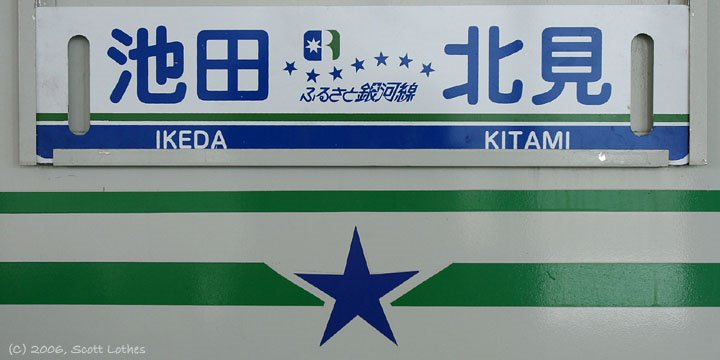 Hokkaido will lose 140 kilometers of railway this month. On April 20th, the Hokkaido Chihoku Highland Railway will make its last runs, ending 95 years of rail service to many rural communities, small towns and agricultural valleys of eastern Hokkaido.
 The north-south oriented line was completed in 1911, making it among Hokkaido’s first railways. At the time it was a mainline linking Ikeda, a city near the Pacific coast, with Abashiri, across the island on the Sea of Okhotsk. Twenty-one years later, in 1932, a new, more direct line was completed between Abashiri and the more populous western part of Hokkaido. That leads me to believe that the Chihoku line between Ikeda and Kitami lost a great deal of its importance as a trunk line. It retained, however, significant importance as a feeder route, serving rich timber- and farmlands. Signs outside the town of Honbetsu proclaim it to be Japan’s number one bean producer. There’s even a small shrine dedicated to that crop beside one of the railway stations.
With time, however, the freight business either dried up or shifted to trucks, leaving only the patronage of a small population base to support the railway. In 1989, JR Hokkaido sold off the Chihoku line, creating the Hokkaido Chihoku Highland Railway. The new operator took significant measures to improve service and cut financial losses, immediately increasing train frequency by 40%, while acquiring newer, more cost effective equipment and further reducing operating costs by eliminating on-board conductors. The operator also brought the line a facelift, adopting the “Galaxy Railway” nickname and decorating its stations in stars and Zodiac signs, while applying festive, cartoon paintschemes to some of its trains. Service continued to improve, including a daily express that cut travel time between Kitami and Ikeda by over 45 minutes and provided direct service across JR tracks to Obihiro.
Improved service and image can only go so far, though. The fact remains that the Chihoku line traverses very sparsely populated countryside. There is a Japanese website ranking the 200 most remote, off-the-beaten-path railway stations (hikyoh eki) in the country. Of the 33 stations on the Chihoku Line, eight make the list, including four that rank in the top 30.
Ridership remained low. In 1998, the line averaged only 361 passengers per day per kilometer, ranking it last out of all rural lines in the country. By contrast, JR Hokkaido’s target for rural lines is 2000 passengers per day per kilometer. Operating expenses in 1998 on the Chihoku Line exceeded revenues by nearly 500 million yen. (Source: “Railway Operators in Japan 2,” by Shuichi Takashima, Japan Railway and Transport Review, September 2001.) Despite strong support from the communities it serves, including over 160 high school students who ride it every school day, the Chihoku Line announced its closure last March.
Since learning of the line’s imminent demise two months ago, I had been plotting ways of getting there. When I found out that Maureen’s musical rehearsal in April was only half an hour from the line, I had my chance. I contacted Dustin, an American teacher in Muroran who has admitted a certain interest in Japanese railways. I’m working to further corrupt him, and thought this to be an excellent opportunity. He had an office party on Friday evening, but was free for the rest of the weekend. “Do you mind leaving really early on Saturday?” I asked. He didn’t mind at all. He even convinced Judy, a British teacher also in Muroran, to tag along.
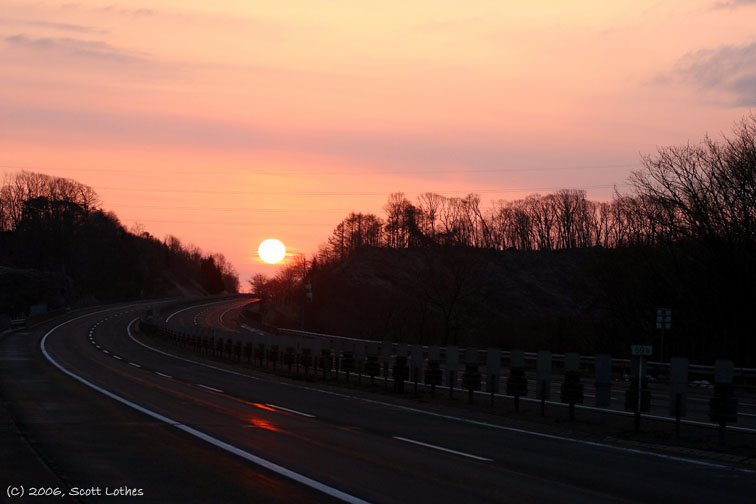 At 3:45am on Saturday, the three of us were abruptly roused by all three of Dustin’s well-synchronized alarm clocks going off at exactly the same time. We were pulling out of the driveway within 25 minutes, and were only a little disturbed to see a man out walking his dog at that hour. A fabulous sunrise on the highway near Tomakomai gave us all a good feeling about the trip.
There seems to be a certain Japanese – or, perhaps human – fascination with closures, abandonments, last runs, and all layings to rest of the works of men. The station agent at Ikeda, the southern terminus of the Chihoku Line, opened the train for boarding half an hour prior to the scheduled 9:55 departure, a full twenty minutes earlier than usual. On this line that has ranked dead last in ridership nationwide for so many years, we could only find two seats open seats. Fifteen minutes before departure, it was standing room only. And still more passengers kept coming.
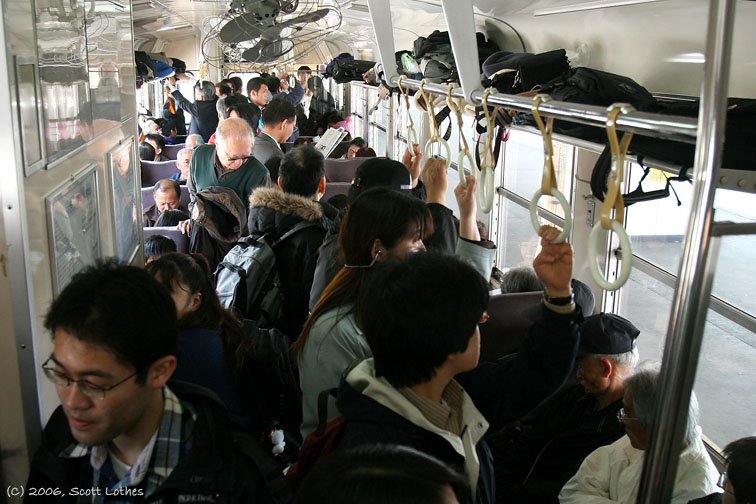 “You’d think they’d add another car,” Dustin said of the one-car train.
“It might be that they don’t have another car to add,” I replied.
The train pulled out right on time and began its three-hour run through the countryside. We stopped at nearly every station, the facilities ranging from forlorn wooden platforms without a building in site to modern, multi-story buildings that double as community centers in the towns they serve. The promotional literature on hand was quick to point out such good citizenship, but we could find nothing regarding whether the stations could remain opened without the support of the railway.
There were few if any passengers getting on or off at most stops, but nearly every platform had at least one photographer documenting the moment. Some had several. Midway through the run, Judy was shocked to notice that one man in a small, white SUV seemed to be following us, taking photos at one location then racing ahead of the train to another spot.
“Do you suppose he’ll follow us all the way to Kitami?” Judy asked in disbelief.
“And probably all the way back, too,” I returned.
“Is he crazy?” she quipped. “Who, in their right mind, goes flying around following a train all day?”
“Well, me, for one, if I had a car,” I replied without the sheepishness that usually accompanies such a response. For once, my way of thinking was the majority.
Returning on the southbound train that afternoon, we managed to secure three seats together by rushing the platform the moment boarding was announced. The train was just as full, if not a little more so, and we found a middle-aged Japanese man standing in the aisle beside us. He introduced himself, in very good English, as Go Yukawa and struck up a conversation.
“Where are you from?” we asked him.
“Yokohama, near Tokyo.”
“You came all the way from Yokohama just to ride this train?” Judy’s mouth stood agape.
“You still don’t get it, do you?” I chided her.
“Well, I think I’m beginning to get it, but it still astonishes me.”
Returning to our Japanese friend, I asked, “How long are you staying here?”
“I flew up from Tokyo this morning. I fly home tonight.”
“You must like trains!” Even I had trouble hiding my shock over that.
“Yes,” he agreed. “And you?”
“Oh yes, very much.”
“I was hoping to take lots of photos today,” he said, pointing to my camera, “but it is too crowded. I come here to memorize this run, memorize this railway…but all I memorize is too many people.”
At the end of the run, back at Ikeda, we rushed to the front of the train with Yukawa-san to take photos in the four minutes before his connecting train left for Obihiro. We lingered for a bit in the sunset light after most of the other passengers had left, and drove a bit north into the countryside to watch the next northbound roll off into the fading light and explore Samamai, the first station north of Ikeda and number 72 on the hikyoh eki list.
“Obihiro is well-known for their butadon,” Dustin told us as we entered the city.
“What’s that?” I asked.
“Grilled pork over rice. It’s very good.”
“That sounds great to me. I’d love to find an out-of-the-way, local place to eat dinner.”
“Hey! I think that place right there had a sign for butadon,” he exclaimed, pointing over his right shoulder.
I couldn’t see anything even resembling a restaurant, but he turned around and pulled into a wooden shack with a small sign out front. Inside, we found a single table and a small bar in front of the kitchen area, which appeared to be in front of the owners’ living quarters. A smiling, wrinkled woman brought us steaming bowls of grilled pork over rice in a sauce that was delicious beyond words. She gave us tea and miso soup free of charge, then took our photo with a small Polaroid camera, which she added to her guestbook that Dustin signed for all three of us (the joke at Dustin’s school is that his Japanese is better than all the Japanese teachers in the English department – and it’s only a half-joke).
We followed a steaming creek up to an onsen where we soaked with a night view of Obihiro, then enjoyed free lodging generously provided by Maureen’s musical group. We also had Sunday morning free while the performers rehearsed. I was thinking of how I’d like to return to the railway and take some more photos, but decided I’d better not push Dustin and especially Judy too far.
As we piled into his car, he turned and asked what we wanted to do.
“You’re driving,” I told him.
“I’m just along for the ride,” Judy added.
“Well, I was thinking I might like to go back and get some photos of the stations on the railway.”
“That sounds fine to me!” I replied, trying unsuccessfully to conceal my enthusiasm.
“I’ve come this far with you crazy guys,” Judy said. “I might as well get the full experience.”
 After visiting several of the nearby stations and even photographing a pair of trains, we found ourselves at the Ashoro station wondering where to go next. There was time to explore Obihiro, or time to explore more of the railway, but not time to do both.
 “Do you want to find your station?” Dustin asked.
As part of the Galaxy theme, the railway has labeled certain stations with the twelve signs of the Zodiac. Despite the crowds, I had managed to snap photos of the signs at Dustin’s and Judy’s stations on the previous day, but had missed my own.
“It’s a quite bit further north,” I replied. “We don’t have to find it. I just want to buy a key chain here, and you guys can decide where we’re going next.”
Judy was the first to speak when I returned from making my purchase.
“We’ve been talking,” she told me, very matter-of-factly, “and we’ve decided that we need to go find your station.”
I beamed. “I love you guys!”
My station, Aeries, was Kamitoshibetsu, a log structure in a sawmill town where an old siding once used to load lumber onto flatcars now rusted in the weeds between the station and the mill. I couldn’t have been happier.

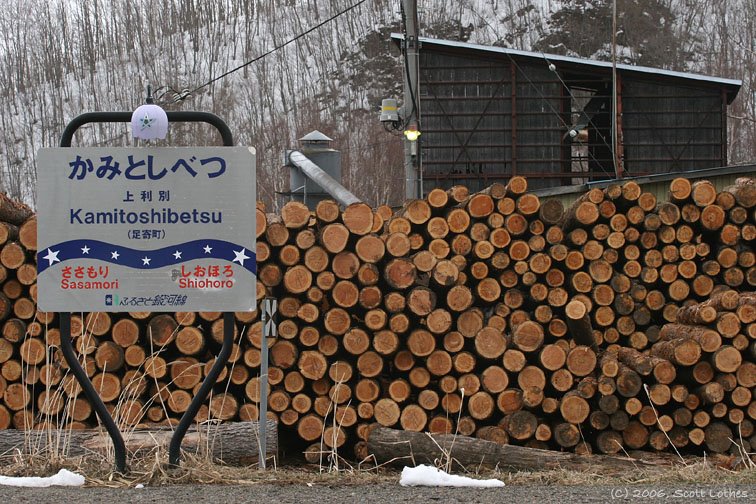
There was another hikyoh eki nearby, and Dustin endeavored to find it. Along the way, we crossed a stream on a road bridge parallel to a bridge on the railway. Looking at the railway bridge, Judy exclaimed, “Oh, that would be a nice shot, right there!”
I glanced at the timetable but said nothing.
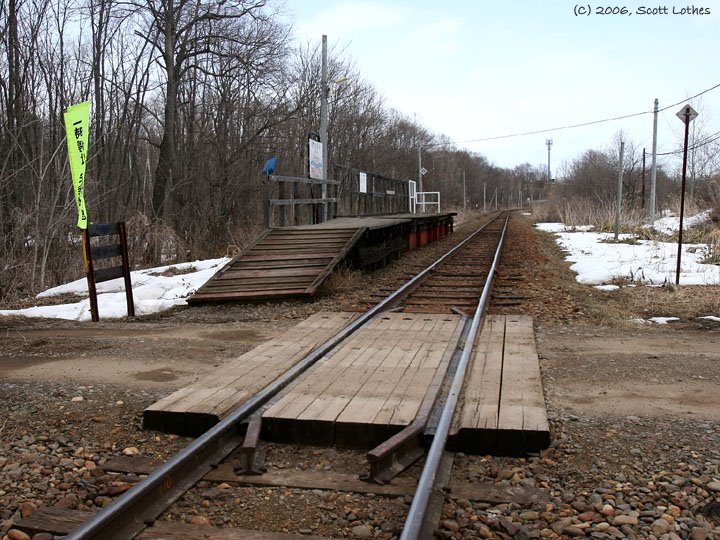 Dustin found Sasamori station, number 30 on the list, near the end of a dirt road with absolutely nothing else around. It is served by nine trains daily, five one way and four the other, and none of us could figure out why.
 Looking at the schedule posted on the simple wooden platform, I remarked, “There’s a northbound coming soon.”
Dustin glanced at his watch. “We probably should start heading back.”
“C’mon! It’s only twelve minutes.”
Dustin looked at Judy.
“Let’s get the man his shot!” she returned. “You’ll share the photo, won’t you?”
“Absolutely!”
“Okay,” Dustin agreed. “Where do you want it?”
“Either here or back at that bridge.”
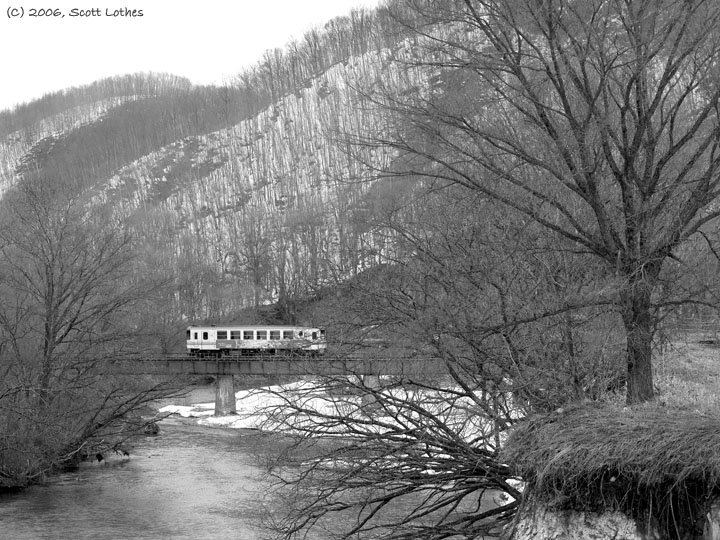 “Oh, the bridge is a better shot.” Judy made the decision.
As the single car rolled across the bridge and into history, I wished that Yukawa-san could have been with us. Not on the crowded trains, but out here in the towns and countryside along the line, did I fix my memories of the Chihoku Line.
We returned to the musical rehearsal just in time for me to get some photos of the cast teaching one of their dances to several local kids, and thereby earn at least a little of our free lodging from the night before. When they were finished, we found Maureen, loaded her and her stuff into the car with us and all of our stuff, and chased the setting sun back towards Muroran.
“So where are we going for our next trip?” Dustin asked me on the drive home.
“Well, I’ve been thinking of riding length of the Hidaka line sometime.”
“Oh, that would be nice!”
“Where’s that?” Judy asked tentatively.

“It runs southeast from Tomakomai right along the coast. Ocean on one side, horse farms on the other.”
“I can’t believe I’m saying this,” she began, “but let me know when you’re going. I just might want to tag along.”
Subscribe to:
Posts (Atom)